Can AI Analyze Concrete Curing? What GCs Need to Know
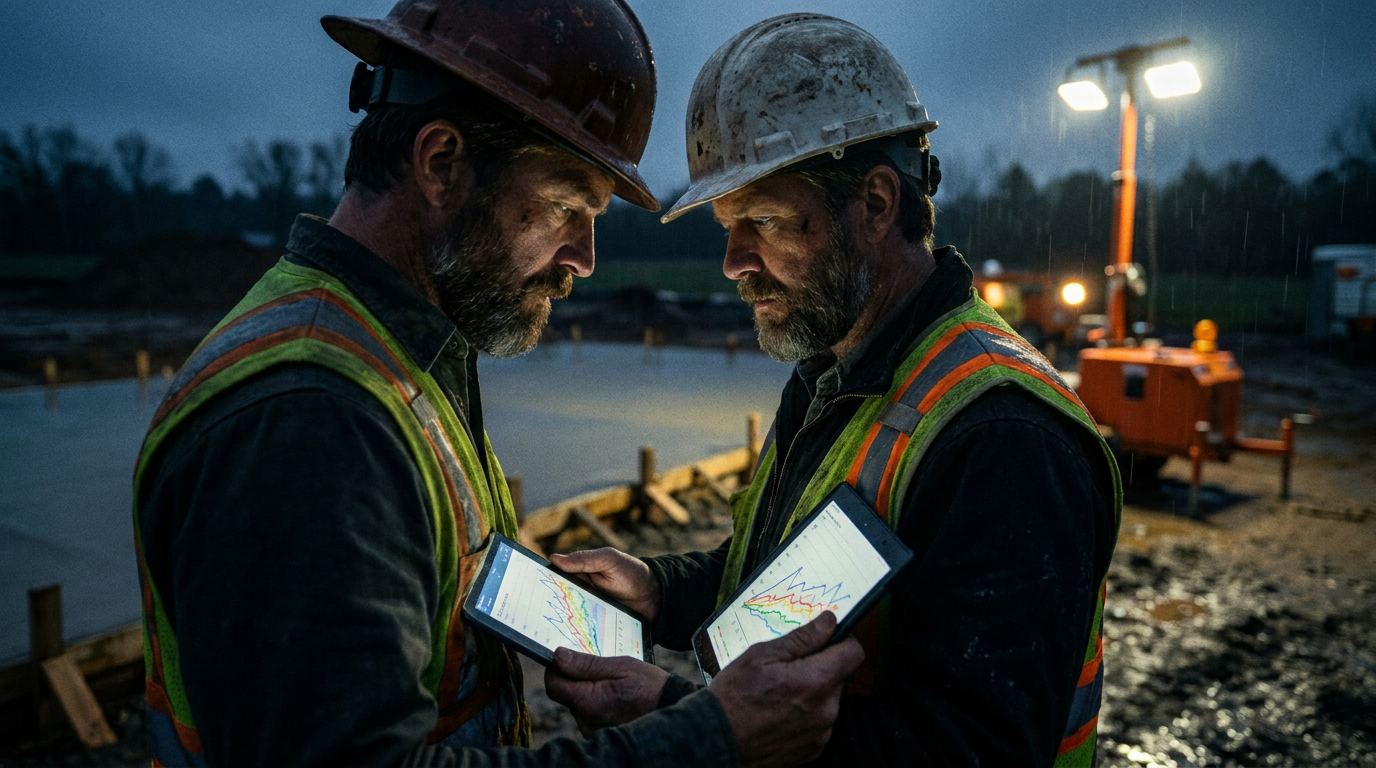
Yes, AI can analyze concrete curing sensor data. It uses machine learning to process temperature and maturity information from embedded sensors. This allows AI to predict concrete strength in real-time, identify potential problems early, and help you make faster decisions about when to strip forms or move to the next step.
You Can't Rush Concrete, But You Can Rush a Schedule
Waiting for concrete to cure feels like watching paint dry, but with a lot more money on the line. For decades, the jobsite has been held hostage by the 28-day cylinder break test. We pour, we wait, we test. It's a reliable system, but it's slow. And in modern construction, slow costs money.
Every day you wait for a lab result is a day you could be stripping forms, stressing cables, or loading the next floor. The pressure is always on to move faster. But guessing about concrete strength is a dangerous game. Guess wrong, and you're looking at costly rework, or worse, a structural failure.
This is where technology is changing the game. Wireless sensors have been around for a few years, giving us real-time temperature and maturity data. That was a big step up. But the real revolution is what happens next: using Artificial Intelligence (AI) to analyze that data.
From Raw Data to Real Answers
Concrete curing sensors are small, wireless devices you embed in the pour. They track the internal temperature of the concrete as it hydrates and hardens. Using a standard formula (ASTM C1074), this temperature data is converted into a "maturity" index, which is a good indicator of strength.
This is already useful. But it's just raw data. You still have to interpret it. AI takes it to the next level. Instead of just showing you the temperature, AI platforms can:
- Predict Strength in Real-Time: AI models are trained on thousands of data points from different concrete mixes and conditions. They can take the live data from your pour and accurately predict its compressive strength (in PSI or MPa) at any given moment. You don't have to wait for a lab test to know when you've hit 3,000 PSI.
- Forecast Future Strength: The system can tell you not just the strength now, but when it will reach the target strength for the next activity, like stripping forms or post-tensioning. This lets you plan your schedule with confidence.
- Detect Problems Early: Is one part of the slab curing much slower than another? Is there a sudden temperature spike that could lead to cracking? AI can flag these anomalies instantly, sending you an alert so you can fix the problem before it gets serious. Maybe it needs curing blankets, or maybe there was an issue with the mix.
This isn't science fiction. It's happening on jobsites right now. It's one of the most practical ways GCs are using technology to improve their ops.
How AI Helps Your Bottom Line
This tech is cool, but what does it mean for your business? It comes down to time, money, and risk.
- Faster Schedules: The biggest win is time. Instead of waiting 7, 14, or 28 days, you can move on the moment the concrete hits the required strength. On a multi-story building, shaving one or two days off each pour cycle can save weeks or even months on the overall project schedule.
- Reduced Labor and Material Costs: Faster schedules mean your crews are more productive. You can strip and reuse forms quicker. In cold weather, you can stop paying for heating and blankets sooner because you know exactly when the concrete is strong enough to withstand the cold on its own.
- Lower Risk and Better Quality: Cylinder breaks only test a small sample. Sensors and AI give you a picture of the entire pour. You have a complete, digital record of the concrete's entire curing history. This is powerful documentation for quality control and can be a lifesaver if any disputes arise later. It's a key part of modern jobsite management.
Using this kind of tool also shows clients that you are a forward-thinking gc who uses the best tools to deliver projects faster and safer. It can be a real advantage when bidding for new work.
Putting AI to Work on Your Site
You don't need a team of data scientists to use this technology. The companies that make the concrete sensors (like Giatec, Hilti, and others) usually provide the AI software as part of their service. The workflow is simple:
- Select Your Mix: You tell the software which concrete mix you're using.
- Place the Sensors: You tie the sensors to the rebar before you pour.
- Monitor the Data: You watch the strength predictions on your phone, tablet, or computer.
Here are some ways you can use AI to manage the data and communicate with your team.
Analyze the following concrete sensor data from the past 24 hours for Pour #4 on the East Deck. Data is provided as a CSV file [attach file]. Identify any temperature readings that exceed the project spec of 160°F. Flag any sensor that shows a curing rate 20% slower than the average of the other sensors. Provide a summary of the current predicted PSI for each sensor and estimate when the pour will reach 3,500 PSI.
This technology makes communication with stakeholders much clearer. You can replace vague updates with hard data.
Draft a daily project update email for the structural engineer and the owner's rep. The subject should be "Concrete Strength Update - Level 3 Pour". State that based on AI-powered sensor analysis, the slab has reached its target strength of 4,000 PSI as of 8:00 AM this morning. Confirm that we will begin stripping forms this afternoon, which is two days ahead of the original schedule. Attach the full strength report from the sensor platform.
The Bottom Line
The old way of working with concrete isn't broken, but it's being left behind. AI-powered analysis of sensor data gives you information you've never had before. It turns a waiting game into a strategic advantage.
It allows you to build faster, smarter, and with less risk. It's not about replacing the skilled tradespeople on your site. It's about giving them better tools to do their jobs more effectively. If you're a GC looking for a competitive edge, this is one piece of tech you can't afford to ignore.
Frequently asked questions
37 copy-paste prompts that save tradespeople 5+ hours a week. Plus one short email every Friday — no fluff.
More for jobsite ai

How Plumbers Use ChatGPT on the Jobsite (5 Ways)
How Plumbers Use ChatGPT on the Jobsite (5 Ways) comes down to using AI to do the slow stuff — quoting, paperwork, marketing, and customer follow-up — so y

How to Use ChatGPT on the Jobsite (Practical Guide)
How to Use ChatGPT on the Jobsite (Practical Guide) comes down to using AI to do the slow stuff — quoting, paperwork, marketing, and customer follow-up — s
AI Voice Notes to Job Report in 60 Seconds
AI Voice Notes to Job Report in 60 Seconds comes down to using AI to do the slow stuff — quoting, paperwork, marketing, and customer follow-up — so you can