
Can AI Analyze a Refrigerant PT Chart? The Straight Answer
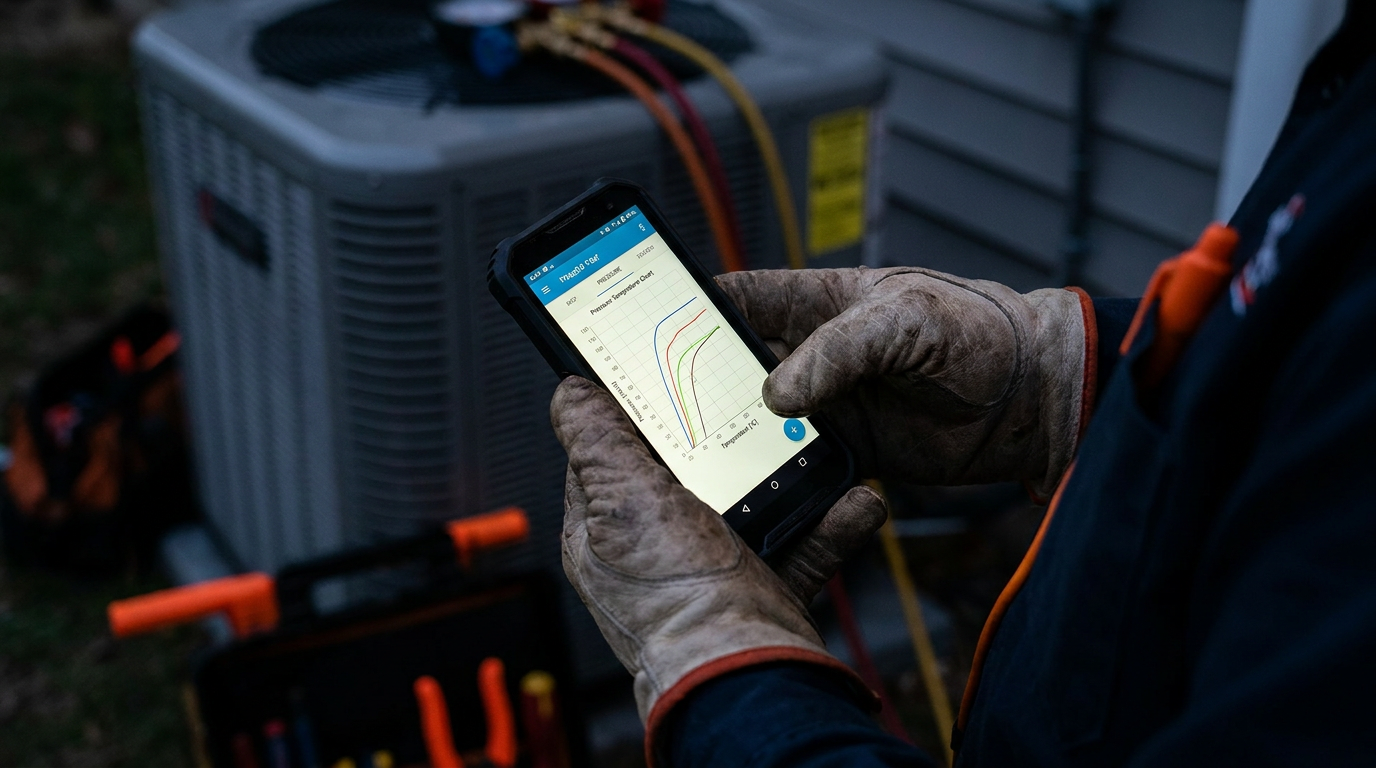
Yes, AI can analyze a refrigerant pressure-temperature chart. By uploading a photo or inputting data, AI can quickly cross-reference pressures and temperatures for specific refrigerants. This helps you identify potential issues like overcharging or restrictions, but it's a tool, not a replacement for your professional experience.
Straight Talk: Can AI Read a Refrigerant PT Chart for You?
Let's cut to the chase. You're on a rooftop, the sun's beating down, and you're staring at your gauges. You could pull out a laminated PT chart or scroll through an app. Or, you could just ask an AI. The question is, can you trust the answer?
For years, reading a pressure-temperature chart has been a fundamental skill. It's how we know if a system is charged right, running efficiently, or about to give up the ghost. But technology is changing how we work. Artificial intelligence is no longer just a buzzword; it's a tool right there on your phone. So, can it handle a core HVAC task like analyzing refrigerant data?
We're going to look at what AI can actually do with your pressure and temperature readings, where it shines, and where it still falls short of a seasoned tech's gut feeling.
How AI Tackles a PT Chart
Think of AI as the sharpest apprentice you've ever had. It has memorized every PT chart for every common refrigerant, from R-22 to R-410A to the newer replacements. It doesn't get them confused and it calculates instantly.
Here’s how it works:
- You Provide the Data: You can either type in the numbers from your gauges—say, 125 PSIG on the low side and 350 PSIG on the high side—or even upload a clear photo of your manifold gauge set.
- AI Reads and Recognizes: If you upload a photo, the AI uses computer vision to read the needles on the gauges. If you type it in, it just takes the data as given.
- It Cross-References: The AI then pulls up the data for the specific refrigerant you named. It finds the saturation temperature that corresponds to the pressures you gave it. It can do this in seconds.
- It Provides Analysis: This is where it gets useful. A good AI won't just give you the saturation temp. It will use other data points you provide, like line temperatures, to calculate superheat and subcooling. It can then offer a basic diagnosis based on those numbers.
For example, if you tell it the suction line is 65°F and the saturation temp is 40°F, it will tell you the superheat is 25 degrees. It might then suggest that this is high and could point to an undercharge or a metering device issue.
Analyze this R-410A system. My suction pressure is 118 PSIG and my liquid line pressure is 420 PSIG. The suction line temperature is 55°F and the liquid line temperature is 95°F. Calculate the saturation temperatures, superheat, and subcooling. Based on these numbers, is the system running within normal parameters?
Putting AI to the Test: Real-World Scenarios
Knowing the theory is one thing. Seeing it work on the job is another.
Scenario 1: The Annual Tune-Up
You're doing a standard maintenance check on a 3-ton residential R-410A system. It seems to be running fine. You hook up your gauges and get your readings. You plug them into an AI and ask for an analysis. The AI confirms your saturation temps and calculates a superheat of 12°F and subcooling of 10°F. It concludes that the charge appears correct for the current conditions. It’s a fast, simple confirmation of what you already suspected. No fumbling with a chart, just a quick second opinion.
Scenario 2: The Problem Call
A customer calls because their AC isn't cooling. You find the suction pressure is low and the head pressure is a bit high. The suction line is warm. You're already thinking it could be a restriction or a serious undercharge. You give the numbers to an AI.
I'm working on a residential R-22 system that isn't cooling. The low-side pressure is 45 PSIG and the high-side pressure is 275 PSIG. The outdoor temperature is 90°F. Analyze these pressures and suggest three possible causes for the issue.
The AI might come back with:
- Possible Restriction: Low suction and high head pressure can indicate a blockage in the liquid line, like a clogged filter drier or a faulty TXV.
- Severe Undercharge: While low suction is classic for an undercharge, the high head pressure is unusual unless combined with another problem, like non-condensables.
- Compressor Inefficiency: The compressor may not be pumping effectively, causing pressure issues on both sides.
This doesn't replace your diagnostic process. You still have to do the work. But it can help you organize your thoughts and make sure you don't overlook a possibility. It’s a brainstorming partner that never gets tired.
The Right Way to Use AI for Diagnostics
AI is a powerful tool, but it's not a magic wand. It's only as good as the information you give it. This is the most important thing to remember. The phrase "garbage in, garbage out" has never been more true.
For an accurate analysis, you need to provide more than just pressures. A good prompt should always include:
- Refrigerant Type: This is non-negotiable.
- Suction and Discharge Pressures: The core data.
- Suction and Liquid Line Temperatures: Essential for calculating superheat and subcooling.
- Outdoor and Indoor Temperatures: Context is everything. A system's pressures will be totally different on a 75°F day versus a 95°F day.
Without this full picture, the AI is just guessing. It can’t feel the airflow from a vent, hear a rattling compressor, or see a dirty condenser coil unless you tell it. Your senses and experience are still the most valuable tools in your truck.
Think of AI as an interactive, super-powered PT chart. It does the math for you and connects the dots based on the data it's given. The final diagnosis and the actual repair work? That's still on you.
Where AI Still Falls Short
AI is smart, but it's not on the jobsite. It lives in a server somewhere, processing data. It has no hands-on experience.
Here's what AI can't do:
- Account for All Variables: It doesn't know if the condenser coil is clogged with cottonwood, if the indoor filter hasn't been changed in a year, or if the ductwork is undersized. You have to observe these things and add them to your diagnosis.
- Perform Physical Tests: AI can't hook up gauges, check for leaks with a detector, or measure amp draws. It's a brain, not a body.
- Have a Gut Feeling: After years in the field, you develop an instinct. You can sometimes tell what's wrong just by the sound a unit is making. AI doesn't have that intuition. It only knows the numbers.
So, while AI is a great assistant for running the numbers, it's not ready to take your job. It's here to make the technical parts faster so you can focus on the hands-on diagnostics that actually solve the customer's problem.
The real power comes from combining your experience with the AI's speed. Use it to verify your calculations and explore possibilities. But always trust your training and what you see in front of you. The final call is, and should be, yours.
Frequently asked questions
37 copy-paste prompts that save tradespeople 5+ hours a week. Plus one short email every Friday — no fluff.
More for hvac

AI for HVAC Contractors: Everything You Need to Know
AI for HVAC Contractors comes down to using AI to do the slow stuff — quoting, paperwork, marketing, and customer follow-up — so you can stay on the tools.

ChatGPT for HVAC Technicians: 20 Real Use Cases
ChatGPT for HVAC Technicians comes down to using AI to do the slow stuff — quoting, paperwork, marketing, and customer follow-up — so you can stay on the t
AI HVAC Load Calculation: Manual J in Minutes
AI HVAC Load Calculation comes down to using AI to do the slow stuff — quoting, paperwork, marketing, and customer follow-up — so you can stay on the tools