
Can AI Design a Deck That Won't Collapse?
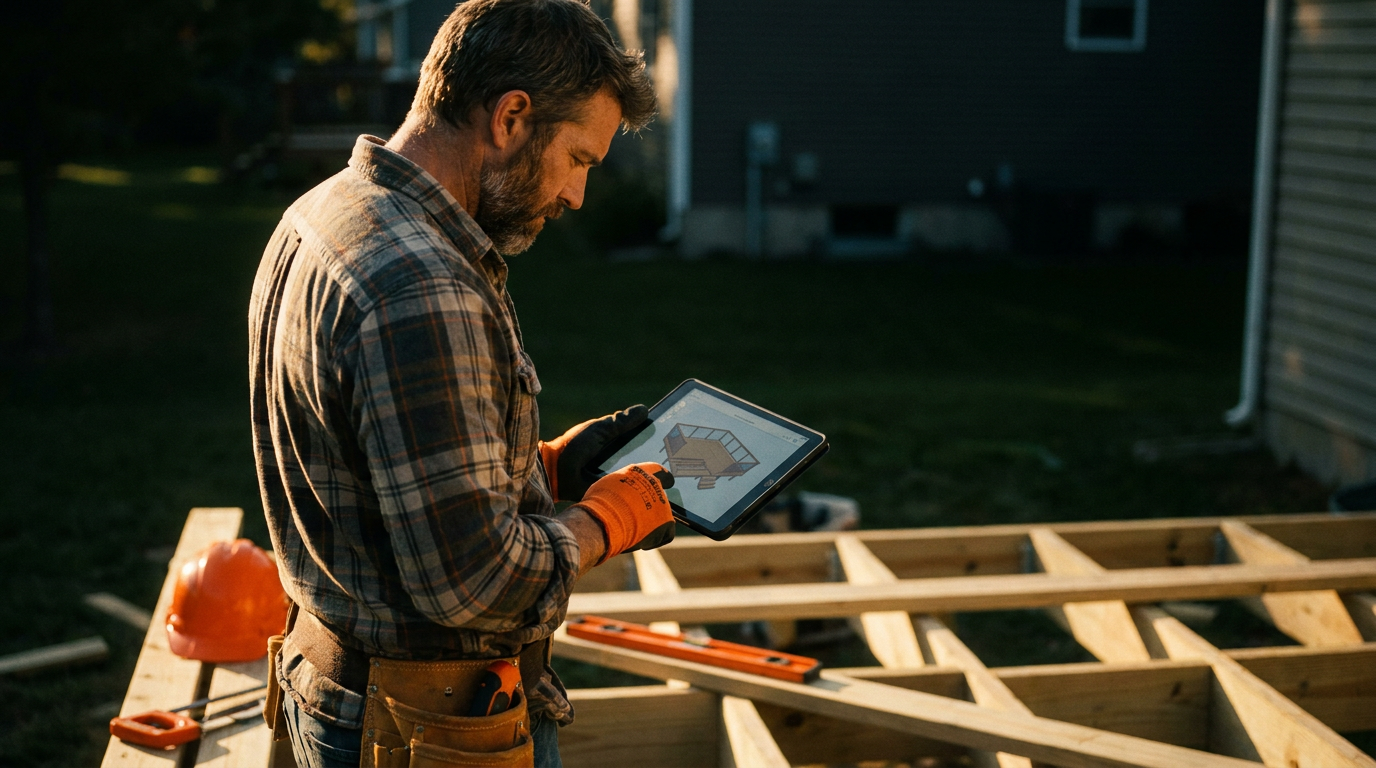
Yes, AI can help you design a custom deck by generating ideas, layouts, and material lists. However, AI is a starting point, not a substitute for a qualified deck builder. A professional must verify all plans to ensure they meet local building codes and are structurally sound.
Can AI Design a Deck That Won't Collapse?
You've seen AI write emails and make pictures. Now you're wondering if it can handle a real job, like designing a deck. The kind of job where mistakes don't just look bad—they can be dangerous. It’s a fair question. A deck that fails isn't just a headache, it's a huge liability.
The straight answer is that AI is a powerful new tool in your toolbox, but it's not the whole toolbox. It can give you a running start on a deck design, but it can't get you across the finish line safely on its own. Let's break down what AI can actually do for deck design and, more importantly, where you absolutely need a human expert to take over.
What AI Can Actually Do for Deck Design
Think of AI as a very fast, very creative apprentice. It's great for the early stages of a project when you're exploring possibilities with a client or for your own home. It excels at tasks that involve brainstorming and visualization.
Here’s where it shines:
Brainstorming Ideas: Stuck on a basic rectangular design? AI can generate dozens of concepts in seconds. You can ask for multi-level designs, decks with built-in planters, kitchens, or fire pits. It can suggest different styles, from rustic to modern, that match the house's architecture.
Creating Visuals: Homeowners often have trouble picturing the final product. AI image generators can turn a text description into a realistic picture of the finished deck. This is a game-changer for client presentations and getting buy-in on a design.
Generating Layouts: You can give an AI the dimensions of a space, and it can suggest different layouts for furniture, stairs, and other features. This helps optimize the flow and usability of the deck before you even think about cutting a board.
Preliminary Material Lists: AI can create a basic list of materials based on your design inputs. This can be a decent starting point for your initial project quoting and material sourcing. It's not perfect, but it can save you some initial estimating time.
Prompting AI for Deck Design Ideas
Getting good results from AI depends on giving it a good prompt. Be specific. The more detail you provide, the better the output will be. Here’s a prompt you can use to get started.
Act as a professional deck designer. I need three distinct design concepts for a custom deck attached to the back of a two-story colonial-style house in New England. The available space is 16 feet wide by 12 feet deep. The deck should be about 4 feet off the ground. Include one design with a built-in bench, one with a pergola, and one multi-level concept. For each, describe the style, suggested materials (like composite vs. pressure-treated wood), and key features.
Where AI Fails: The Non-Negotiables
This is the most important part. AI is powerful, but it's blind to the real world and ignorant of the rules that keep people safe. Relying on it for structural details is a recipe for disaster.
Here’s what AI can't do:
Understand Local Building Codes: Every county and town has its own specific rules. These codes dictate everything: footing depth based on frost lines, railing height, spindle spacing, ledger board attachment methods, and required hardware. An AI model trained on general internet data has no idea about the amendments in the building code for Boise, Idaho versus Naples, Florida. A code violation means a failed inspection, wasted money, and potential legal trouble.
Perform Structural Engineering: This is the big one. AI cannot calculate load-bearing capacity. It can't tell you the correct size and spacing for joists and beams to support the weight of people, snow, and a hot tub. It doesn't understand soil composition to specify the right footing size. Getting this wrong is how decks collapse.
Assess the Job Site: AI can't see the slope of the yard, which impacts post height and stair design. It can't identify underground utility lines you need to avoid when digging footings. It can't inspect the house's rim joist to see if it's solid enough to even support a ledger board. There is no substitute for walking the site.
Select Appropriate Materials: While AI can suggest materials, it doesn't have real-world experience. It may not know that a certain brand of composite decking gets dangerously hot in the Texas sun or that a specific type of wood is prone to rot in the Pacific Northwest. A seasoned pro knows these things from experience, not from a database.
Using AI for a Material List
Even with its limits, you can use AI to speed up your initial material estimate. Just remember, this list needs to be checked and double-checked by you. Never order materials based solely on an AI's output.
Based on the following deck design, generate a preliminary materials list. Design: A 16x12 foot rectangular deck, 4 feet high, using pressure-treated lumber. Joists are 2x8s spaced 16 inches on center. Beams are two 2x10s. Decking is 5/4x6 inch deck boards. The deck includes a simple railing and one set of stairs with 5 steps. List quantities for lumber, concrete for footings, joist hangers, fasteners, and railing components. Add a 10% waste factor to the lumber.
The Bottom Line: AI is a Tool, Not a Tradesman
AI is an exciting technology that can genuinely help in the design process. It can spark creativity, improve client communication, and streamline the very first steps of planning. It’s a great way to explore what’s possible.
But it is not, and may never be, a substitute for a qualified, licensed, and insured professional. The final plans for any structure people will stand on must be created or at least approved by someone who understands engineering principles, is familiar with local codes, and has physically inspected the site.
Use AI to make your project planning better and faster. Use it to show clients what they're getting. But when it comes time to draw up the final blueprints and start building, trust the expertise of a human being. Your reputation and your clients' safety depend on it.
Frequently asked questions
37 copy-paste prompts that save tradespeople 5+ hours a week. Plus one short email every Friday — no fluff.
More for other trades

AI for Painting Contractors: Quoting to Marketing
AI for Painting Contractors comes down to using AI to do the slow stuff — quoting, paperwork, marketing, and customer follow-up — so you can stay on the to
AI for Fence Companies: 9 Practical Plays
AI for Fence Companies comes down to using AI to do the slow stuff — quoting, paperwork, marketing, and customer follow-up — so you can stay on the tools.

AI for Handyman Business: The Solo Operator Stack
AI for Handyman Business comes down to using AI to do the slow stuff — quoting, paperwork, marketing, and customer follow-up — so you can stay on the tools