Can AI Diagnose a Cracked Heat Exchanger?
No, AI cannot definitively diagnose a faulty heat exchanger by itself. While AI can analyze sensor data, combustion readings, and visual inputs to flag potential issues, it's not a substitute for a trained HVAC technician. A pro must perform a physical inspection to confirm a crack and ensure household safety.
Can AI Really Spot a Cracked Heat Exchanger?
A cracked heat exchanger isn't just another repair job. It's a serious safety risk. A leak can release carbon monoxide (CO) into a home, and that's a life-or-death problem. For years, finding these cracks has been a hands-on job for sharp, experienced HVAC techs. But now, with AI everywhere, the question comes up: can a machine do it better?
The short answer is no, not by itself. AI is a powerful tool, but it's not a replacement for your eyes, your training, and your gut. Let’s break down where AI can help and where the buck still stops with you, the professional in the field.
The Old-School Way: Finding Cracks by Hand
Before we talk about AI, let's remember the proven methods. Finding a hairline crack in a metal clamshell, hidden deep inside a furnace, takes skill. You're not just looking for a giant hole.
Most experienced techs rely on a few key methods:
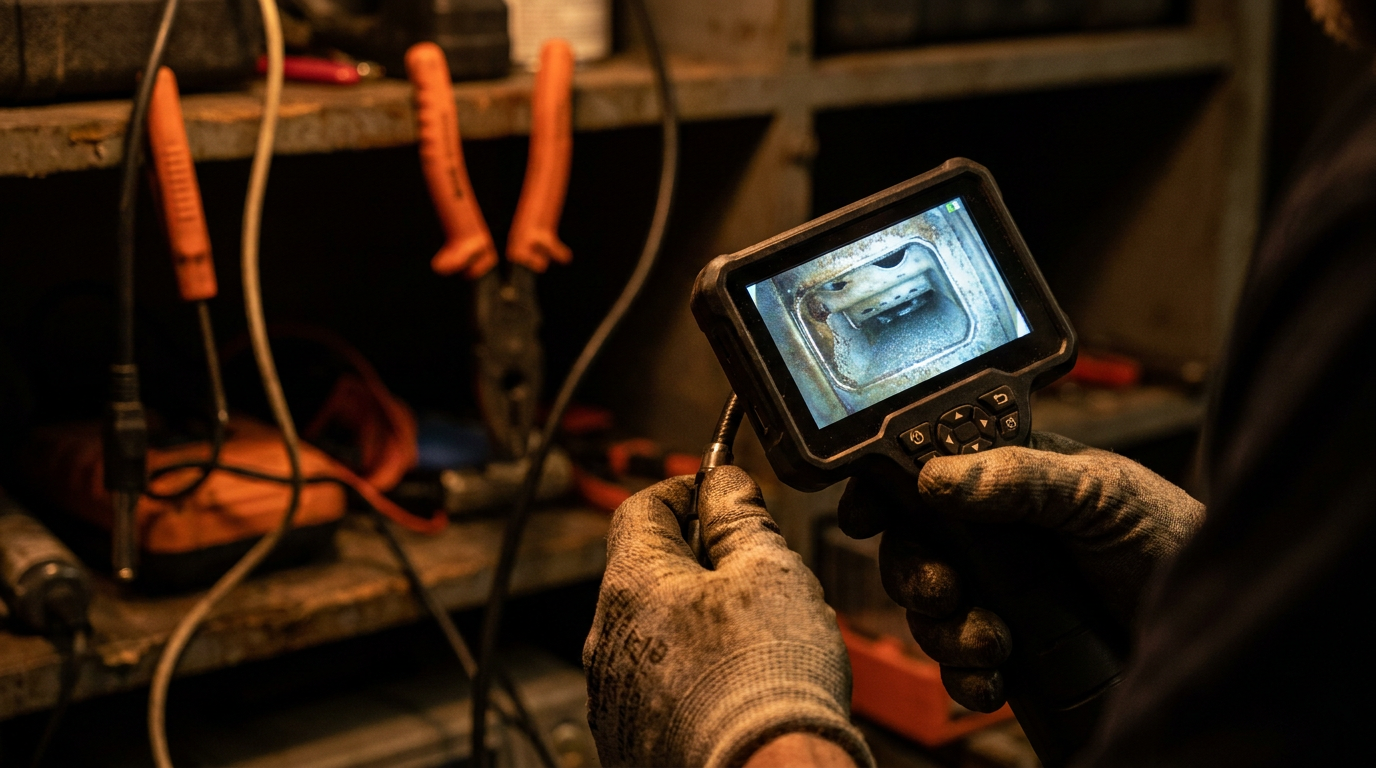
- Visual Inspection: This is the gold standard. Using a good flashlight, mirrors, and increasingly, a video borescope, you get your eyes on the exchanger. You're looking for cracks, rust, or unusual discoloration. This requires patience and knowing exactly where to look on different models.
- Flame Observation: You watch the burner flames when the blower fan kicks on. If the flames dance, waver, or roll out, it's a big red flag. This indicates that air from the blower is pushing through a crack or hole into the combustion chamber.
- Combustion Analysis: A digital combustion analyzer is a pro's best friend. It measures gases like CO in the flue stack. High or fluctuating CO readings can point to incomplete combustion or a breach in the heat exchanger, as it pulls excess air into the mix.
These methods work. But they take time and depend heavily on the tech's experience. A new technician might miss what a 20-year veteran spots instantly.
Where AI Fits In (And Where It Doesn't)
AI isn't going to crawl into a furnace for you. Its strength is in processing huge amounts of data way faster than a human ever could. Think of it as a hyper-aware apprentice that can point you in the right direction.
Here’s how AI can assist in diagnosing a faulty heat exchanger:
1. Analyzing System Data
Modern HVAC systems are loaded with sensors. AI can monitor data from thermostats, pressure switches, and control boards over time. It can spot tiny changes that you wouldn't notice on a single service call.
- Pattern Recognition: AI can learn the normal operating patterns of a specific furnace model. It can then flag deviations, like shorter cycle times or unusual temperature differentials, that might suggest declining heat transfer efficiency—a possible symptom of a crack.
- Predictive Maintenance: By analyzing a unit's age, runtime hours, and fault history, AI can predict when a component like a heat exchanger is approaching its end-of-life. It can tell you, "Furnaces like this one often develop issues after 15 years. This one is at 14.5 years and its runtime is 20% above average. It’s a high-risk unit." This is a game-changer for service agreements. You can find more info on modernizing your business in our ops section.
2. Assisting Visual Inspections
This is where things get interesting. We're not at the point where you can just stick a camera in and have AI say "crack found." But we're getting closer. AI-powered image recognition can be trained on thousands of images of healthy and faulty heat exchangers.
In the near future, a tech could run a borescope camera inside the unit, and software could highlight areas on the screen that look suspicious. The AI wouldn't make the call, but it would act as a second set of eyes, drawing your attention to a potential hairline fracture you might have missed.
3. Making Sense of Combustion Analysis
An AI tool could also analyze combustion data in real-time. Instead of just giving you a number, it could cross-reference the CO, O2, and stack temperature readings with a database of known failure signatures. It might report, "CO levels are fluctuating in a pattern consistent with a small crack on an in-shot burner system."
Using AI Prompts on the Job
You don't need a futuristic diagnostic tool to start using AI today. You can use large language models (like ChatGPT, Gemini, or Claude) right from your phone or tablet to work smarter. Here are a few prompts you can copy and paste.
Act as a senior HVAC technician. Write a clear, simple email to a homeowner named Mrs. Smith. Explain that I have shut off her furnace because I found strong evidence of a cracked heat exchanger. Explain the safety risk of carbon monoxide (CO) in plain terms, without causing panic. State that the unit cannot be used and that I will provide options for replacement tomorrow.
I'm an HVAC tech diagnosing a potential cracked heat exchanger on a 15-year-old gas furnace. The customer's CO detectors have not gone off. A visual inspection is difficult. Create a step-by-step diagnostic checklist for me to follow, from simple to complex. Include flame observation, checking for physical signs like soot, and using a combustion analyzer. Emphasize safety at each step.
Explain to a new HVAC apprentice the three most common types of heat exchanger cracks (e.g., stress cracks from expansion/contraction, rust-through, and manufacturing defects). For each type, describe what it looks like and what the most common cause is. Keep the language direct and easy to understand for someone learning on the job.
The Final Verdict: Human + AI is the Winning Combo
So, can AI diagnose a cracked heat exchanger? No. But it can make you, the technician, far more effective at doing it.
The final call on a life-safety component like a heat exchanger must be made by a trained, certified human being. There's no substitute for a physical inspection and professional judgment. Liability alone makes it a human responsibility. You are the one who has to look the homeowner in the eye and tell them their system is safe—or that it needs to be shut down immediately.
AI is one of the most powerful tools we've ever had. It can help you spot problems earlier, work faster, and communicate more clearly with customers. But it's still just a tool. The real intelligence is in your hands.
Frequently asked questions
37 copy-paste prompts that save tradespeople 5+ hours a week. Plus one short email every Friday — no fluff.
More for hvac
AI for HVAC Contractors: Everything You Need to Know
AI for HVAC Contractors comes down to using AI to do the slow stuff — quoting, paperwork, marketing, and customer follow-up — so you can stay on the tools.

ChatGPT for HVAC Technicians: 20 Real Use Cases
ChatGPT for HVAC Technicians comes down to using AI to do the slow stuff — quoting, paperwork, marketing, and customer follow-up — so you can stay on the t
AI HVAC Load Calculation: Manual J in Minutes
AI HVAC Load Calculation comes down to using AI to do the slow stuff — quoting, paperwork, marketing, and customer follow-up — so you can stay on the tools