Can AI Help You Find a Buried Water Line?
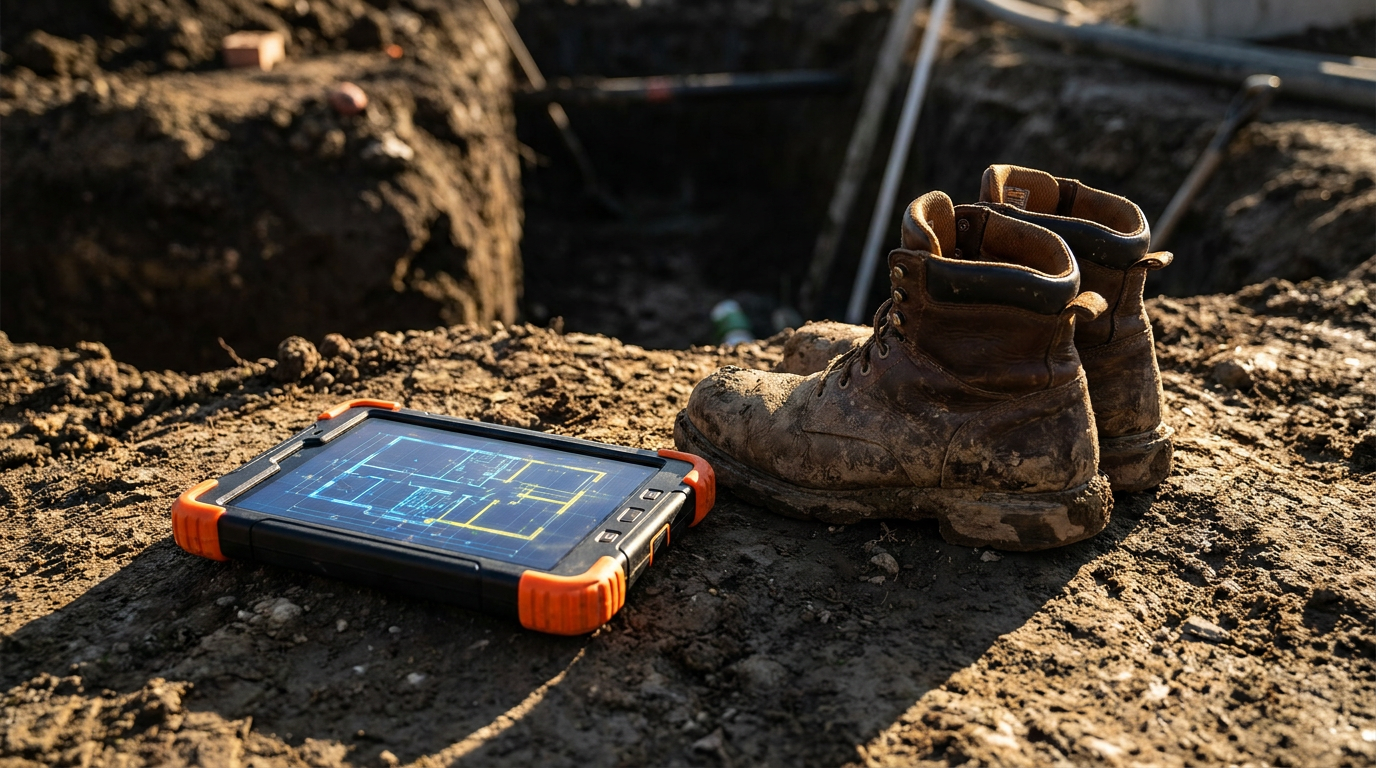
No, AI cannot directly find a buried water line for you. It does not have ground-penetrating radar. However, AI can speed up your research by analyzing site plans, historical records, and geological data to give you a strong starting point before you bring out the locating equipment.
Can AI Really Find a Buried Water Line?
Let's cut to the chase. You're on a job, the clock is ticking, and the as-builts are either missing or a total lie. You need to find a buried water line before you can start trenching. Can you whip out your phone, open an AI app, and have it point to the exact spot?
No. Not today, and probably not anytime soon. AI doesn't have x-ray vision or a magic wand. It can't see through dirt, concrete, and decades of landscaping.
But that doesn't mean it's useless. AI is a powerful tool for your office or truck, not for the trench. It's a research assistant that can save you hours of prep time and help you make a much more educated guess before you fire up the real equipment. Think of it as a super-smart apprentice who can read every blueprint at once.
What AI Can Actually Do
AI's real power is in making sense of huge piles of information. For a plumber, that information is often locked away in dusty file cabinets, confusing municipal websites, or poorly scanned PDF documents. Here’s where AI can help you work smarter, not harder.
Analyze Site Plans and Blueprints
You get a 150-page PDF of a commercial building's blueprints from 1988. Instead of printing it out and highlighting every pipe, you can feed that document to a modern AI model. It can read the text, understand the drawings, and pull out the exact information you need.
It can:
- Identify all marked water lines, vents, and drains.
- Extract details like pipe material, diameter, and listed burial depth.
- Create a simple table of all plumbing-related notes and specifications.
- Flag areas where the blueprints are unclear or contradictory.
This turns a two-hour headache into a five-minute task. You get the intel you need to start forming a plan.
Act as a master plumber reviewing a set of construction blueprints. I am uploading a PDF of the site plans for a commercial property. Scan the entire document, paying special attention to the mechanical and plumbing drawings.

Create a summary that includes:
1. A table listing all specified water lines with their location, material, and diameter.
2. Any notes on the burial depth of exterior utility lines.
3. A list of potential conflicts or unmarked areas that need field verification.
4. The date of the last revision on the plumbing drawings.
Dig Through Public Records
Every plumber knows the pain of dealing with city or county records departments. Websites are slow, databases are ancient, and finding a simple easement document can take forever. AI can act as your agent, navigating these digital mazes.
You can task an AI to search for:
- GIS Data: Publicly available Geographical Information System (GIS) maps often show main utility corridors.
- Easements: AI can scan property records for any mention of utility easements that might give clues about where lines are run.
- Historical Imagery: On some platforms, AI can analyze historical satellite photos to look for old trench lines or construction activity that isn't visible today.
This isn't about finding the pipe to the inch. It's about narrowing the search area from the whole property down to a 20-foot corridor.
The Right Tools Still Rule the Jobsite
AI does the homework. But once you're on site, you still need the real tools for the job. Technology hasn't replaced the need for skill and the right equipment. Your goal is to use the AI's research to know exactly where to start using these tools, saving time and money.
Call 811: This is step one, always. It’s the law. The public utility locating services will mark the main lines from the street to the meter. This is your baseline. AI can’t replace this, but your AI research might give you questions to ask the 811 locator when they are on site.
Ground Penetrating Radar (GPR): For the toughest jobs, GPR is the king. It sends radar waves into the ground and reads the reflections to create a picture of what's below. It's especially good for finding non-metallic pipes like PVC or old transit pipe that other tools miss.
Electromagnetic (EM) Locators: The classic wand. This tool induces a current onto a metallic pipe or a tracer wire, and you use the receiver to follow the signal. It's fast and effective for most metal pipes.
Acoustic Locators: These devices listen for the sound of running water. By placing sensors on known access points like hydrants and valves, you can pinpoint the location of a leak, which in turn tells you where the pipe is.
AI helps you choose the right tool and use it more efficiently. If your AI research of the blueprints says you're looking for a PVC line, you know to skip the EM locator and go straight to GPR or acoustic methods. You can find more info on jobsite tech in our other articles.
I am a plumber preparing to locate a private water line at [123 Main Street, Anytown, USA]. The building was constructed in 1975. The soil is mostly clay. Act as a utility locating expert. Based on this information, create a step-by-step locating plan.

1. List the public records I should search for first and what information to look for.
2. Recommend the top two locating technologies (e.g., GPR, EM Locator, Acoustic) for this scenario and explain why.
3. Outline three potential challenges I might face on this job.
The Bottom Line: Use AI in the Truck, Not the Trench
Don't expect AI to do the digging for you. A buried water line is a physical object, and finding it requires physical methods.
Where AI shines is in preparation. It's a tool that sharpens your most important asset: your knowledge. It helps you walk onto a jobsite with more information than ever before. You'll have a better idea of what you're looking for, where it might be, and what challenges you'll face.
Using AI for research can:
- Reduce time spent on non-billable prep work.
- Lower the risk of costly and dangerous utility strikes.
- Help you look more professional and prepared in front of clients.
- Justify the use of advanced locating equipment by showing you've done your homework.
In the end, your experience, skill, and the feel of the tools in your hands are what get the job done. AI just helps you point them in the right direction.
Frequently asked questions
37 copy-paste prompts that save tradespeople 5+ hours a week. Plus one short email every Friday — no fluff.
More for plumbers
AI for Plumbers: The Practical Field Guide
AI for Plumbers comes down to using AI to do the slow stuff — quoting, paperwork, marketing, and customer follow-up — so you can stay on the tools. Below i

25 ChatGPT Prompts for Your Plumbing Business
25 ChatGPT Prompts for Your Plumbing Business comes down to using AI to do the slow stuff — quoting, paperwork, marketing, and customer follow-up — so you

AI Plumbing Diagnosis Apps: What Actually Works
AI Plumbing Diagnosis Apps comes down to using AI to do the slow stuff — quoting, paperwork, marketing, and customer follow-up — so you can stay on the too