
Chasing Ghosts: Can AI Find an Intermittent Electrical Fault?
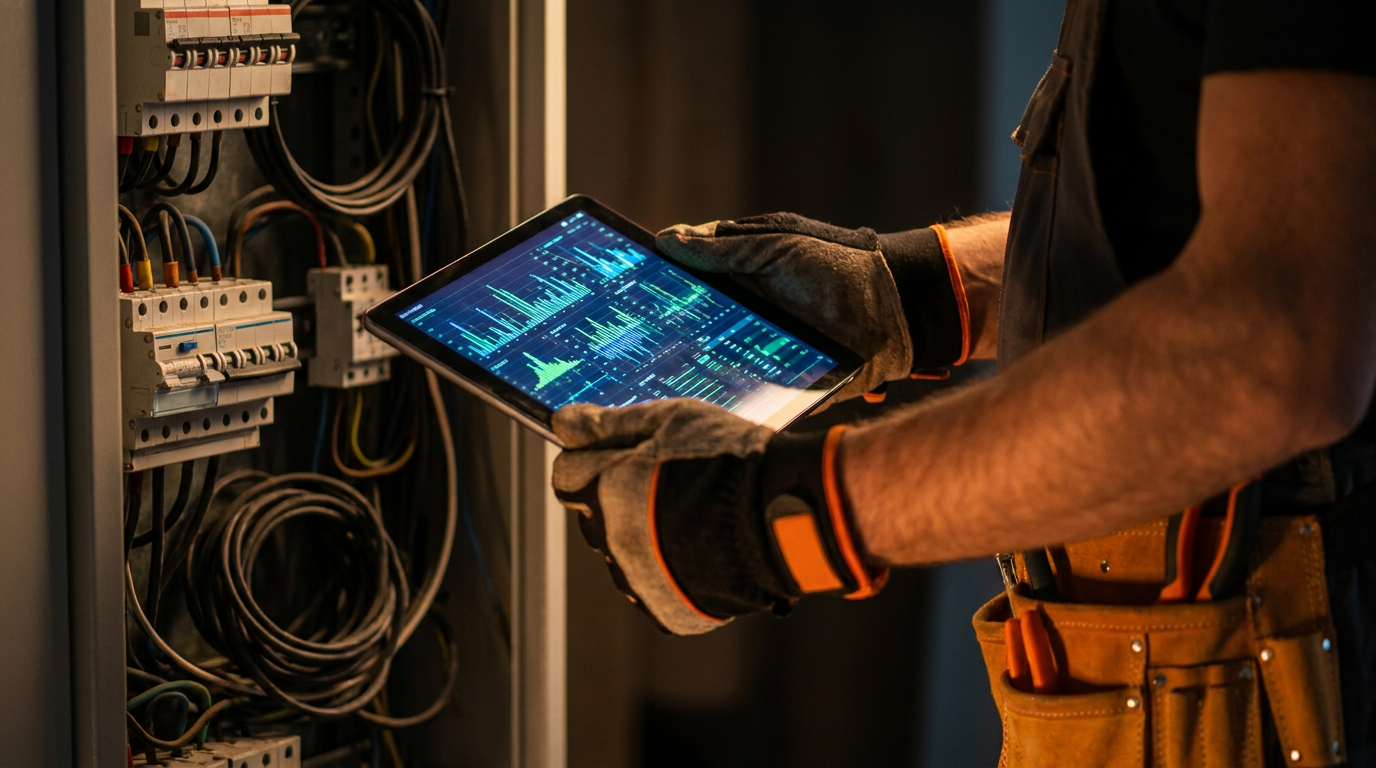
Yes, AI can help find an intermittent electrical fault, but it's not a magic wand. AI tools excel at analyzing patterns from smart meters or sensor data to suggest likely causes. For the hands-on electrician, it's best used as a diagnostic assistant to narrow down possibilities, not as a replacement for boots-on-the-ground testing.
Chasing Ghosts: Can AI Find an Intermittent Electrical Fault?
Every seasoned electrician knows the job. The call comes in for flickering lights, a breaker that trips once a week, or an outlet that works 'most of the time.' You get to the site, and everything tests perfectly. The customer looks at you like you're crazy. You're chasing a ghost.
These intermittent electrical faults are some of the most frustrating and time-consuming problems in the trade. They don't follow a clear pattern and they love to hide when you show up with your meter. It’s a drain on your time and a hit to your profits.
For years, the only solution was experience, patience, and a bit of luck. But now, there’s a new tool making its way into the truck: Artificial Intelligence. It won't replace your brain or your hands, but it might just be the ghost-hunting partner you need.
What We're Really Hunting
Before we talk about AI, let's get on the same page. An intermittent fault is a problem that isn't constant. It comes and goes. The cause is usually one of a few usual suspects:
- Loose Connections: The classic. A backstabbed outlet, a loose wire nut, or a poorly torqued lug in the panel. As temperature changes or vibrations occur, the connection makes and breaks.
- Thermal Issues: A component, like a breaker or dimmer, starts to fail when it heats up. Once it cools, it works again. This is common with heavy loads cycling on and off.
- Failing Components: A device or appliance on the circuit is starting to die. It might draw a huge amount of current for a split second, tripping the breaker, but then seem fine.
- External Factors: Sometimes the problem isn't even in the building. Issues from the utility provider can cause flickering or sags that look like an internal problem.
Finding these requires methodical work. It means checking every connection, monitoring loads, and often, making return trips. This is where AI starts to look interesting.
Where AI Fits in the Toolbox (and Where It Doesn't)
Think of AI as a super-smart apprentice. It can sort through massive amounts of information way faster than a human can. But it can't climb a ladder or use a multimeter. You have to be realistic about what it can and can't do.
What AI is good for:
- Pattern Recognition: If a customer has a smart meter or you install a temporary circuit monitor, AI can analyze months of data in seconds. It can spot that a fault only happens when the HVAC, the well pump, and the microwave are all running.
- Creating Checklists: You can describe a complex problem to an AI and ask it to generate a step-by-step diagnostic plan, ordered from most likely to least likely. This helps you work methodically and not miss a step.
- Hypothesis Generation: Given a set of symptoms, AI can suggest possible causes you might not have considered, drawing from a massive database of technical manuals and forum discussions.
What AI can't do:
- Physical Testing: AI can't verify voltage, check continuity, or torque a lug. That's your job.
- On-Site Observation: It can't see the corrosion on a ground rod or hear the faint buzz of a failing transformer. Your senses and experience are irreplaceable.
- Replace Your License: The final call is always on you. You are the professional responsible for the work being safe and up to code.
AI is a powerful data analysis tool. Your job is to feed it good data and then use your skills to act on its analysis.
Practical AI Prompts for Chasing Ghosts
Talking to an AI is a skill. The better your prompt, the better your answer. Here are a couple of real-world prompts you can copy and paste to get started.
This first one helps you build a solid game plan before you even get out of the truck.
I'm an electrician troubleshooting an intermittent flickering light issue in a residential home. The client says it happens randomly. Create a prioritized diagnostic checklist for me to follow on-site. Start with the simplest and most common causes first, like bulbs and dimmers, and move to more complex issues like neutral connections at the panel and load-related voltage drops. For each step, suggest the specific tool to use, like a multimeter or non-contact voltage tester. The format should be a simple, numbered list I can follow.
This next prompt is for when you have some data points and need to find a pattern.
Act as a diagnostic AI for an electrician. I have the following data points for an intermittent circuit trip on circuit #7 in a commercial building: Trips occurred at 9:05 AM, 1:15 PM, and 4:00 PM on Monday, and 9:10 AM and 1:20 PM on Tuesday. The main loads on this circuit are office computers and a large format printer. The HVAC system for the zone turns on around 9:00 AM and 1:00 PM. Based on this limited data, provide three likely hypotheses for the cause of the intermittent trip. Prioritize them from most to least likely and explain your reasoning for each.
Using prompts like these helps organize your thoughts and leverages the AI's ability to connect dots you might have missed during a long day.
The Gear That Powers the AI
While you can use any AI chatbot on your phone, the real power comes when you pair it with hardware. The world of electrical diagnostics is getting smarter.
- Smart Circuit Monitors: Devices from companies like Sense, Span, and Leviton install in the main panel and monitor every circuit in real-time. Their apps use AI to identify individual appliance loads and spot anomalies. For intermittent faults, their data logs are gold.
- Power Quality Analyzers: Higher-end tools from Fluke or Hioki can be temporarily installed to capture detailed data on voltage sags, swells, transients, and harmonics. The software for these devices uses AI-driven analysis to pinpoint the exact nature and likely source of power disturbances.
Investing in these better tools can seem expensive, but think about the callbacks they can prevent. Saving five hours on a single ghost-hunting job can pay for a serious piece of equipment.
The Human Element is Still King
Let's be clear: AI is not going to put you out of a job. A homeowner isn't going to type their problem into a chatbot and get a fix. They need a professional with the skills to safely open a panel and solve the problem.
AI is a force multiplier. It takes your experience and makes it more efficient. It handles the tedious data sifting so you can focus on the hands-on work. The best electrician in the next decade will be the one who combines their years of field knowledge with the power of these new digital tools.
So, next time you get a call about an electrical ghost, don't just grab your meter. Open up your laptop or phone, too. The ghost might still be hard to find, but with an AI helping you look, it has fewer places to hide.
Frequently asked questions
37 copy-paste prompts that save tradespeople 5+ hours a week. Plus one short email every Friday — no fluff.
More for electricians
AI for Electricians: A Field-Tested Guide
AI for Electricians comes down to using AI to do the slow stuff — quoting, paperwork, marketing, and customer follow-up — so you can stay on the tools. Bel

27 ChatGPT Prompts for Electricians (Copy & Paste)
27 ChatGPT Prompts for Electricians (Copy & Paste) comes down to using AI to do the slow stuff — quoting, paperwork, marketing, and customer follow-up — so

AI Electrical Load Calculator: How It Works & Free Prompt
AI Electrical Load Calculator comes down to using AI to do the slow stuff — quoting, paperwork, marketing, and customer follow-up — so you can stay on the