Can AI Design a Fire Sprinkler System? A Pro's Guide
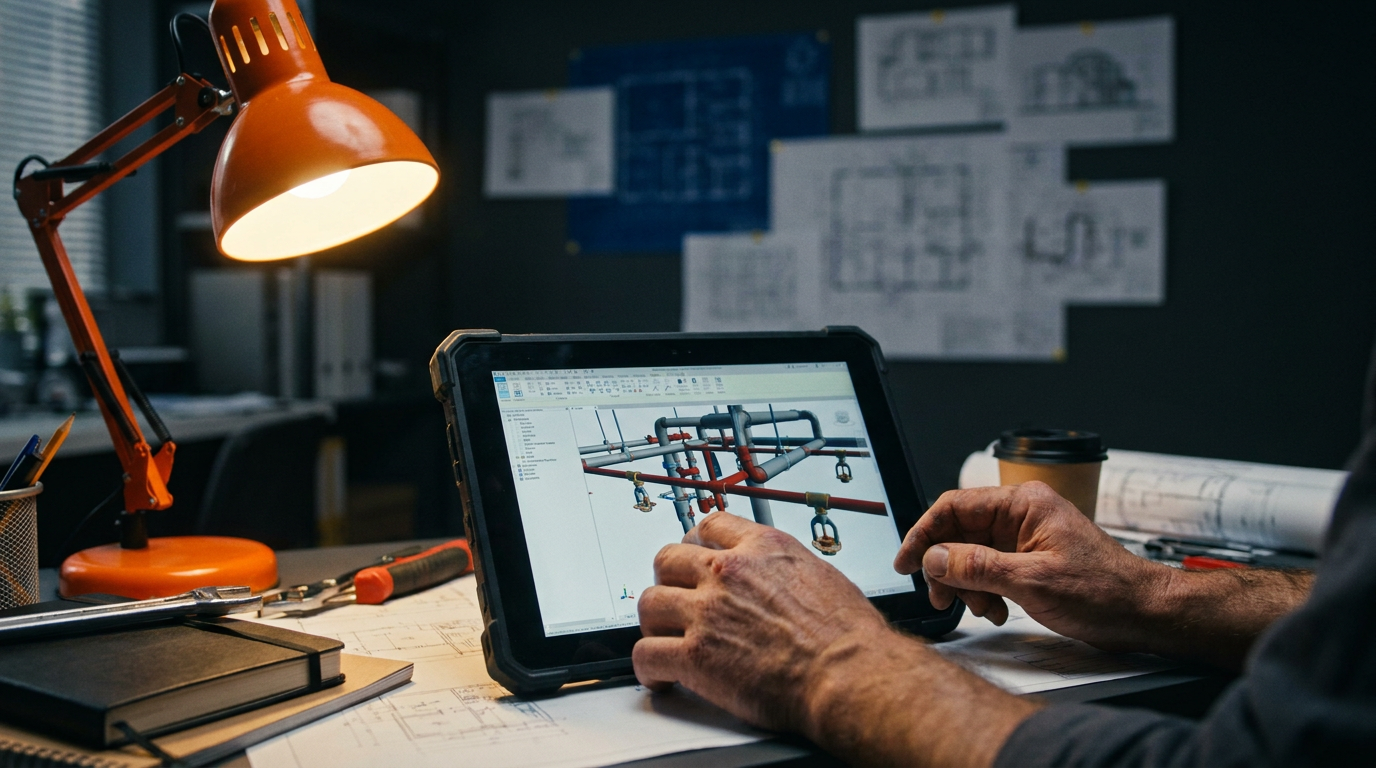
No, AI cannot fully design a fire sprinkler system on its own today. While AI tools can assist with tasks like clash detection, component placement, and hydraulic calculations, they can't replace the certified human designer. Critical judgment, code interpretation, and legal liability still require a professional's sign-off.
Can AI Design a Fire Sprinkler System? The Real Answer
Let's get straight to it. The short answer is no. Right now, AI cannot fully design a code-compliant fire sprinkler system from scratch, stamp it, and send it for permits. The tech just isn't there yet.
But that's not the whole story. Anyone telling you AI is useless in this field is just as wrong as the person saying it will take all our jobs tomorrow. The truth is in the middle. AI is becoming a powerful tool—a 'co-pilot' that can handle the grunt work, freeing up designers to focus on the stuff that requires real brainpower.
Think of it like a top-of-the-line impact driver. It makes you faster and more efficient, but it doesn't replace your knowledge of how to frame a wall. This article cuts through the hype and shows you what AI can actually do for fire protection pros today and what's coming down the pipe.
What AI Can Do for Sprinkler Design Right Now
AI is already working behind the scenes in the software many of us use. It's not a magic button, but a set of features that streamline complex tasks. Here’s where it’s making a real difference.
Automated Clash Detection: This is one of the biggest wins so far. In a complex 3D model (BIM), AI can automatically scan for places where your sprinkler pipe is trying to occupy the same space as an HVAC duct, a structural beam, or electrical conduit. This saves countless hours and prevents costly rework on the job site.
Generative Design for Pipe Routing: Some advanced software is using AI to suggest optimal pipe routes. You can set parameters—like start point, end points, and areas to avoid—and the AI will generate dozens of possible layouts. A human designer then reviews these options and chooses the most practical and cost-effective one. It’s a huge time-saver compared to manually drawing every line.
Streamlining Hydraulic Calculations: While AI isn't performing the core Hazen-Williams calculations itself (that's still handled by validated software), it can help prepare the system for calculation. It can quickly identify the most remote area, set up the calculations, and flag potential pressure issues before you even run the numbers. This helps you get to a balanced system faster.
Intelligent Component Selection: AI can be trained to suggest the right sprinkler head type, pipe size, or hanger based on the design parameters you've set. For example, if you define an area as a corrosive environment, the AI can automatically populate the design with corrosion-resistant heads and coated pipe, reducing manual errors.
The Human Element: Why You Still Need a NICET-Certified Pro
Software is a tool. The real work still comes down to professional judgment and legal responsibility. No AI company is willing to stamp a drawing and take on the liability if a system fails. That responsibility falls on a certified human, and for good reason.
Code Interpretation is an Art
NFPA 13 isn't a simple checklist. It's a complex document that requires interpretation based on the specific building, its use, and its hazards. An AI can read the text of the code, but it can't understand the intent behind it. It also can't call up the local fire marshal to clarify a specific requirement or negotiate an alternative method, which is a regular part of the job.
Liability and the Stamp
A NICET Level III or IV certification, or a Professional Engineer (P.E.) license, isn't just a piece of paper. It represents years of experience and is a legal declaration that the design is safe and compliant. The person who stamps that drawing is professionally and financially responsible for it. Until an AI can get its own insurance and stand up in court, a human will always be the one making the final call.
On-Site Realities
An AI has never walked a job site. It can't see the beat-up I-beam that isn't on the original drawings or talk to the foreman about a last-minute change from the owner. Design is an iterative process that involves coordinating with other trades and adapting to real-world conditions. This requires communication, problem-solving, and experience—all human traits.
Prompts You Can Use for Real-World Help
Instead of asking AI to do your job, use it to make your job easier. Think of it as a junior designer who can do research and drafting tasks for you. Here are a couple of prompts you can copy and paste into a tool like ChatGPT or Claude to get a head start on your work.
Act as a senior fire protection designer with NICET Level IV certification. I am starting the design for a new fire sprinkler system. Generate a comprehensive pre-design checklist for a 5-story, wood-frame (Type V-A construction) residential apartment building. The system should be a wet pipe system compliant with NFPA 13R. Include sections for architectural review, water supply data, structural coordination, and specific questions for the Authority Having Jurisdiction (AHJ).
This prompt doesn't ask the AI to design the system. It asks the AI to create a tool—a checklist—that helps you, the human expert, do your job more thoroughly.
Explain the key differences between an Ordinary Hazard (Group 1) and an Ordinary Hazard (Group 2) classification under NFPA 13. Provide three specific real-world examples for each classification. Present the information in a simple table with columns for: 'Factor', 'Ordinary Hazard (Group 1)', and 'Ordinary Hazard (Group 2)'. Factors should include combustibility of contents, quantity of combustibles, and typical design density/area.
Here, you're using AI as a powerful research assistant. It can summarize complex code sections and present them in an easy-to-understand format, saving you time you'd otherwise spend flipping through the codebook.
The Future: Your Job Is Evolving, Not Disappearing
The role of the fire sprinkler designer is changing. The days of spending 80% of your time on manual drafting and calculations are numbered. The future is about leveraging technology to handle the repetitive stuff.
This shift allows designers to focus on higher-value work:
- Front-end design and consulting: Working with architects and owners early in the process to make smarter decisions.
- Complex problem-solving: Tackling unique building challenges that require creative, code-compliant solutions.
- Project management: Ensuring the design is installed correctly and efficiently on site.
- Quality control: Using your expertise to validate and approve the work that AI helps generate.
Companies that build tools for our trade are all moving in this direction. They know the future is a partnership between human expertise and artificial intelligence. To stay ahead, you need to be willing to learn how to use these new tools. For more on how this impacts your business, check out our guide to AI for your trade business.
The designer of tomorrow won't be replaced by AI. They will be the one who knows how to use AI to get the job done better, faster, and more profitably.
Frequently asked questions
37 copy-paste prompts that save tradespeople 5+ hours a week. Plus one short email every Friday — no fluff.
More for other trades

AI for Painting Contractors: Quoting to Marketing
AI for Painting Contractors comes down to using AI to do the slow stuff — quoting, paperwork, marketing, and customer follow-up — so you can stay on the to
AI for Fence Companies: 9 Practical Plays
AI for Fence Companies comes down to using AI to do the slow stuff — quoting, paperwork, marketing, and customer follow-up — so you can stay on the tools.
AI for Handyman Business: The Solo Operator Stack
AI for Handyman Business comes down to using AI to do the slow stuff — quoting, paperwork, marketing, and customer follow-up — so you can stay on the tools