Can AI Generate a Trade-Specific Safety Quiz? Here's How.
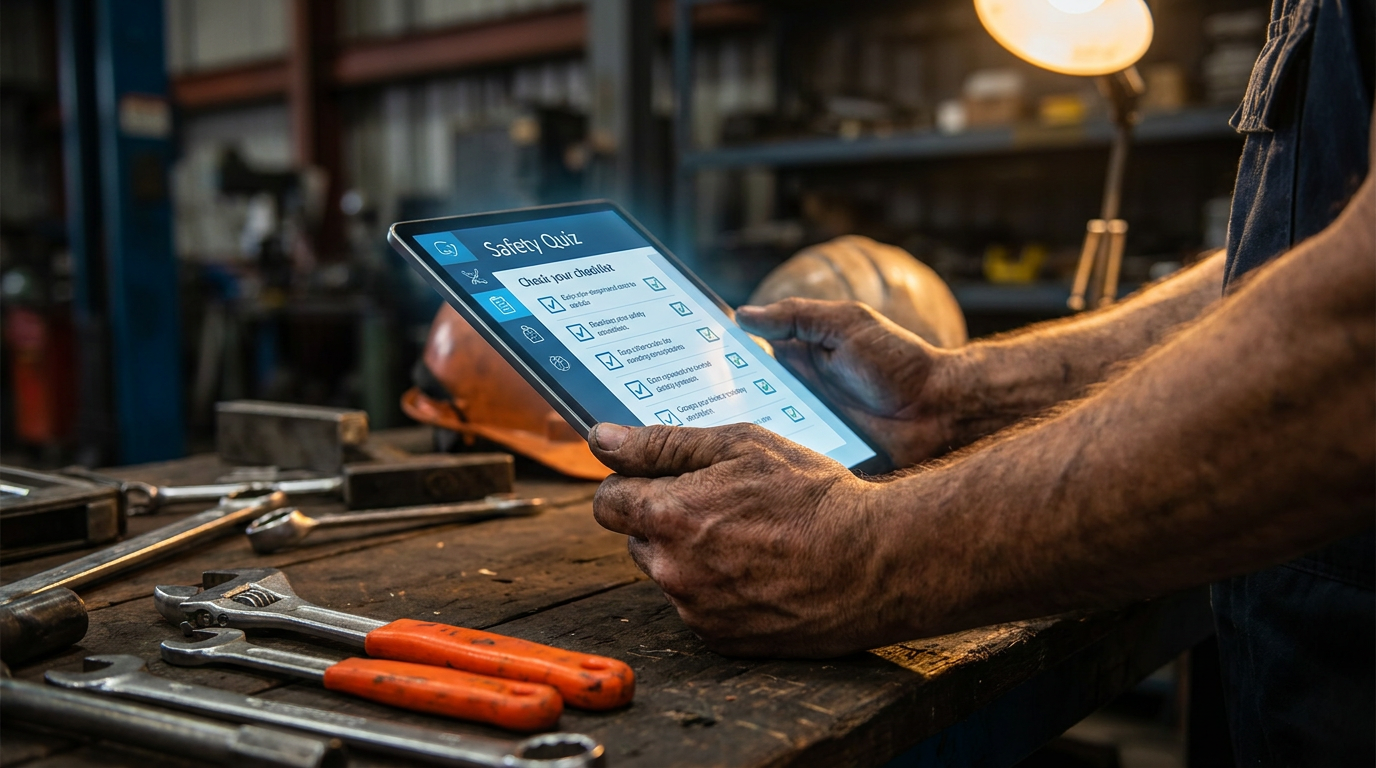
Yes, AI can generate a trade-specific safety quiz. By providing a detailed prompt with your trade, specific job site risks, and relevant OSHA standards, you can create a custom quiz in minutes. This saves time and helps ensure new hires understand critical safety protocols from day one.
Can AI Generate a Trade-Specific Safety Quiz? Here's How.
Let's be honest. The generic, one-size-fits-all safety quiz you download from the internet is mostly useless. It doesn't cover the real risks your crew faces every day. An electrician doesn't need to know the finer points of trenching safety, and a plumber doesn't need a deep dive on arc flash. You need something that matters.
In the past, building a custom safety quiz for every new hire was a major time suck. You had to dig through OSHA manuals and write questions yourself. Now, you can use Artificial Intelligence (AI) to do the heavy lifting. It can create a relevant, trade-specific safety quiz in a few minutes, not a few hours.
Why Bother with Custom Safety Quizzes?
A good safety quiz isn't just about checking a box for the insurance company. It’s your first line of defense in building a strong safety culture. When you test a new hire on the specific dangers of their job, you accomplish a few key things:
- Real-World Relevance: It shows you take their specific role seriously. A custom quiz about ladder safety for a roofer or lockout/tagout for an HVAC tech is immediately more useful than a general construction quiz.
- Finds Knowledge Gaps: The quiz will instantly show you what your new hire does and doesn't know. If they fail the questions on GFCI protection, you know exactly where to focus your hands-on training.
- Better Retention: People remember information better when it's directly related to their work. A targeted quiz helps new employees absorb and retain critical safety knowledge from day one.
- OSHA Compliance: A documented, role-specific safety quiz is solid proof that you are actively training your employees on the hazards they will face, which is a core requirement of OSHA.
How to Use AI to Build Your Safety Quiz
The quality of the quiz you get from an AI depends entirely on the quality of the instructions, or 'prompt,' you give it. A lazy prompt like "make a safety quiz" will give you a lazy, generic quiz. You need to be specific.
A good prompt should include these key pieces of information:
- Trade and Skill Level: Are you testing an apprentice plumber or a journeyman electrician?
- Job Site Type: Is the work residential, commercial, or industrial? New construction or service calls?
- Specific Tasks and Hazards: What will they be doing? Mention tasks like soldering copper pipes, working in attics, handling refrigerants, or operating a scissor lift.
- Tools and Equipment: List the key tools they will use, from power saws to multimeters.
- Relevant Standards: Mentioning specific OSHA standards (like 1926 for construction or 1910 for general industry) helps the AI focus on compliant information.
- Quiz Format: Ask for what you want. 10 multiple-choice questions with an answer key? 5 true/false questions? Be clear.
Here’s a prompt you can use right now.
Act as a construction safety manager. Generate a 10-question multiple-choice safety quiz for a new apprentice plumber. The work is primarily on residential new construction sites. The quiz should cover common hazards like slips, trips, and falls; basic tool safety for pipe cutters and drills; soldering and fire prevention; and working in unfinished spaces like basements and attics. Provide a separate answer key at the end.
Refining Your AI-Generated Quiz
AI is a powerful tool, but it's not a safety expert. It can make mistakes. Never copy and paste a quiz and hand it to a new employee without reviewing it first. Always trust, but verify.
- Fact-Check the Answers: Read through every question and answer. Does it make sense? Is it accurate according to current OSHA regulations and industry best practices?
- Edit for Your Business: The AI doesn't know your company's specific safety rules. Add questions that relate directly to your safety manual. For example, “Who is the company’s designated competent person for fall protection?” or “Where are the first aid kits located in the work vans?”
- Keep it Simple: AI can sometimes use complicated language. Rewrite any questions that are confusing or use too much jargon. The goal is to test knowledge, not reading comprehension.
This step is critical. The final quiz is your responsibility, not the AI's. Taking 15 minutes to review and customize the quiz ensures it's both accurate and effective. This is a key part of improving your hiring process.
Review the following safety quiz question and answer. Is it accurate according to OSHA standard 1926? Rewrite it to be clearer for a brand new employee with English as their second language.

[Paste the AI-generated question and answer here]
Beyond the Quiz: Other Ways AI Helps with Safety
Generating quizzes is just the start. You can use the same prompting techniques to build out your entire safety program.
- Toolbox Talks: Need a quick 5-minute safety talk for your crew tomorrow morning? AI can write one for you. Just tell it the topic, the trade, and how long it should be.
- Job Hazard Analysis (JHA): AI can create a solid JHA template for a specific task. Ask it to list the steps of a task, the potential hazards at each step, and the controls to mitigate those hazards.
- Understanding Regulations: You can paste a chunk of a dense OSHA standard into an AI and ask it to summarize the key points in plain English. This can save you hours of reading.
Write a script for a 5-minute toolbox talk for a residential roofing crew. The topic is job site hydration and recognizing the signs of heat exhaustion. Keep the language simple and direct. Include 3 key takeaways at the end.
Using AI for safety isn't about cutting corners. It's about working smarter. It lets you create customized, relevant training materials quickly, so you can spend more time on the job site, leading your crew and keeping them safe. It's a tool. Use it to build a stronger, safer business.
Frequently asked questions
37 copy-paste prompts that save tradespeople 5+ hours a week. Plus one short email every Friday — no fluff.
More for hiring & hr
AI Job Description for Electrician Apprentice (Template)
AI Job Description for Electrician Apprentice (Template) comes down to using AI to do the slow stuff — quoting, paperwork, marketing, and customer follow-u

How to Screen Trades Resumes With AI (Fairly)
How to Screen Trades Resumes With AI (Fairly) comes down to using AI to do the slow stuff — quoting, paperwork, marketing, and customer follow-up — so you
30 AI-Generated Interview Questions for Plumbers
30 AI-Generated Interview Questions for Plumbers comes down to using AI to do the slow stuff — quoting, paperwork, marketing, and customer follow-up — so y