
Can AI Help Diagnose Voltage Drop in Electrical Circuits?
Yes, AI can help diagnose voltage drop by analyzing real-time digital multimeter logs, checking run lengths against NEC tables, and isolating high-resistance faults. While AI cannot turn physical screws, it identifies branch circuit anomalies, calculates load changes, and eliminates manual field math in seconds.
The Reality of Voltage Drop on the Job
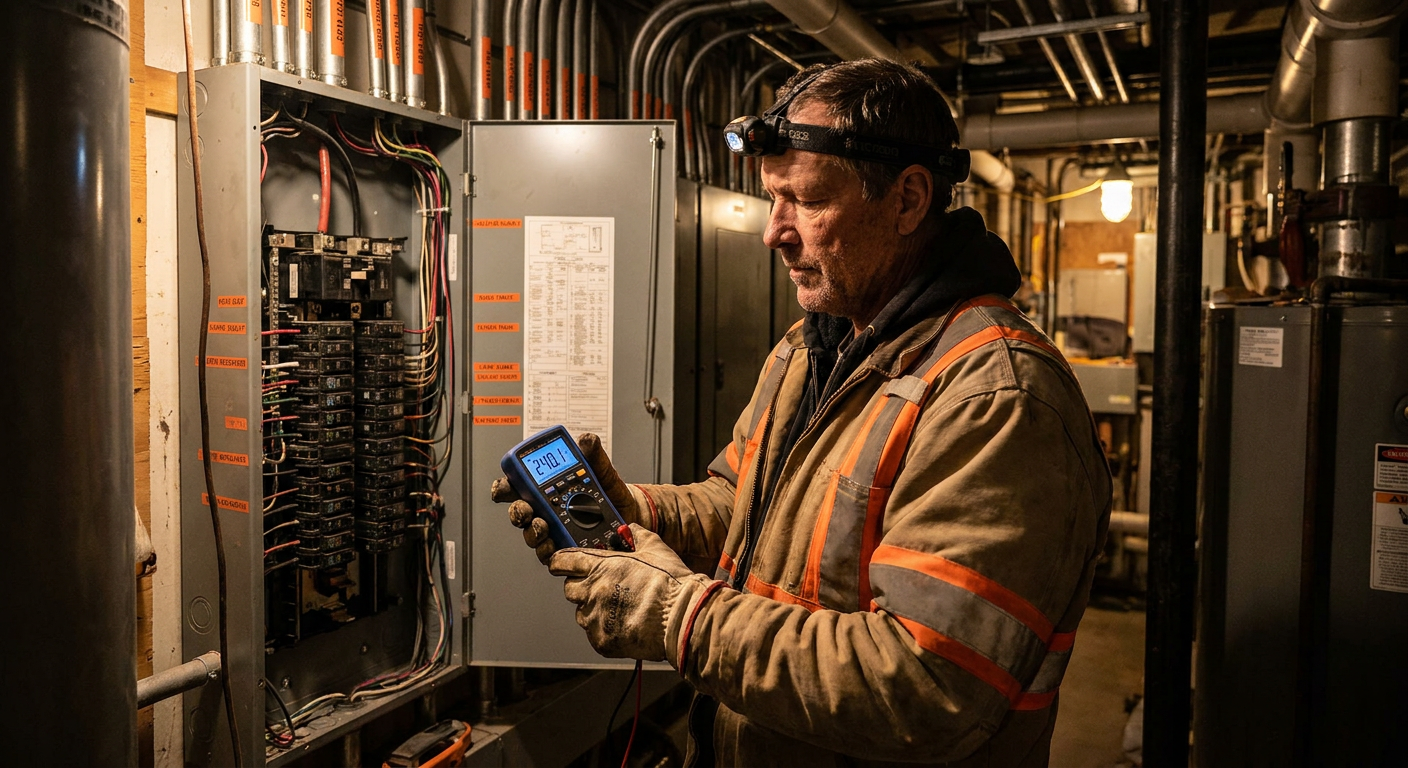
Every field tech knows the headache of chasing phantom voltage loss. You get called out because a motor is overheating, LED drivers are flickering, or an industrial control panel resets at random intervals. You pull out your meter, read 112 volts at the panel, and find 103 volts at the end of a long branch circuit under load.
Finding the loss is step one. Finding out why it is dropping takes time. Is the copper undersized for that 180-foot run? Is there a corroded splice in an intermediate junction box? Or did someone splice aluminum and copper without the right connectors three renovations ago?
Can AI help diagnose voltage drop before you spend half a day pulling wire and opening every box in the ceiling? The short answer is yes. AI will not pull wire or strip insulation, but it acts like a second lead tech riding in your passenger seat. It handles complex Ohm's law calculations, parses logger files, and spots resistance patterns faster than any paper scratchpad.
How AI Works With Multimeter Data and Field Readings
AI does not have eyes, but it eats numbers for breakfast. Modern Bluetooth meters and power quality analyzers log thousands of data points per minute. Most electricians never look at ninety percent of that data because scrolling through a raw CSV spreadsheet on a phone is miserable work.
When you feed logged electrical values into an AI model, it processes the math across the whole timeline. It correlates the exact second an inductive load kicks on with the millivolt drop on the line conductor. It separates normal inrush current dip from continuous resistive drop.
Here is what an AI model checks when you give it basic jobsite parameters:
- Conductor gauge and material (copper versus aluminum)
- Total one-way distance from the panel to the equipment
- Ambient temperature derating factors
- Conduit type (PVC, EMT, or rigid steel, which affects inductive reactance)
- Measured operating current versus rated nameplate draw
By comparing your measured drop against theoretical National Electrical Code standards, the AI tells you right away if the drop is purely due to run length or if there is extra, unwanted resistance hidden inside the pipe.
Spotting High-Resistance Faults Versus Long Runs
National Electrical Code guidelines recommend keeping voltage drop under 3 percent on branch circuits and 5 percent total across the feeder and branch circuit combined. That keeps equipment running cool and prevents warranty callbacks.
When a circuit drops 8 percent, you have two choices. Either the wire is simply too small for the distance, or you have a bad connection somewhere down the line. A bad connection creates localized heat and burns out equipment.
AI helps you separate these two problems without opening ten junction boxes first. If you give an AI the wire size, distance, and current, it calculates the baseline resistance of the wire. If your measured drop is double what the baseline says it should be, you know you are not dealing with an undersized wire problem. You are dealing with a bad splice, a loose lug, or a failing breaker contact.
If you work as a licensed electrician, using an AI model to run this differential math saves you hours of ladder work. You immediately stop planning a wire pull and start looking for the hot joint.
Using AI Prompts on the Jobsite
You do not need custom software to put this to work. You can use standard conversational AI on your phone right from the service truck. You just need to give the tool clear, raw facts without fluff.
Here is a diagnostic prompt you can run when a customer complains about equipment cutting out under load.
Act as a master electrician diagnosing branch circuit voltage drop. Here are the field measurements:
- Nominal system voltage: 120V single-phase
- Measured voltage at panel under load: 119.2V
- Measured voltage at load terminals under load: 109.8V
- Measured load current: 14.2A
- Conductor: 12 AWG stranded copper in EMT conduit
- One-way run distance: 135 feet
- Ambient temperature: 85 degrees Fahrenheit

Calculate the expected theoretical voltage drop based on standard NEC Chapter 9 tables. Tell me the theoretical drop in volts and percentage, compare it to my actual measured drop, and state whether the loss is consistent with wire resistance or indicates an abnormal high-resistance point in the circuit.
When you run this prompt, the AI compares the expected loss against your actual 9.4-volt drop. It tells you instantly that 12 AWG copper over 135 feet at 14.2 amps should only drop around 7.5 volts. That extra 1.9-volt drop points directly to a loose termination, a pitted switch contact, or an unrecorded extension of the run.
Here is another prompt for commercial three-phase feeder issues:
Act as an electrical engineer troubleshooting a three-phase feeder.
Data:
- System: 480V 3-phase, 4-wire
- Feeder: 3/0 AWG copper in steel conduit, 210 feet
- Phase A loaded current: 165A, voltage to neutral: 268V
- Phase B loaded current: 160A, voltage to neutral: 274V
- Phase C loaded current: 162A, voltage to neutral: 273V
- Voltage at main distribution panel: 277V phase-to-neutral on all phases.

Analyze the voltage drop across all three phases. Identify why Phase A shows higher drop despite similar loading, and give three probable physical causes to inspect in the field.
This kind of prompt gives you an immediate punch list. It forces you to look at Phase A lugs, meter the disconnect blades, and inspect terminations before you waste time condemning the main transformer.
Parsing Meter Export Files
If you use a recording meter like a Fluke 1730 or similar data logger, you can export your findings to a spreadsheet. Instead of building charts manually in Excel, you can upload the text or CSV data straight into an AI tool.
Ask the AI to spot voltage sag events that coincide with specific equipment cycles. For example, you can tell the AI to look for dips greater than 4 percent that last longer than 500 milliseconds. The AI will flag the timestamps and show you the matching current spikes.
I have uploaded a CSV export from a power quality logger monitoring a 208V 3-phase circuit over 24 hours. Analyze the data to:
1. Find all instances where line-to-line voltage dropped below 198V.
2. Cross-reference those timestamps with line current to determine if the drop was driven by sudden inrush current or sustained overload.
3. Summarize the worst voltage drop event with exact timestamp, lowest voltage, peak current, and duration in seconds.
This turns two hours of spreadsheet analysis into thirty seconds of reading. You get clean facts you can paste straight into a service report for your commercial client.
Limits of AI in Electrical Diagnostics
AI is a calculator with language skills. It does not replace your meter, your eyes, or your torque wrench.
First, AI does not know if your test leads have high internal resistance. If your lead wires are beat up and adding 0.4 ohms to your meter readings, the AI will assume your field readings are gospel truth and give you bad conclusions. Bad input data guarantees bad output.
Second, AI does not know jobsite history. It does not know that a roof leaked into a junction box two weeks ago or that a drywall crew drove a screw through a conduit run on Tuesday. You still have to walk the pipe, smell the enclosures, and feel for heat with an infrared camera.
Third, never trust an AI calculation for final engineered designs without double-checking the NEC handbook or your local jurisdiction amendments yourself. AI models can mix up single-phase and three-phase formulas if you write sloppy prompts. Always verify the math before you order five thousand dollars worth of 4/0 copper.
Practical Field Workflow for Service Electricians
To make this work in your daily trade routine, build a standard routine:
- Take your baseline readings at the source and the load while the circuit is under normal operating current.
- Measure the physical run length with a laser measure or wheel.
- Open your phone's AI app while sitting in the truck.
- Dictate the wire gauge, material, run distance, operating amps, and measured drop using voice-to-text.
- Compare the AI output to your meter screen.
If the AI shows the drop is normal for that run length, you have an engineering problem: the wire is too small and needs to be upsized. If the AI shows your measured drop is way above theoretical limits, you have a maintenance problem: there is bad hardware somewhere between the panel and the load.
Using AI to separate engineering issues from hardware failures keeps you from wasting time. It sharpens your diagnostic speed, impresses the facility manager, and gets your truck rolling to the next billable call faster.
Frequently asked questions
37 copy-paste prompts that save tradespeople 5+ hours a week. Plus one short email every Friday — no fluff.
More for electricians
AI for Electricians: A Field-Tested Guide
AI for Electricians comes down to using AI to do the slow stuff — quoting, paperwork, marketing, and customer follow-up — so you can stay on the tools. Bel
27 ChatGPT Prompts for Electricians (Copy & Paste)
27 ChatGPT Prompts for Electricians (Copy & Paste) comes down to using AI to do the slow stuff — quoting, paperwork, marketing, and customer follow-up — so

AI Electrical Load Calculator: How It Works & Free Prompt
AI Electrical Load Calculator comes down to using AI to do the slow stuff — quoting, paperwork, marketing, and customer follow-up — so you can stay on the