Can AI Help Plan a Conduit Run to Avoid Clashes?
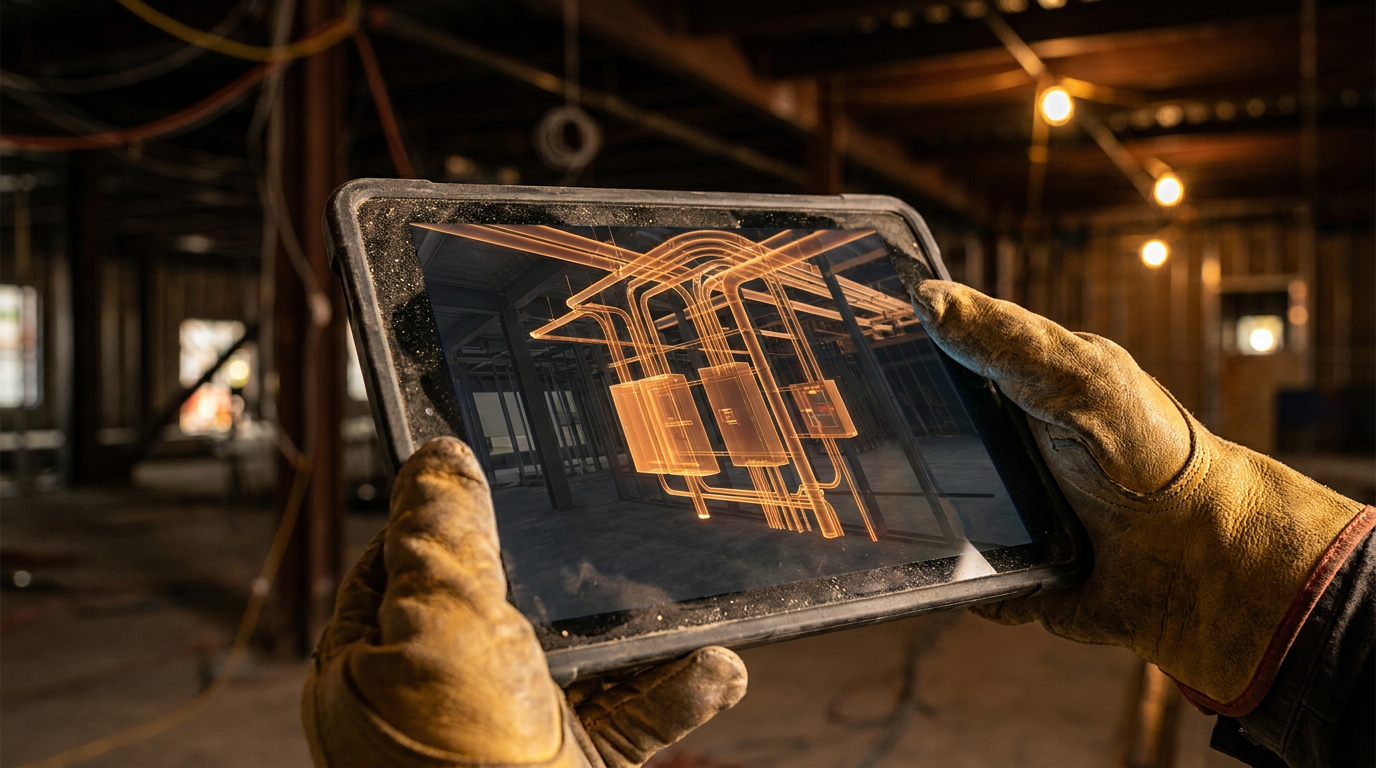
Yes, AI can help lay out conduit runs in a commercial building. AI tools, especially in BIM software, analyze 3D models to find optimal paths, detect clashes with HVAC and plumbing, and suggest routes that save material. It acts as a powerful digital pre-check before you ever step on site.
You Can't Bend a Pipe Through a Duct
We’ve all been there. You’re on a commercial job, maybe a hospital or a high-rise office. The prints look clean. You start pulling tape, marking your supports, and then you see it. A 24-inch duct sitting exactly where your 4-inch feeder is supposed to go. The mechanical guys got there first. Now it’s a fire drill of RFIs, change orders, and wasted time.
That’s the old way. The costly way. For years, the best tools we had were a good tape measure and a foreman who could smell a problem from three floors away. But now, we have something else in the toolbox: Artificial Intelligence.
Don't roll your eyes. This isn't about robots taking your job. It's about a tool that can look at a million data points in a 3D model and spot that clash before the duct is even ordered. It’s about using AI to make our jobs faster, cleaner, and more profitable. Let's break down how AI can help you plan a conduit run and avoid a dozen clashes before you even load the truck.
What AI Actually Does for Conduit Layouts
First, let's get one thing straight. When we talk about AI for conduit runs, we're usually not talking about asking a chatbot like ChatGPT to design your electrical system. While those tools are useful for some tasks, the real power is in specialized software.
This is where Building Information Modeling (BIM) comes in. Software like Autodesk Revit, Navisworks, and other platforms are the brains of the operation. They create a detailed 3D digital twin of the building. AI is the feature inside that software that makes the model smart.
Here’s what it can do for you:
- Clash Detection: This is the big one. The AI scans the entire 3D model, which includes structural, mechanical, plumbing, and electrical systems. It automatically flags every single point where your conduit run intersects with a pipe, a duct, a steel beam, or anything else. Instead of finding clashes on-site, you get a detailed report of them during pre-construction. This is a game-changer.
- Route Optimization: Once clashes are identified, AI can suggest alternative routes. Based on parameters you set—like avoiding certain zones, minimizing bends, or using standard material lengths—it can generate options. This isn't just about avoiding obstacles; it's about finding the most efficient path that saves on both material and labor.
- Code Compliance Checks: Some advanced systems are being trained on the National Electrical Code (NEC). The AI can flag potential violations in your layout, like bend radius issues, conduit fill problems, or improper support spacing. It's not a replacement for a licensed electrician's judgment, but it's a great first line of defense.
- Material Takeoffs: An AI-assisted model knows exactly how much conduit you need, down to the inch. It can generate a Bill of Materials (BOM) that includes every stick of pipe, every connector, every coupling, and every support. This makes your quoting process dead accurate.
Putting AI to Work: Prompts for the Real World
Even without expensive BIM software, you can use general AI models to help with the planning phase. The key is to give the AI a clear role and detailed information. Think of it as a very knowledgeable, but very literal, apprentice.
Here are a couple of prompts you can copy and paste to get started.
Act as a senior electrical foreman with 25 years of experience in commercial construction. I am planning a conduit layout for the main electrical room of a new 5-story data center. The room is 50' x 30' with 18' ceilings.

Generate a detailed pre-installation checklist. The checklist should focus on coordinating with other trades and avoiding common points of failure. Include sections for:

1.  Structural Coordination (e.g., core drill locations, embedded plates)
2.  Mechanical Coordination (e.g., clearance from chillers, air handlers)
3.  Plumbing & Fire Protection (e.g., avoiding sprinkler heads, floor drains)
4.  Access & Future Maintenance (e.g., ensuring panel doors can open fully, leaving space for future circuits)
This next prompt helps you think through problems before they happen.
I am an electrician planning a run of 4-inch EMT conduit in a crowded hospital ceiling plenum. The available space is a 12-inch high by 24-inch wide corridor between a large HVAC duct and the primary sprinkler main.

My run needs to cross perpendicular to a dozen 1-inch water lines spaced 16 inches on center.

Based on this description, list three potential code-compliant solutions for crossing the water lines. For each solution, analyze the pros and cons regarding labor time, material cost, and potential for future access.
The Limits: Where AI Falls Short
This technology is powerful, but it's not magic. It's a tool, and like any tool, it has limitations. Knowing them is just as important as knowing its strengths.
- Garbage In, Garbage Out: An AI analysis is only as good as the 3D model it's reading. If the mechanical engineer's model is incomplete or the structural steel is off by six inches, the AI's clash detection report is useless. Model accuracy is everything.
- No Field Experience: AI has never pulled wire on a cold Tuesday morning. It doesn't have the "feel" for a job site. It can't tell you that the general contractor always pours concrete a week late or that the local inspector is a stickler for a specific type of support. That knowledge only comes from experience.
- It's Not Licensed: The AI is not the Engineer of Record. It is not the Authority Having Jurisdiction (AHJ). Its suggestions are just that—suggestions. The final call, and the liability, rests with the licensed professionals on the job. You are the expert in the room, not the computer.
Think of AI as the ultimate pre-flight checklist. It helps you spot problems on paper, saving you from discovering them when you're 20 feet up on a lift. It's one more piece of crucial jobsite information. For more on that, see our guides on managing the jobsite.
The Future is Already Here
What's coming next is even more interesting. We're on the cusp of generative design, where you'll tell the AI the start and end points of a run and the constraints, and it will generate hundreds of optimized route options in minutes.
Combine that with Augmented Reality (AR). Imagine putting on a pair of glasses like the HoloLens and seeing the AI-designed conduit run projected right onto the ceiling grid. You’d see exactly where every support, bend, and junction box goes before drilling a single hole.
This isn't science fiction. Large-scale contractors are already using these techniques on major projects. As the technology gets cheaper and easier to use, it will become a standard part of the toolbox for every commercial electrician. The goal is simple: build it once, digitally, so you can build it right the first time, physically.
Frequently asked questions
37 copy-paste prompts that save tradespeople 5+ hours a week. Plus one short email every Friday — no fluff.
More for electricians
AI for Electricians: A Field-Tested Guide
AI for Electricians comes down to using AI to do the slow stuff — quoting, paperwork, marketing, and customer follow-up — so you can stay on the tools. Bel
27 ChatGPT Prompts for Electricians (Copy & Paste)
27 ChatGPT Prompts for Electricians (Copy & Paste) comes down to using AI to do the slow stuff — quoting, paperwork, marketing, and customer follow-up — so

AI Electrical Load Calculator: How It Works & Free Prompt
AI Electrical Load Calculator comes down to using AI to do the slow stuff — quoting, paperwork, marketing, and customer follow-up — so you can stay on the