Can AI Help You Select the Right Wire Gauge?
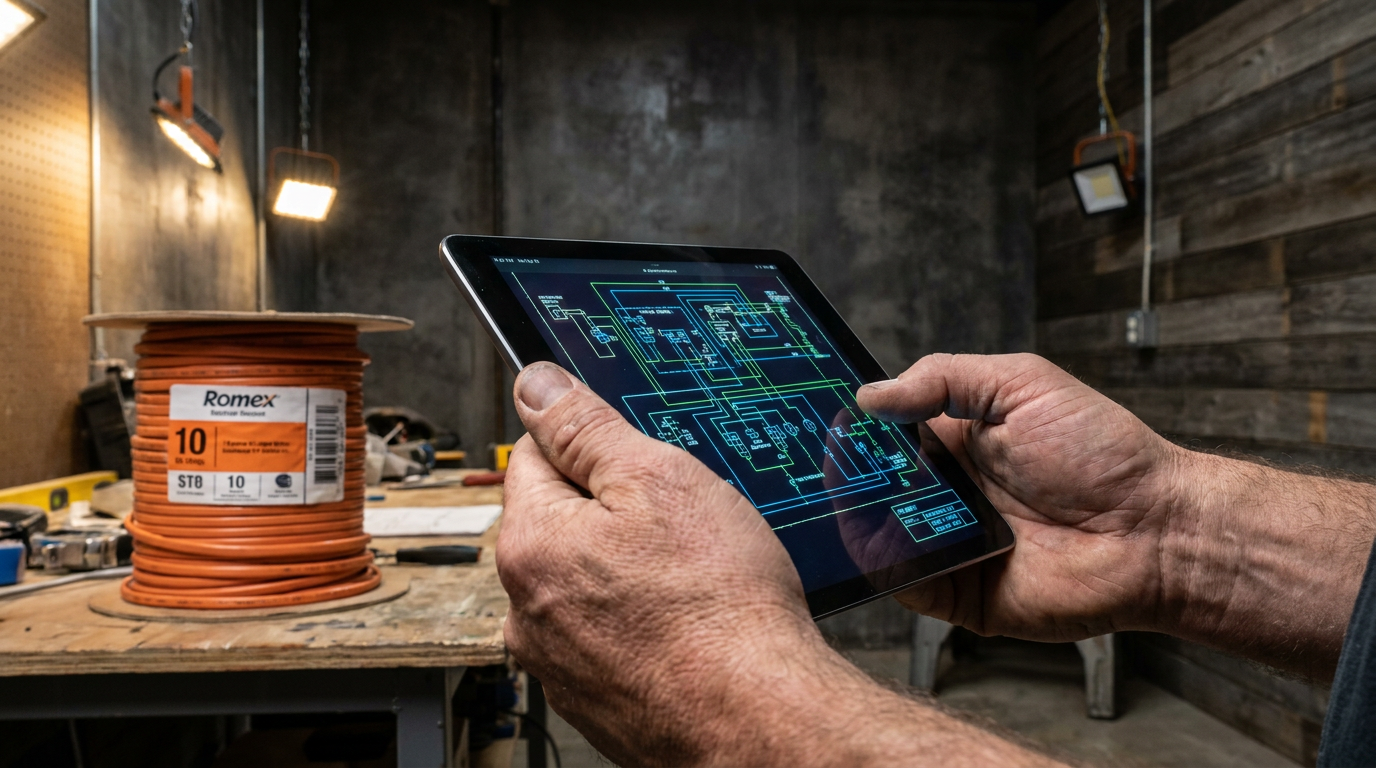
Yes, AI can help select wire gauge by quickly processing inputs like load, distance, and ambient temperature against NEC tables. But it's a tool, not a replacement for a licensed electrician. AI doesn't have jobsite awareness or legal liability, so you must always verify its suggestions against code and your own expertise.
Can AI Help You Select the Right Wire Gauge?
Choosing the right wire gauge isn't just a suggestion. It's about safety, code compliance, and performance. Get it wrong, and you risk overheating, voltage drop, or a failed inspection. For years, we've relied on codebooks, charts, and specialized calculators. Now, AI is in the mix.
But can you really trust a chatbot with something as critical as wire sizing? The answer is more complex than a simple yes or no. AI can be a powerful assistant, but it's not ready to take your job. Think of it as a calculator on steroids, not a licensed journeyman in a box.
This guide breaks down where AI shines, where it falls short, and how you can use it to work smarter, not just harder.
What AI Can and Can't Do for Wire Sizing
Artificial intelligence is good at one thing: processing massive amounts of data very quickly. When it comes to wire selection, that data is the National Electrical Code (NEC), physics principles, and standard formulas. Here’s what that means for you on the job.
What AI Gets Right
- Fast Calculations: AI can compute ampacity and voltage drop in seconds. Feed it the load, distance, and voltage, and it will spit back an answer faster than you can find the right page in your codebook.
- Handling Multiple Factors: This is where AI starts to get useful. When you have to account for ambient temperature correction and adjust for more than three current-carrying conductors in a raceway, AI can do the math instantly. It prevents simple human error when juggling multiple derating factors.
- Comparing Options: You can ask an AI to compare the required gauge for copper versus aluminum for the same load, and it will give you both answers side-by-side. This helps in the quoting phase when material costs are a major factor.
Where AI Fails the Real-World Test
- No Jobsite Awareness: AI has never been on a hot roof in Texas or in a crowded, unventilated attic. It doesn't know about the nearby steam pipe or the unusual routing you have to take. It only knows the numbers you give it. Your professional judgment is needed to account for real-world conditions.
- Legal Liability: When you sign off on a job, your name and license are on the line. If a wire fails and causes a fire, the inspector and the insurance company aren't going to blame a chatbot. The responsibility is always yours. AI has no license and takes no liability.
- Local Code Amendments: The NEC is the baseline, but nearly every jurisdiction has its own amendments. AI models are trained on the general NEC, not the specific rules for Boulder, Colorado, or Miami-Dade County, Florida. You are responsible for knowing and following local code.
- No Common Sense: Sometimes a calculation is technically correct but practically a bad idea. An AI might suggest a wire gauge that barely meets code, while an experienced electrician would go one size larger for future-proofing or to reduce heat. That's experience, not computation.
Using AI Prompts to Get Better Answers
The key to using AI is giving it a good prompt. The more specific your input, the more accurate the output. Vague questions get vague, and often wrong, answers.
Start with the basics. A good prompt for wire sizing should always include the core information. Here are a few prompts you can copy and paste to get started.
Act as an expert electrician referencing the NEC. I need to select the correct THHN copper wire gauge for a dedicated circuit. Here are the details:

- Voltage: 240V, single-phase
- Load: 40 amps (continuous load)
- One-way distance: 125 feet
- Installation: In conduit

Calculate the minimum wire gauge required, considering both ampacity and a maximum voltage drop of 3%. Show your calculations.
That prompt is a solid start. But for more complex jobs, you need to provide more detail to account for derating. A better prompt includes variables for ambient temperature and conductor fill.
I am sizing a circuit for a rooftop AC unit in Phoenix, Arizona. Act as an electrical code expert. Determine the correct THHN-2 copper conductor size.

- Load: 32A FLA (Full Load Amps)
- Voltage: 208V, 3-phase
- One-way run length: 180 feet
- Conduit: EMT
- Conductors in conduit: 6 current-carrying conductors (two 3-phase circuits)
- Ambient Temperature: 115°F (46°C)

Calculate the required wire gauge after applying all necessary derating factors for ambient temperature and conductor bundling according to the NEC. Ensure the final voltage drop is under 3%. Explain each step of the derating process.
The Limits of AI: Code, Liability, and Your Gut
Even with a perfect prompt, an AI's answer is just a starting point. It's a tool for verification, not a replacement for your expertise. Always treat the output with healthy skepticism.
Think of it like this: A framing nailer is faster than a hammer, but it won't tell you if you're building the wall in the wrong place. AI is a tool that makes the math part of your job faster, but it can't handle the thinking part.
Before you pull that wire, ask yourself:
- Does this pass the 'sniff test'? Does the answer feel right based on your experience? If an AI suggests 14 AWG for a 50-amp run, you know something is wrong. Don't blindly trust it.
- Have I checked the code myself? Use the AI's answer as a guide, but open your NEC book or app to confirm the relevant tables (like 310.16 for ampacity and Chapter 9, Table 8 for conductor properties).
- What are the local rules? Call your local inspection office or check their website if you're unsure about a local amendment. Ignorance isn't an excuse.
AI is becoming a valuable part of the modern jobsite, from project management apps to estimating software. For wire selection, it’s best used as a double-check or a way to quickly run numbers on a complicated scenario. The final call, and the responsibility that comes with it, is always yours.
Frequently asked questions
37 copy-paste prompts that save tradespeople 5+ hours a week. Plus one short email every Friday — no fluff.
More for electricians
AI for Electricians: A Field-Tested Guide
AI for Electricians comes down to using AI to do the slow stuff — quoting, paperwork, marketing, and customer follow-up — so you can stay on the tools. Bel
27 ChatGPT Prompts for Electricians (Copy & Paste)
27 ChatGPT Prompts for Electricians (Copy & Paste) comes down to using AI to do the slow stuff — quoting, paperwork, marketing, and customer follow-up — so

AI Electrical Load Calculator: How It Works & Free Prompt
AI Electrical Load Calculator comes down to using AI to do the slow stuff — quoting, paperwork, marketing, and customer follow-up — so you can stay on the