Can an AI Bot Help You Troubleshoot a VFD?
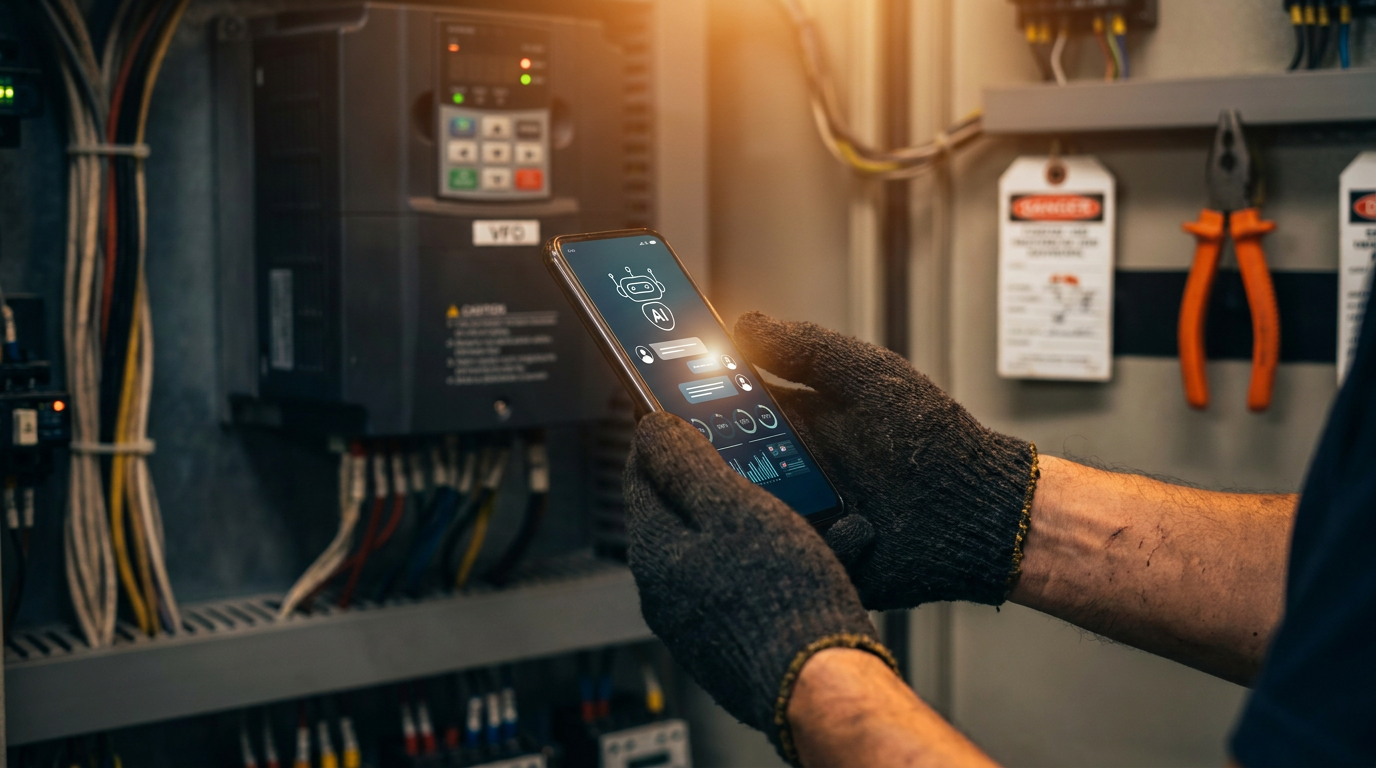
Yes, an AI bot can help you troubleshoot a VFD, but it's a tool, not a replacement for your expertise. It can quickly interpret fault codes, suggest diagnostic steps based on the manual, and even help you write reports. Think of it as a super-powered apprentice on your phone.
Can an AI Bot Help You Fix a Busted VFD?
You're on site. A critical production line is down. The culprit is a variable frequency drive that’s flashing a fault code you haven't seen in a while. The pressure is on, the client is breathing down your neck, and the 400-page PDF manual on your phone is a pain to search through.
We’ve all been there. But now, there’s a new tool in the box: artificial intelligence. These AI chatbots, like ChatGPT and others, are more than just a gimmick. They can be a serious asset for an electrician in the field. But let's be clear: an AI isn't going to put on gloves and use a meter. Your job is safe. This is about working smarter, not getting replaced.
Think of AI as the sharpest apprentice you've ever had. It’s read every manual ever printed and can recall information instantly. Your job is to take that information and apply your real-world skill to solve the problem.
What AI Can Actually Do for VFDs
Forget the science fiction hype. Here's how AI can help you on a real job, today. It’s about speed and accuracy for the knowledge-based parts of your work.
Instant Fault Code Lookup: Instead of scrolling through a PDF index, you can just ask. Tell the AI the VFD model and the fault code, and it will pull up the cause and recommended actions in seconds. This is a huge time-saver when you're working on an unfamiliar drive.
Manual Interpretation: Some manufacturer manuals are dense and poorly written. You can paste a confusing paragraph into an AI and ask it to "explain this like I'm an electrician on the job." It can simplify complex engineering-speak into plain language.
Suggesting Diagnostic Steps: Based on a fault code, you can ask an AI to create a logical troubleshooting sequence. It might suggest checking input voltage first, then motor winding resistance, then output transistors. You still have to do the work, but it provides a solid game plan.
Parameter Cross-Referencing: Need to know what parameter P121 does on a Siemens SINAMICS G120? Or how to set up motor data on an Allen-Bradley PowerFlex 525? The AI can pull that specific information instantly, saving you from hunting through menus.
Drafting Reports: After you fix the drive, you can tell the AI what the problem was and what you did to fix it. Ask it to write a clear, professional summary for your work order or to email the client. This makes your paperwork faster and more consistent.
Prompts to Get You Started
Don't just ask simple questions. Give the AI a role and plenty of context. The better your prompt, the better your answer. Try these out.
I am an industrial electrician troubleshooting an Allen-Bradley PowerFlex 525 VFD. It is showing fault code F004, 'UnderVoltage.' The VFD is controlling a 10 HP conveyor belt motor. Based on the official user manual, provide a step-by-step troubleshooting guide. Prioritize safety and list the most likely causes first. Include required tools like a multimeter for each step.
This kind of detailed prompt gets you a specific, actionable checklist, not a vague definition.
I am commissioning a new ABB ACS355 drive for a centrifugal pump application. The motor nameplate data is: 15 HP, 460V, 18.7 FLA, 1750 RPM. Generate a list of the essential start-up parameters I need to program. Explain what each parameter does in simple terms. Include parameters for motor data, accel/decel times, and min/max speed.
Where AI Falls Short (For Now)
An AI is a powerful brain, but it has no hands, eyes, or common sense. Knowing its limits is key to using it safely and effectively.
It Can't Do the Work: AI can't perform a Lockout/Tagout. It can't put a meter on a terminal block to check for 480V. It can't smell a burning contactor or hear a bad motor bearing. The physical part of the job is, and always will be, yours.
It Can Be Wrong: AI models can "hallucinate," meaning they make up information that sounds correct but is totally false. They might invent a parameter number or mix up troubleshooting steps. Always cross-reference critical information with the official manufacturer's manual. The AI is a guide, not a gospel.
No Real-World Context: The AI doesn't know that this VFD is in a dusty grain elevator that overheats every summer. It doesn't know that the third-shift operator likes to hit the E-stop button too hard. Your experience and site awareness are things AI can't replicate.
Safety is 100% On You: Never, ever let an AI make a safety decision. It can remind you of the steps for LOTO, but you are the one responsible for verifying zero energy state. The AI has no liability; you have all of it.
A New Workflow for Troubleshooting
So how do you fit this into your day? It’s about adding a step, not changing your whole process. Improving your methods is a core part of running a smart business, just like good quoting and estimating.
- Identify: Get the VFD model number, the fault code, and a description of the problem from the operator.
- Query: Use a detailed prompt to ask an AI for the fault code meaning and a troubleshooting plan.
- Verify: Quickly scan the AI's answer. Does it make sense based on your experience? If it involves changing parameters or doing deep diagnostics, open the PDF manual to confirm.
- Execute: Perform your LOTO. Get your tools out. Follow the troubleshooting steps—the real, hands-on work.
- Document: Once the problem is solved, use the AI to help you write a quick, clean report on the fix.
This process keeps you in control. It uses the AI to cut down on research time, freeing you up to focus on the hands-on diagnosis and repair. It’s a tool that helps you get the customer back up and running faster, which makes you look good and helps your bottom line.
Frequently asked questions
37 copy-paste prompts that save tradespeople 5+ hours a week. Plus one short email every Friday — no fluff.
More for electricians
AI for Electricians: A Field-Tested Guide
AI for Electricians comes down to using AI to do the slow stuff — quoting, paperwork, marketing, and customer follow-up — so you can stay on the tools. Bel
27 ChatGPT Prompts for Electricians (Copy & Paste)
27 ChatGPT Prompts for Electricians (Copy & Paste) comes down to using AI to do the slow stuff — quoting, paperwork, marketing, and customer follow-up — so

AI Electrical Load Calculator: How It Works & Free Prompt
AI Electrical Load Calculator comes down to using AI to do the slow stuff — quoting, paperwork, marketing, and customer follow-up — so you can stay on the