Can AI Spot Different Types of Roof Damage?
Yes, AI can identify different types of roof damage with high accuracy. Trained on millions of images, these systems can distinguish between hail impacts, wind-lifted shingles, and normal wear. This helps roofers create faster, more consistent damage reports for homeowners and insurance adjusters, saving time on the ground.
Can AI Tell Hail Damage from Wind Damage on a Roof?
You’ve done it a thousand times. You chalk up a test square, count the hits, and try to explain to a homeowner why the pockmarks on their shingles are from hail, not just old age. You know the difference between a wind-lifted creased shingle and one that was just installed poorly. It’s knowledge earned through experience.
Now, technology is catching up to that experience. The question on every roofer's mind is a simple one: can a computer really do that job? Can AI identify different types of roof damage, and can it do it right?
The straight answer is yes. Artificial intelligence, specifically computer vision, is getting very good at spotting and categorizing roof damage. It’s not here to take your job. It’s here to make your job faster, easier, and more profitable by giving you data to back up what you already know.
How AI Learns to See Damage
Think of AI like a new apprentice, but one who can study millions of examples in a single afternoon. That’s essentially how it works. Tech companies “train” an AI model by feeding it a massive library of images.
- Image Sets: It sees hundreds of thousands of photos of hail hits on asphalt shingles, metal panels, and tile.
- Labeling: Experts label each image, telling the AI, “This is hail damage.” “This is a wind crease.” “This is blistering from a manufacturing defect.” “This is just normal granule loss.”
- Pattern Recognition: The AI learns the subtle patterns. It learns that hail damage is typically random, with bruises and indentations. It learns that wind damage often shows up as horizontal creases or lifted shingles, especially near the eaves and rake edges.
After seeing millions of these examples, the AI can look at a new picture from a drone and say, with a high degree of certainty, what kind of damage it’s looking at. It's not magic. It’s just pattern recognition on a massive scale.
Spotting the Difference: Hail vs. Wind
This is where the technology shines. Differentiating between damage types is critical for insurance claims, and AI provides the objective evidence you need.
Identifying Hail Damage
Hail strikes are bruises. The AI is trained to look for key indicators that line up with standards from organizations like HAAG Engineering.
- Impact Marks: Bruises or dark spots where granules have been knocked off.
- Random Pattern: Hail doesn’t fall in neat lines. AI recognizes the scattered, random distribution of hits across a roof slope.
- Associated Damage: It can also be trained to cross-reference damage on soft metals, like vents and gutters, to confirm a hail event.
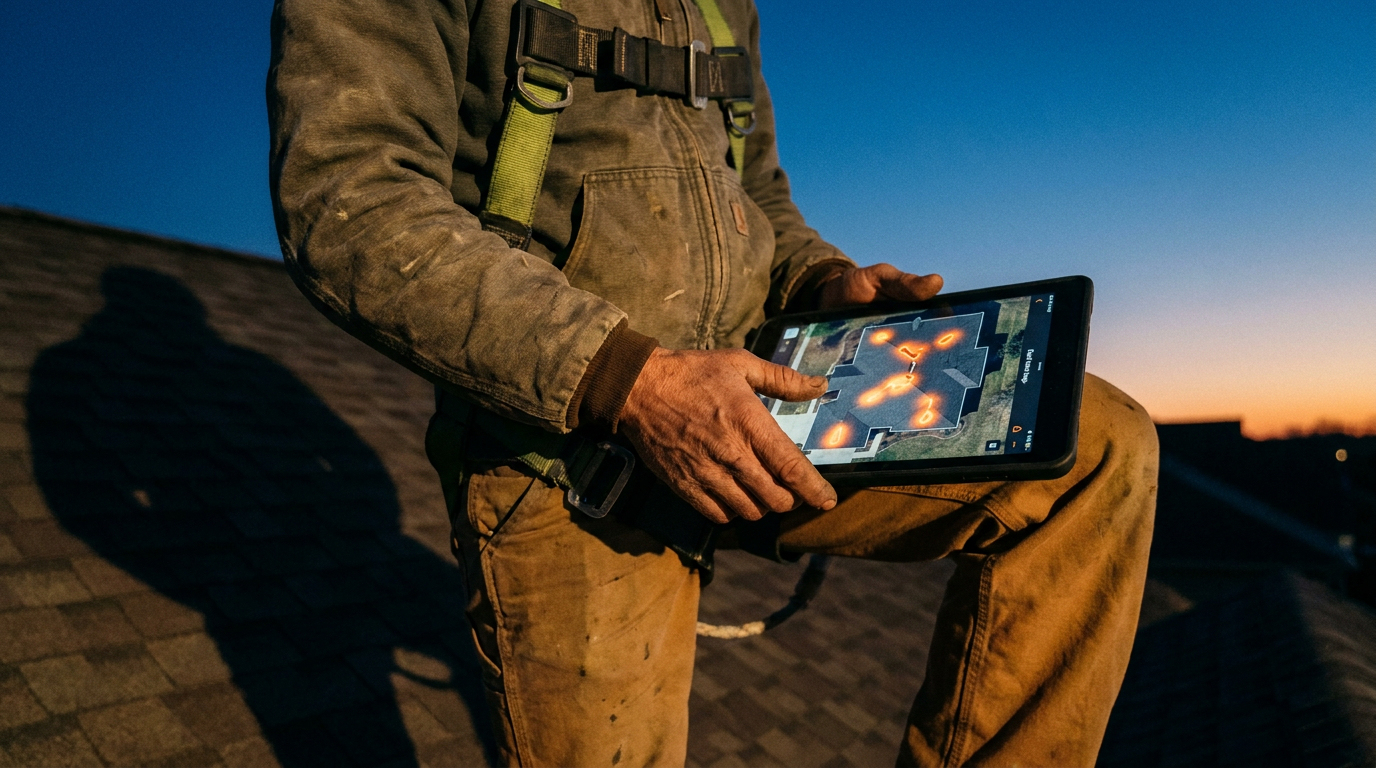
When your drone flies a roof after a storm, the AI scans every single image. It doesn’t get tired and it doesn’t miss a spot. It then generates a report, often overlaying a colored map on the roof diagram, showing exactly where each verified hail hit is located.
Identifying Wind Damage
Wind damage looks completely different, and the AI knows it.
- Lifted Shingles: The most obvious sign is a shingle that has been lifted and is no longer sealed to the one below it. AI can detect the shadows and lines that indicate a break in the seal.
- Creases: Shingles that have been flapped by the wind will have a horizontal crease where the adhesive strip is. The AI is trained to spot these distinct lines.
- Missing Shingles: This is an easy one for both humans and AI. The system will flag any area where the underlayment is exposed.
Because AI can analyze the entire roof surface at once, it can spot patterns that a human might miss. For example, it might identify a clear line of wind damage along a specific ridge that points to a specific wind direction, strengthening your case with an adjuster.
Prompts You Can Use Today
AI isn't just for analyzing photos. You can use language models to improve your customer communication and operations. Try copying and pasting these into your favorite AI chat tool.
Act as a roofing project manager. I'm meeting with a homeowner to explain the results of our AI-powered roof inspection. Write a simple, 3-paragraph script I can use. Explain what the AI does, what it found (mention 15 confirmed hail hits on the south slope and 3 wind-lifted shingles on the west ridge), and what the next steps are for filing an insurance claim. Keep the language simple and reassuring. Avoid technical jargon.
Act as an operations manager for a roofing company. Create a Standard Operating Procedure (SOP) for our crews on using drone and AI software for roof inspections. The SOP should be a numbered list and cover these key stages: 1. Pre-flight checklist (drone batteries, weather, airspace). 2. Flight plan for full roof coverage. 3. Photo quality requirements (no blur, correct overlap). 4. Uploading photos to the AI platform. 5. Reviewing the AI-generated report and adding manual notes. 6. Exporting the final report for the customer and insurance.
The Real-World Payoff for Roofers
This technology sounds great, but what does it actually mean for your business? It comes down to three things: speed, accuracy, and better documentation.
1. Speed Up Your Inspections
A roofer can spend 45 minutes to an hour on a single roof, carefully walking the surface and taking photos. A drone can fly that same roof and capture all the necessary images in about 10-15 minutes. While the photos are uploading to the AI platform, you can be driving to the next job. The analysis that used to take you an hour is done automatically. This means you can run more estimates in a single day.
2. Get Consistent, Accurate Results
Let's be honest. One roofer might count 10 hail hits in a square, while another, more conservative roofer might only count 7. This inconsistency can cause problems. AI removes that human variable. It uses the same criteria every single time, on every single roof. This consistency builds trust with both homeowners and insurance carriers. It provides a single source of truth for your entire team.
3. Dominate the Insurance Game
This is the biggest advantage. An AI-generated report is not just your opinion; it's a detailed, data-backed document. It includes high-resolution photos, precise measurements, and a clear summary of the findings, with each piece of damage individually identified and categorized.
When you submit a claim with this level of evidence, it’s much harder for an adjuster to argue. It streamlines the process, leading to faster approvals and fewer disputes. This is a game-changer for your quoting and estimating workflow. You are no longer just a roofer; you are a data provider.
Is AI the Future of Roofing?
AI is not a replacement for a seasoned roofer. You still need your experience to look at the big picture, to check flashing, to understand the complexities of a roof system, and to build a relationship with the homeowner. Technology can't do that.
But AI is an incredibly powerful jobsite tool that handles the most tedious, time-consuming part of your job. It lets you focus on what you do best: selling the job and building the roof.
By adopting AI for damage detection, you position your company as a modern, tech-forward business. It shows homeowners and insurance companies that you are serious about accuracy and efficiency. In a competitive market, that’s a powerful edge. It's a key part of your marketing strategy that sets you apart from the guys still relying on just a ladder and a piece of chalk.
Frequently asked questions
37 copy-paste prompts that save tradespeople 5+ hours a week. Plus one short email every Friday — no fluff.
More for roofing

AI for Roofing Contractors: The Complete Guide
AI for Roofing Contractors comes down to using AI to do the slow stuff — quoting, paperwork, marketing, and customer follow-up — so you can stay on the too
AI Roof Measurement From a Photo: Apps That Work
AI Roof Measurement From a Photo comes down to using AI to do the slow stuff — quoting, paperwork, marketing, and customer follow-up — so you can stay on t