
Can AI Interpret Refrigerant Pressure Readings? A Guide
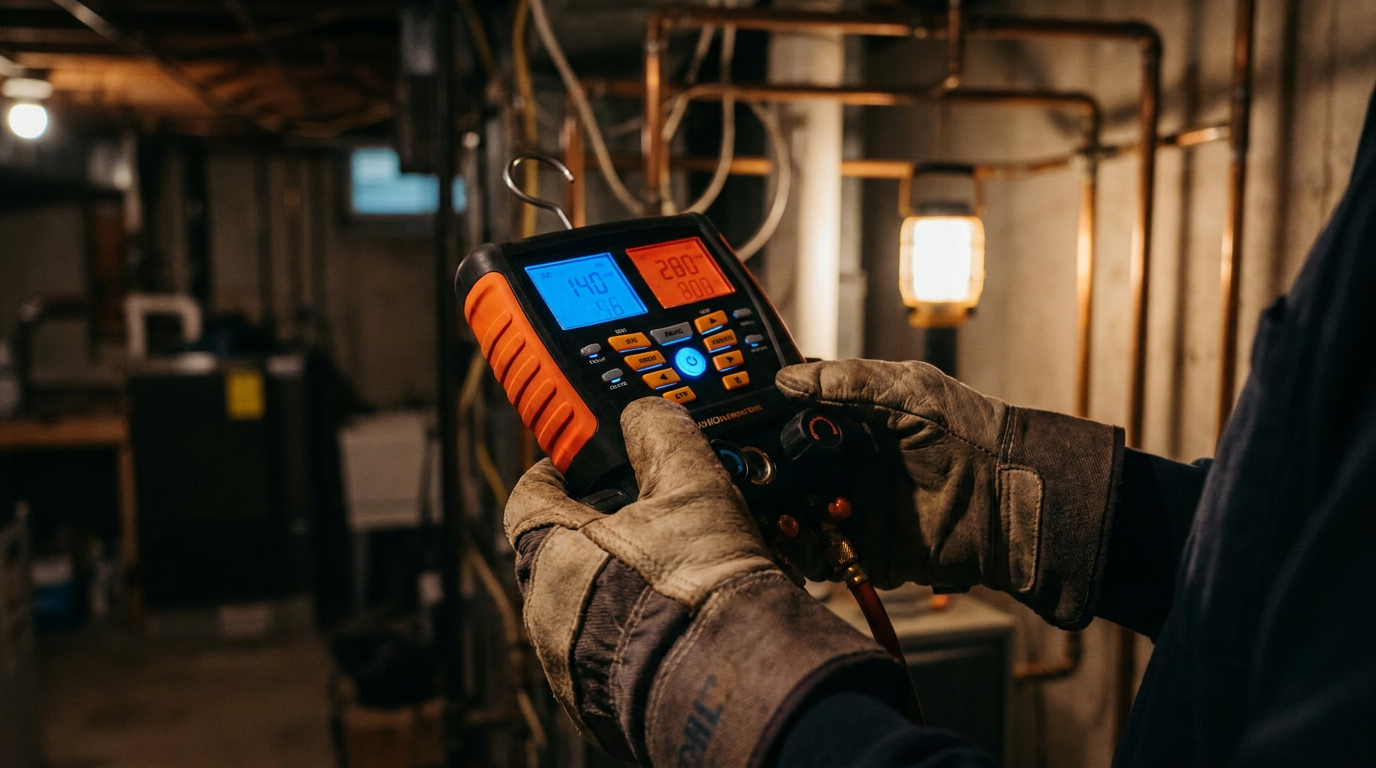
Yes, AI can interpret refrigerant pressure readings. By analyzing pressure and temperature data alongside system specs, AI tools can diagnose issues like overcharging, undercharging, or blockages. This helps techs work faster and more accurately, but it doesn't replace a skilled technician's final judgment on the job.
Can AI Interpret Refrigerant Pressure Readings? A Guide
You've spent years learning to trust your gauges. You know the feel of a system, the sound of a healthy compressor, and what a P/T chart means in the real world. So when someone mentions using AI to read pressures, it's fair to be skeptical. Is a robot really going to tell you how to do your job?
The short answer is no. But it can make you a lot faster.
Think of AI not as a replacement for your brain, but as the smartest apprentice you've ever had. It has a perfect memory, knows every P/T chart ever made, and can do complex calculations in a split second. It's a tool, just like your digital manifold or your recovery machine. It’s here to help you solve the problem and get to the next call.
What AI Actually Does with Your Readings
When we say AI can 'interpret' refrigerant pressures, it's not looking at your analog gauges. It's crunching numbers. You feed it data points, and it analyzes them against a massive database.
Here’s what the AI is looking at:
- Low-Side (Suction) Pressure: The pressure of the refrigerant entering the compressor.
- High-Side (Liquid) Pressure: The pressure of the refrigerant leaving the compressor.
- Suction Line Temperature: The temperature of the refrigerant vapor at the compressor inlet.
- Liquid Line Temperature: The temperature of the liquid refrigerant before the metering device.
- System Information: Refrigerant type (R-410A, R-22, R-32), metering device (TXV or fixed orifice), and equipment data.
- Environmental Conditions: Indoor and outdoor temperatures.
From these numbers, the AI instantly calculates superheat and subcooling. Then, it compares those results to the ideal operating parameters for that specific unit in those specific conditions. It can flag readings that are out of spec and suggest potential causes, like:
- Low charge
- Overcharge
- Airflow restriction (dirty filter or coil)
- Liquid line restriction
- Inefficient compressor
It’s pattern recognition on a huge scale. The AI has seen thousands of similar scenarios and knows what they usually mean.
The Tools Making It Happen
You don't need a special computer science degree to use this stuff. The tools are already on the market, and some are probably in your truck right now.
Smart Digital Manifolds: Brands like Fieldpiece (with its Job Link app) and Testo (with its Smart Probes) are leading the charge. You hook up your probes, and the data streams directly to an app on your phone or tablet. The app's software does the AI analysis in real-time, offering live diagnostics and system health reports. It takes the manual P/T chart lookup and calculations off your plate.
Generative AI Chatbots: This is where it gets interesting. You can use a general-purpose AI like ChatGPT or Google Gemini right from your phone. You don't need special equipment, just your standard gauges and a temperature clamp. You manually input the readings and ask the AI for an analysis. The key is giving it a clear, detailed prompt.
This is a powerful way to get a second opinion or troubleshoot a tricky problem. It can also help you explain a complex issue to a homeowner in simple terms, which can be useful when improving your quoting process.
AI Prompts for Refrigerant Analysis
The quality of the AI's answer depends entirely on the quality of your question. Vague questions get vague answers. Be specific. Here are some prompts you can copy and paste.
I'm working on a residential split system using R-410A with a TXV. Outdoor temp is 85°F, indoor is 75°F. My readings are: Low-side pressure: 120 psig. High-side pressure: 350 psig. Suction line temp: 55°F. Liquid line temp: 95°F. Calculate the superheat and subcooling and list three potential problems based on these readings, from most likely to least likely.
This prompt gives the AI everything it needs: refrigerant type, system type, conditions, and all four key measurements. It asks for specific calculations and a prioritized list of problems.
Explain superheat and subcooling like I'm a new HVAC apprentice. Tell me what high superheat with low subcooling usually means on a fixed orifice system. Give me a simple analogy for how a TXV works to maintain superheat.
AI is a great training tool. Use it to help greenhorns on your team understand core concepts. It can explain things in different ways until the idea clicks.
Where AI Falls Short (For Now)
This technology is powerful, but it has limits. Your experience is still the most important tool in the truck. AI can't replace your senses or your judgment.
- It Has No Senses: An AI can't hear a screaming compressor bearing, see a visually obvious dirty condenser coil, or feel for a hot spot on a clogged filter drier. It only knows the numbers you feed it.
- Garbage In, Garbage Out: If your probes aren't calibrated, your temperature clamp is making poor contact, or you input the wrong refrigerant, the AI's diagnosis will be completely wrong. Your fundamental skills are still the foundation of a good diagnosis.
- Context is King: The AI doesn't know the history of the unit. It doesn't know that the system is 25 years old and has had three previous refrigerant leaks. It doesn't know the homeowner keeps piling boxes in front of the return air grille. That's where you, the professional, connect the dots.
The Verdict: A Tool, Not a Replacement
AI isn't coming for your job. It's a tool to make you better at it.
Using AI to interpret refrigerant readings is like upgrading from a rusty pipe wrench to a powered press tool. It makes you faster, more precise, and more efficient. It lets you focus on the bigger picture—finding the root cause and making the repair—instead of getting bogged down in manual calculations.
Embrace it. Learn how to use it. It’s one more tool that helps you fix the problem right the first time and get on to the next job.
Frequently asked questions
37 copy-paste prompts that save tradespeople 5+ hours a week. Plus one short email every Friday — no fluff.
More for hvac

AI for HVAC Contractors: Everything You Need to Know
AI for HVAC Contractors comes down to using AI to do the slow stuff — quoting, paperwork, marketing, and customer follow-up — so you can stay on the tools.

ChatGPT for HVAC Technicians: 20 Real Use Cases
ChatGPT for HVAC Technicians comes down to using AI to do the slow stuff — quoting, paperwork, marketing, and customer follow-up — so you can stay on the t
AI HVAC Load Calculation: Manual J in Minutes
AI HVAC Load Calculation comes down to using AI to do the slow stuff — quoting, paperwork, marketing, and customer follow-up — so you can stay on the tools