AI Inventory for Your Plumbing Business: Tame Your Shop & Van
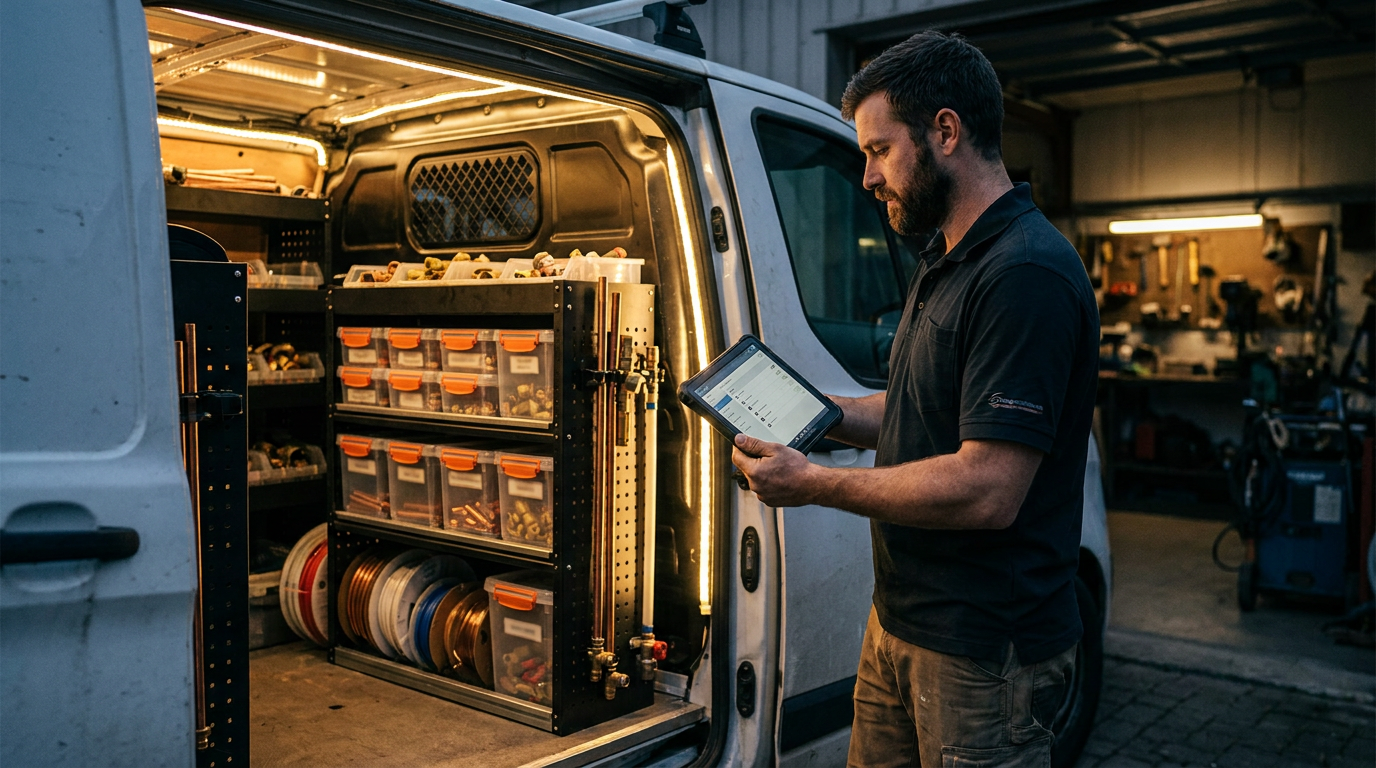
AI inventory management for a plumbing business uses software to automatically track parts in your shop and vans. It predicts what you'll need for upcoming jobs, automates reordering, and reduces trips to the supply house. This saves time, cuts down on lost materials, and makes your business more profitable.
You're Losing Money in That Messy Van
Another run to the supply house. You were sure you had a 3/4-inch sharkbite cap in the van, but it's gone. That's an hour of wasted time, gas money burned, and a schedule that's now thrown off for the rest of the day. The cost of that missing fitting isn't fifty cents; it's a hundred dollars or more in lost labor and opportunity.
Every plumber knows this story. Your shop and van are packed with thousands of dollars in fittings, valves, and parts. But when you need that one specific piece, it's nowhere to be found. Or you have ten of them, buried under a pile of stuff you haven't touched in a year. This isn't just annoying; it's a direct hit to your bottom line.
It’s time to stop guessing and start knowing. AI-powered inventory management is no longer a tool for giant corporations. It's a practical solution that can help any plumbing business, big or small, get control of its stock and stop bleeding cash on lost parts and wasted time.
What is AI Inventory Management, Really?
Let's get one thing straight: this isn't about robots counting your copper fittings. Think of AI as a really smart assistant that lives in your phone or computer. It's software that's designed to do the tedious work for you.
AI inventory management connects to the data you already have—like invoices, job schedules, and quotes—to track what you use, what you have, and what you'll need next. Instead of you manually counting bins, the AI does the math.
Here’s how it works in simple terms:
- It Tracks Usage: When a tech completes a water heater install and bills for two 24-inch flexible water lines, the system automatically subtracts those two lines from your van's inventory.
- It Sees the Future: The AI looks at your schedule. It sees you have three toilet replacements next week. It knows that means you'll probably need three wax rings, three flange repair kits, and three new supply lines. It warns you if you're running low.
- It Learns Your Business: The system gets smarter over time. It learns that your tech, Mike, tends to use more solder than Dave. It learns that jobs in one part of town often require more PEX fittings because the houses are newer. It's custom-fit to how you actually work.
Many Field Service Management (FSM) platforms are already building these tools in. They're not just for scheduling anymore; they're becoming the brain of your entire operation.
The Real Cost of a Disorganized Van
We all know disorganized inventory is a problem, but let's put some real numbers on it. The waste adds up in ways you might not even track.
- Wasted Labor: The average unplanned supply house run can take 60-90 minutes. At a conservative shop rate of $100/hour, that’s $100-150 of non-billable time gone. Do that a few times a week, and you're losing thousands per month.
- Overstocking: Tying up cash in parts you don't need is a huge hidden cost. That $5,000 of extra PEX fittings sitting in your shop could be cash in the bank or invested in a new tool that makes you money.
- Understocking: This is the most obvious cost. You show up to a job, realize you're missing a part, and have to leave. The customer is annoyed, your schedule is wrecked, and your reputation takes a hit.
- Lost and Damaged Parts: Fittings get crushed, fall behind shelves, or just disappear. A box of ProPress fittings isn't cheap. Losing just a few here and there adds up to hundreds or thousands of dollars over a year.
AI inventory management tackles all of these problems by giving you a clear, real-time picture of what you own and where it is.
Act as a professional organizer for a plumbing business. I've taken a picture of a shelf in my work van. Analyze the image, identify all the plumbing fittings and tools you can see, and create a simple list. Then, suggest a bin and label system to organize these items for quick access on a job site.
How AI Gets Your Shop and Van Organized
Putting AI to work on your inventory isn't a massive, expensive project. You can start small and see the benefits right away. The goal is to create a system that works for you, not the other way around.
Here are a few practical ways AI helps.
Automated Tracking
Forget clipboards and spreadsheets. Modern systems use simple tech to track everything. You can use barcode or QR code scanners—just stick a label on a bin, and scan it when you take parts out or put them in. Some newer systems even use image recognition. You can snap a photo of a shelf, and the AI will identify and count the items for you.
Predictive Ordering
This is the game-changer. An AI system can act as your virtual parts manager. It sets minimum and maximum stock levels for every item. When your stock of 1/2-inch copper 90s drops below the minimum, it automatically adds them to a purchase order. You just review and approve. No more emergency runs because someone used the last one and forgot to mention it.
Job-Specific Loadouts
Before a tech leaves for a job, the AI can generate a precise pick list. The job is a kitchen faucet swap? The system tells the tech to grab a basin wrench, a specific faucet model, two new angle stops, and two supply lines. This ensures they have exactly what they need, reduces the clutter in the van, and prevents them from hoarding parts "just in case."
I'm a plumbing business owner. I'm providing you with the text from my last 20 invoices. Please analyze this data and create a table with two columns: 'Part/Material' and 'Quantity Used'. List the top 15 most frequently used parts. This will help me create a baseline for my van's stock.
Getting Started Without Breaking the Bank
You don't need to buy a six-figure software package to start. You can ease into it.
- Start with Your Data: Your best starting point is your own history. Use a simple AI tool (like ChatGPT or a similar program) to analyze your last few months of invoices. Ask it to list your most commonly used parts. This is your new master list for what every van should carry.
- Use Your Existing Software: Check if your current quoting or scheduling software has an inventory module. Many do, and you might just need to activate it. This is the easiest first step because it's already connected to your job data.
- Calculate the ROI: Think about it this way. If a basic inventory system costs $100 a month but saves you just two supply house runs, it has already paid for itself. That doesn't even count the savings from less overstock and fewer lost parts.
- Create Simple SOPs: A tool is only as good as the process around it. Once you have a system, create a simple Standard Operating Procedure (SOP) for your team. This makes sure everyone uses the tool correctly.
Act as an operations manager for a trades business. Write a simple, 5-step Standard Operating Procedure (SOP) for a plumbing technician to follow at the end of each day. The goal is to ensure their van is restocked correctly for the next day's work using an AI-generated parts list.
It's About Time, Not Just Parts
Ultimately, managing your inventory with AI isn't just about counting fittings. It's about buying back your most valuable resource: time.
Less time spent searching for parts means more time on billable work. Less time managing spreadsheets means more time training your team or finding new customers. By letting technology handle the boring, repetitive tasks, you free up yourself and your techs to do the skilled work that actually makes money.
This technology is here now, and it's built for businesses like yours. It's rugged, it's practical, and it delivers a clear return on investment. Stop letting your profits leak out through the floor of a messy van. It's time to get organized.
Frequently asked questions
37 copy-paste prompts that save tradespeople 5+ hours a week. Plus one short email every Friday — no fluff.
More for plumbers

AI for Plumbers: The Practical Field Guide
AI for Plumbers comes down to using AI to do the slow stuff — quoting, paperwork, marketing, and customer follow-up — so you can stay on the tools. Below i

25 ChatGPT Prompts for Your Plumbing Business
25 ChatGPT Prompts for Your Plumbing Business comes down to using AI to do the slow stuff — quoting, paperwork, marketing, and customer follow-up — so you

AI Plumbing Diagnosis Apps: What Actually Works
AI Plumbing Diagnosis Apps comes down to using AI to do the slow stuff — quoting, paperwork, marketing, and customer follow-up — so you can stay on the too