
Can AI Help Assess Boston's Knob and Tube Wiring?
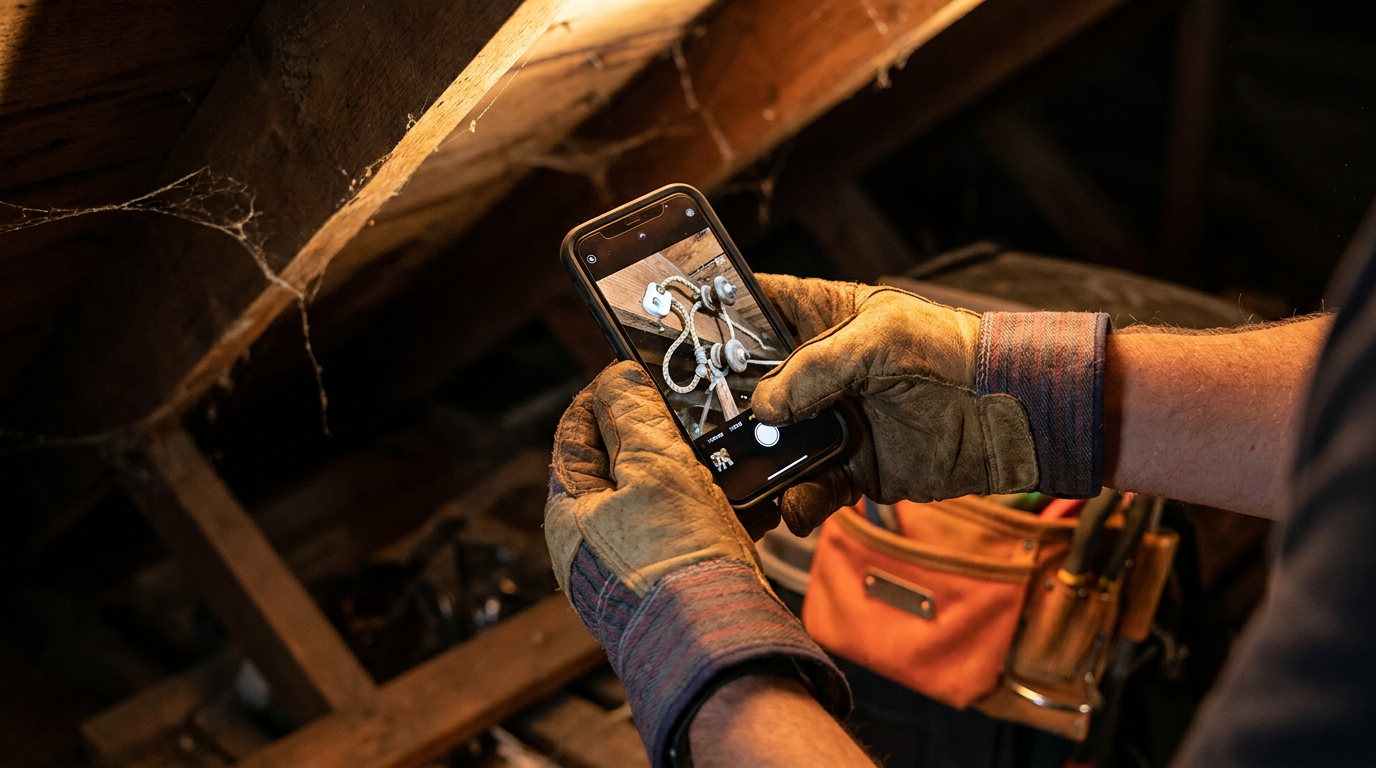
Yes, AI tools can help electricians with knob and tube wiring assessment in Boston, but they don't replace your expertise. AI excels at analyzing photos to spot potential issues like frayed insulation or improper splices, and organizing data from large jobs, making your reports faster and more consistent.
Assessing Old Knob and Tube in Boston: Can AI Help Electricians?
If you're an electrician in Boston, you know knob and tube wiring. It’s in the bones of the city, from the three-deckers in Dorchester to the brownstones in the South End. It's a headache to assess, a risk to work around, and a challenge to quote. The job is tedious and the stakes are high.
For generations, the only tools for the job were a good flashlight, a sharp eye, and years of experience. But now, there’s a new tool in the box: artificial intelligence. We’re not talking about robots pulling wire. We’re talking about smart software on your phone or laptop that can make the inspection and quoting process faster and more accurate.
This isn't corporate fluff. This is about using technology to save time on the paperwork so you can spend more time on the real work. Let's look at how AI can actually help you tackle Boston's oldest wiring systems.
The Old Enemy: Knob and Tube in Boston's Bones
Knob and tube (K&T) was the standard from the 1880s to the 1940s. A lot of Boston's housing stock comes from that era. While the system was solid for its time, it has major drawbacks today:
- No Ground Wire: K&T is a two-wire system. That means no equipment ground, which is a major safety issue for modern appliances.
- Brittle Insulation: The original rubberized cloth insulation becomes dry and brittle over time. It can flake off with the slightest touch, exposing live wire.
- Overloaded Circuits: These systems were designed for a few lights and maybe a radio. They were never meant to handle a modern home's load of computers, microwaves, and big-screen TVs.
- Improper Modifications: Over 100 years, countless homeowners and handymen have tapped into these circuits. You find dangerous splices, connections made with duct tape, and wires buried in insulation—a serious fire hazard.
According to the Massachusetts Association of Realtors, the presence of knob and tube wiring can be a major hurdle in real estate transactions, often requiring a full assessment by a licensed electrician. This is where the pressure comes from. You're not just checking wires; you're impacting a home sale.
Where AI Fits In (And Where It Doesn't)
Let's be clear: AI is not a licensed electrician. It can't test a circuit, verify voltage, or make a final judgment call on safety. Your license and your experience are what matter.
Think of AI as a very smart, very fast assistant. It's a tool for documentation and initial analysis. Its main job is to handle the data so you can focus on the physical inspection.
Here’s what AI is good for:
- Visual Analysis: Analyzing dozens of photos to spot potential issues you might miss after a long day.
- Documentation: Turning your jumbled, voice-to-text notes into a clean, organized report.
- Estimating: Helping you build a preliminary materials list for a rewire quote.
AI doesn’t replace your expertise. It supports it.
Using AI for Visual Inspection and Triage
This is the most powerful use of AI for K&T assessment. You’re already taking pictures for your records. Now, those pictures can work for you.
- Take Clear Photos: During your walkthrough, take high-resolution photos of everything. Get shots of the porcelain knobs and tubes, the wiring in the attic and basement, any visible splices, and the service panel.
- Use an AI Tool: Use a general AI model with image analysis, like ChatGPT-4o or Google's Gemini. Upload your photos.
- Give it a Clear Prompt: Tell the AI exactly what to look for. You are the expert directing the tool.
Here’s a prompt you can copy and paste to get started.
Analyze this image of knob and tube wiring. I am a licensed electrician. Identify and list potential safety hazards based on visual evidence. Focus on insulation condition, wire splices, proximity to other materials like insulation or wood, and signs of modification or damage. Present the findings as a bulleted list.
The AI will scan the image and might point out things like: "Potential fraying on black wire in upper left," or "Unidentified splice wrapped in electrical tape near center joist." This doesn't mean it's right, but it gives you a list of points to double-check in person. It acts as a second set of eyes.
AI for Documentation and Quoting
After the inspection, the paperwork begins. This is where AI can save you hours. Instead of typing up a long report from scratch, you can use AI to structure your findings.
Walk through the site and use a voice recorder app on your phone to dictate notes. Don't worry about making them neat. Just talk.
"Okay, in the attic... K&T looks mostly undisturbed. Insulation is brittle but intact on the main runs. Found one junction box, looks like a homeowner special, modern Romex tied into the K&T with just wire nuts and tape, not in a box. Big fire hazard. Basement run is covered in spray foam insulation on the west wall. Another code violation..."
Once you're back at the truck, you can feed that audio transcript into an AI with a prompt like this:
I'm an electrician assessing a knob and tube system in a Boston home. Take my raw inspection notes below and organize them into a clear, structured report section titled 'Knob and Tube System Assessment.' Categorize findings under 'Insulation Condition,' 'Wire Condition,' 'Improper Modifications,' and 'Immediate Hazards.' Rewrite my notes in professional but plain language.

[Paste your messy audio transcript or notes here]
The AI will turn your rough notes into a professional document you can use for your report. This process makes your quoting faster and more consistent across jobs. It can also help you generate a preliminary materials list, giving you a head start on pricing the replacement job.
The Limits and Risks of Using AI
This technology is powerful, but it's not perfect. You have to be aware of the risks.
- AI Can Be Wrong: It can "hallucinate" or misidentify things. It might mistake a piece of black pipe for a wire or miss a dangerous splice that's partially hidden. Never trust the AI output without verifying it yourself.
- It Doesn't Know Local Code: The AI doesn't know the specific amendments to the National Electrical Code (NEC) used in Boston or the Commonwealth of Massachusetts. For example, it won't know the specific local rules about covering K&T with insulation.
- It's Not a Substitute for Testing: AI can't use a multimeter. It can't check for voltage, test polarity, or confirm grounding. The physical, hands-on part of the job is still 100% on you.
To keep yourself safe and manage the tool effectively, you can even use AI to create a starting point for your own safety protocols.
As an AI assistant for a master electrician, generate a comprehensive safety and assessment checklist for a residential knob and tube wiring inspection in an old home. Include sections for visual inspection, tooling requirements, client communication points, and potential code violations to look for. This is a starting point for my own expert checklist.
Use the output to build your own standard operating procedure. The AI gives you a solid draft, and your expertise refines it into a bulletproof process.
In the end, AI is just another tool on your belt. It’s like upgrading from a manual screwdriver to a power drill. It won’t make the decisions for you, but it can make the work faster, easier, and more organized. For electricians dealing with Boston's century-old wiring, that’s a tool worth having.
Frequently asked questions
37 copy-paste prompts that save tradespeople 5+ hours a week. Plus one short email every Friday — no fluff.
More for electricians
AI for Electricians: A Field-Tested Guide
AI for Electricians comes down to using AI to do the slow stuff — quoting, paperwork, marketing, and customer follow-up — so you can stay on the tools. Bel

27 ChatGPT Prompts for Electricians (Copy & Paste)
27 ChatGPT Prompts for Electricians (Copy & Paste) comes down to using AI to do the slow stuff — quoting, paperwork, marketing, and customer follow-up — so

AI Electrical Load Calculator: How It Works & Free Prompt
AI Electrical Load Calculator comes down to using AI to do the slow stuff — quoting, paperwork, marketing, and customer follow-up — so you can stay on the