
Ditch the Guesswork: AI Lawn Care Material Calculation
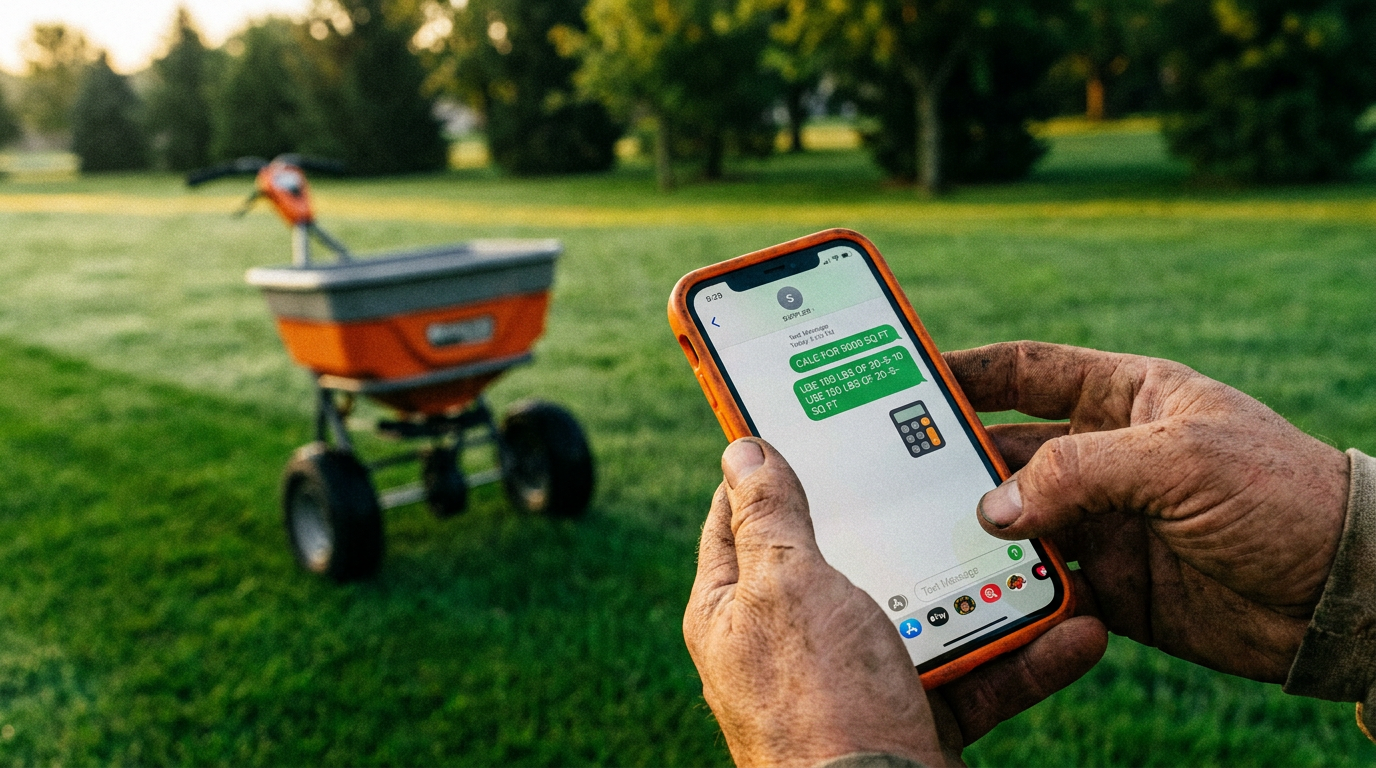
You can use AI for lawn care material calculation by giving it lawn dimensions, soil type, and product specs. AI models like ChatGPT or Google Gemini can then generate precise fertilizer, seed, or pesticide amounts, reducing waste and improving your job profitability. It's about working smarter.
Stop Burning Cash on Guesstimates
Every landscaping pro knows the feeling. You're standing in the aisle at the supply house, looking at 50-pound bags of fertilizer. You think you need ten, but maybe it's nine? Or eleven? You buy ten, get to the job, and come up one bag short. That's another trip back to the store, burning fuel and time you can't bill for. Or you buy eleven, and now you have a half-used bag sitting in the truck, taking up space and losing money.
Guessing on materials is a hidden tax on your business. It eats into your profit margin slowly, one bag of seed or bottle of herbicide at a time. Your old calculator and notepad are fine for simple squares, but jobs are rarely that easy. You have weird-shaped lawns, slopes, and customers with specific demands. It's time to use a tool that's already in your pocket: Artificial Intelligence.
Using AI for lawn care material calculation isn't about futuristic robots. It's about using a smart assistant to do the complex math for you, so you can focus on the real work.
Why Your Old Calculator Is Costing You Money
Let's be blunt. Relying on mental math or a basic calculator for your material estimates is a rookie move. It leaves too much money on the table.
Here’s how guesstimating hurts your bottom line:
- Overbuying: This is the most obvious cost. Extra material sits in your shop or truck, tying up cash. Fertilizer can go bad, and seed can lose its viability. That's pure waste.
- Underbuying: The unplanned trip to the supplier is a killer. An hour round-trip for one bag of seed can turn a profitable job into a break-even one. You're paying your crew to sit while you drive.
- Inconsistent Results: Applying too little fertilizer means the customer won't see the results they paid for, leading to callbacks and a damaged reputation. Applying too much can burn the lawn, creating an even bigger problem.
- Lost Bids: If your material estimates are padded to avoid running short, your bids might be too high. In a competitive market, you could be losing jobs to competitors who have their numbers dialed in. Check out how better numbers can help you start winning more bids.
Your business deserves more precision. AI provides that precision without needing expensive, dedicated software.
How AI Changes the Game for Material Calculation
Think of an AI chatbot like ChatGPT or Google Gemini as a super-powered calculator that understands plain English. You don't need to know formulas. You just need to describe the problem.
Instead of you calculating square footage, then dividing by the coverage rate on the bag, you just give the AI all the information at once. It can process multiple variables instantly.
Here's what you can feed it:
- Lawn Dimensions: Not just length and width. You can describe it: "a rectangular area 50 feet by 80 feet, with a circular flower bed in the middle that has a 10-foot diameter."
- Product Specs: Tell it the N-P-K ratio of your fertilizer (like 24-0-6) and the bag size.
- Application Rates: Give it the target application rate from the product label or your own expertise, like "I need to apply 1 pound of nitrogen per 1,000 square feet."
You can get started with a simple prompt right now.
Act as a professional landscaper. I need to fertilize a lawn that is 6,500 square feet. I am using a 24-0-6 fertilizer that comes in 50-pound bags. The bag says it covers up to 15,000 square feet. My goal is to apply 0.9 pounds of actual nitrogen per 1,000 square feet. How many pounds of fertilizer do I need for the whole lawn, and how many bags should I buy?
The AI will do the math, telling you exactly how much product to use and how many bags to purchase. No more guesswork.
Getting Granular: Beyond Basic Square Footage
This is where AI really shines. Real-world lawns are never perfect rectangles. They have curves, slopes, and obstacles. Your material needs also change based on conditions.
AI can easily handle these complex variables:
- Irregular Shapes: Describe the area using multiple shapes. "The front yard has a 40x60 foot rectangle and a triangular section on the side with a base of 20 feet and a height of 30 feet."
- Exclusions: Tell the AI what not to include. "...but subtract a 12x20 foot driveway and a 10x10 foot patio from the total area."
- Soil and Site Conditions: For more advanced applications, you can add more detail. "This is a new lawn with loamy soil. I'm overseeding with tall fescue. Increase the standard seed application rate by 15% for better establishment."
Trying to calculate this with a notepad would be a headache. With AI, it's just another sentence in your prompt.
I'm creating a seed estimate for a customer. The total property is 1 acre, but the turf area is about 22,000 sq ft. The lawn is mostly Kentucky Bluegrass. I need to overseed it. My seed is a high-quality KBG mix that comes in 25-pound bags. The recommended rate for overseeding is 2-3 pounds per 1,000 sq ft. There is one large bare patch that is roughly 20x20 feet that needs to be treated as a new seeding (4-5 lbs per 1,000 sq ft). Calculate the total seed needed in pounds and tell me how many bags to buy.
Building a System, Not Just a Prompt
Using AI for a one-off calculation is helpful. Integrating it into your daily operations is a game-changer.
- Create a Master Prompt: Don't re-invent the wheel every time. Work with your AI to create a template you can use for every job.
- Save It: Keep this template in a notes app on your phone. When you're on-site measuring a new property, you can pull it up, fill in the blanks, and get your material list before you even get back in the truck.
- Train Your Team: Show your foreman or crew leaders how to use the prompt. It empowers them to make smart decisions and handle those unexpected material runs themselves, freeing you up to work on the business.
This isn't just about saving a few bucks on fertilizer. It's about building a more efficient, professional, and profitable landscaping business. You look smarter to your clients, your bids are more accurate, and your profit margins are protected. Start today, and make every estimate count.
Act as a landscaping operations consultant. Create a reusable markdown template for me to calculate lawn care materials. The template should have clear sections and placeholders for me to fill in for any job. Include sections for:

1.  Total Area Calculation (with space for multiple shapes and subtractions like driveways).
2.  Fertilizer Calculation (with placeholders for N-P-K ratio, bag size, and application rate).
3.  Seed Calculation (with placeholders for seed type, bag size, and separate rates for overseeding vs. new seeding).
4.  Liquid Application (for herbicides/pesticides, with placeholders for mix ratio and sprayer tank size).

Present this as a clean, copy-pasteable template using markdown formatting.
Frequently asked questions
37 copy-paste prompts that save tradespeople 5+ hours a week. Plus one short email every Friday — no fluff.
More for landscaping
AI for Landscaping Business Owners: Real ROI
AI for Landscaping Business Owners comes down to using AI to do the slow stuff — quoting, paperwork, marketing, and customer follow-up — so you can stay on
ChatGPT Prompts for Lawn Care Business (20 Tested)
ChatGPT Prompts for Lawn Care Business (20 Tested) comes down to using AI to do the slow stuff — quoting, paperwork, marketing, and customer follow-up — so