Can AI Hear a Water Leak With Your Phone's Mic?
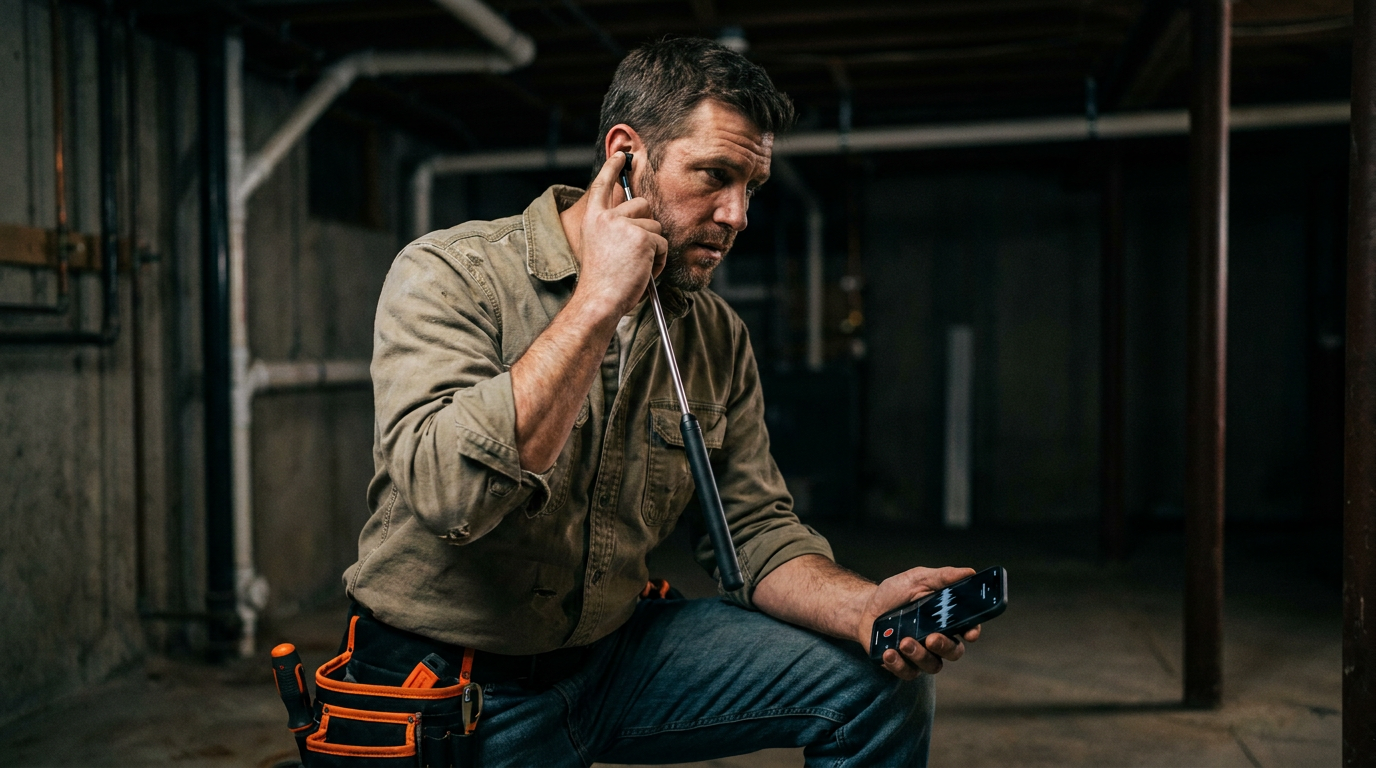
Yes, AI can listen for leaks with a smartphone microphone, but its accuracy is limited. These apps analyze sound frequencies to identify potential drips or hisses. While they can be a helpful first check, they don't replace professional acoustic leak detectors, especially for deep or quiet leaks behind thick walls.
Can Your Phone's Mic Hear a Water Leak? Testing AI Leak Detection Apps
The sound of a hidden water leak is the sound of money dripping away. For your client, it's damage, mold, and a high water bill. For you, it's a puzzle to solve. The faster you find the source, the faster you get paid and move to the next job. For years, that meant using expensive acoustic detectors and a well-trained ear.
Now, a new kind of tool is showing up on app stores. These apps claim your smartphone's microphone and some artificial intelligence can do the job. Just hold your phone against a wall and let the AI tell you if there's a leak.
It sounds great. But does it work? We put these AI leak detection apps to the test to see if they're a real tool for the trade or just a gimmick.
How Pros Hear Leaks: The Old School Way
Before we look at the apps, let's remember how professional leak detection works. It's all about sound and vibration. Water escaping a pressurized pipe creates a distinct sound, often a hiss or a whoosh. The frequency of this sound changes based on the pipe material, the size of the hole, and the water pressure.
Professional gear is built specifically for this task:
- Acoustic Amplifiers: These devices take the faint sound of a leak and make it loud enough for a human ear to hear. They come with headphones that block out job site noise.
- Ground Microphones: These are super-sensitive listening devices placed on the ground, concrete slab, or floor. They can pick up vibrations that your ear would never notice.
- Listening Rods: These metal rods let you touch a pipe, valve, or wall and transfer the vibration directly to the amplifier. They let you pinpoint the sound's origin.
The key here is sensitivity and filtering. Pro equipment is designed to isolate the specific frequency range of water leaks (usually 100 Hz to 4,000 Hz) and filter out background noise like traffic, appliances, or footsteps.
How AI Tries to Do the Same Job
AI leak detection apps try to copy this process using the hardware you already own: your smartphone.
The process is simple on the surface:
- The app uses your phone's built-in microphone to record audio.
- It runs this audio through an AI model.
- This model has been 'trained' on thousands of sound samples, learning to tell the difference between a leak, a running toilet, and a humming refrigerator.
- The app then gives you a reading, often a simple 'Leak Detected' or 'No Leak Found' message, sometimes with a graph showing the sound frequencies.
But your phone has big disadvantages. Its microphone is designed to record human speech, not the low-frequency rumble of a slab leak. It has no built-in noise cancellation for the kinds of sounds found on a job site. The quality of the microphone varies wildly from a cheap Android to a new iPhone.
Putting the Apps to the Test
We downloaded a few popular AI leak detection apps to see how they performed in a few real-world scenarios.
Test 1: The Obvious Leak. We tested on a toilet with a faulty flapper, creating a slow, constant running sound. Every app we tried correctly identified a 'potential leak.' The sound was clear and loud enough for the phone's mic to pick it up easily. No surprise here.
Test 2: The Pinhole Leak. We simulated a pinhole leak in a copper pipe behind a single layer of drywall. The sound was a very faint hiss, barely audible to the human ear. We held the phone directly against the wall where we knew the leak was.
- Result: Mixed. One app reported a high probability of a leak after about 30 seconds of listening. Another app heard nothing. A third gave a 'maybe' result. A professional listening rod would have found this in seconds.
Test 3: Background Noise. We ran the same pinhole leak test, but this time with an HVAC unit running in the next room.
- Result: Complete failure. Every app was thrown off by the low hum of the air handler. They either reported no leak or gave false positives all over the wall, confused by the background noise. This is the biggest weakness. Your phone's mic can't tell the difference between a leak and a washing machine.
This is a good time to remember the value of professional jobsite tools. They are built for the harsh and noisy environment of a real job, not a quiet lab.
Explain to a homeowner, in simple terms, why my professional acoustic leak detector is more reliable than a smartphone app. Focus on microphone sensitivity, frequency range, and noise filtering. Keep it under 100 words and build trust in my professional equipment.
So, Are These Apps Useless for a Pro?
Not entirely. They have a few uses, as long as you understand their limits.
- Client Communication: An app can be a good way to show a client what you're hearing. Recording the sound of a leak and showing them a visual graph on your phone can help them understand the problem.
- First Pass: If you suspect a very obvious leak, an app can give you a quick confirmation before you haul out the heavy gear.
- Training Your Ear: For an apprentice, using an app can be a good way to start learning what different types of leaks sound like. It helps connect the sound to a visual representation.
But these apps are not a replacement for professional equipment and a trained ear. Relying on an app to find a tricky leak is a big risk. A missed leak can lead to thousands of dollars in water damage and a destroyed reputation. According to the Insurance Information Institute, water damage is one of the most common causes of homeowners insurance claims. Getting it right matters.
Good marketing for your business involves showing you use the right tools for the job. Explaining why your professional gear is better than a simple app builds trust and justifies your service fee.
Write a short social media post for my plumbing business. Explain that while technology like phone apps for leak detection is interesting, our professional experience and high-end equipment are what really solve the problem. The goal is to build trust and highlight our expertise.
The Future of AI in Plumbing
This technology will get better. Phone microphones will improve. The AI models will be trained on more diverse data, helping them filter out background noise.
We might see hybrid tools emerge: a professional-grade listening rod that connects to a smartphone app for analysis and reporting. This would combine the best of both worlds—a sensitive, purpose-built sensor with a powerful computer and user-friendly interface.
For now, the verdict is clear. AI leak detection apps are an interesting development and a potentially useful tool for homeowners to run a quick check. But for a professional plumber, they are not ready for prime time.
Your experience, skill, and professional-grade tools are still your most valuable assets. Trust your gear, trust your training, and use your phone for what it's best at: calling the client to tell them the job is done.
Frequently asked questions
37 copy-paste prompts that save tradespeople 5+ hours a week. Plus one short email every Friday — no fluff.
More for plumbers
AI for Plumbers: The Practical Field Guide
AI for Plumbers comes down to using AI to do the slow stuff — quoting, paperwork, marketing, and customer follow-up — so you can stay on the tools. Below i

25 ChatGPT Prompts for Your Plumbing Business
25 ChatGPT Prompts for Your Plumbing Business comes down to using AI to do the slow stuff — quoting, paperwork, marketing, and customer follow-up — so you

AI Plumbing Diagnosis Apps: What Actually Works
AI Plumbing Diagnosis Apps comes down to using AI to do the slow stuff — quoting, paperwork, marketing, and customer follow-up — so you can stay on the too