Can AI Optimize Refrigerant Charging? A Tech's Guide
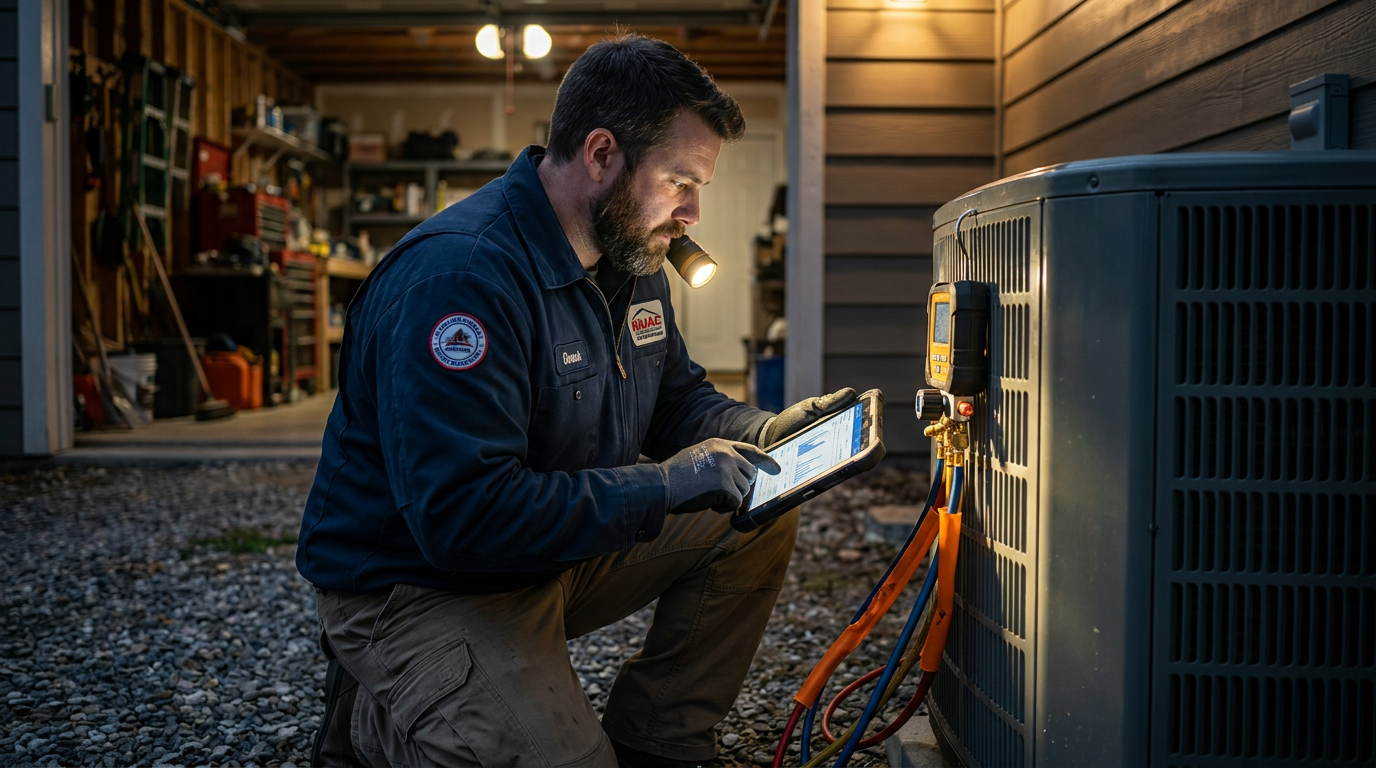
Yes, AI can optimize HVAC refrigerant charging by connecting to smart tools like digital manifolds and probes. It analyzes real-time data—pressures, temperatures, and system specs—to calculate the ideal charge. This helps techs work faster, improve accuracy, reduce energy waste, and prevent costly callbacks from under or overcharged systems.
Getting a perfect refrigerant charge feels more like an art than a science sometimes. You're balancing superheat, subcooling, line set length, and a dozen other variables. A little off, and you're looking at an inefficient system. Way off, and you're looking at a fried compressor and a callback.
For years, we've relied on our gauges, calculators, and experience. But now, AI is showing up on the jobsite. It's not a robot that will take your job. It's a new kind of tool that can help you nail the charge every single time.
The Problem with the Old Way
We all know the drill. Charging by superheat for a fixed orifice system or subcooling for a TXV. It works. But it depends on a lot of things going right.
- Changing Conditions: The outdoor temperature shifts, the sun hits the condenser, or the indoor load changes. All these things can throw off your readings while you're working.
- Human Error: We all have those days. It's easy to misread a gauge, forget a calculation step, or use the wrong PT chart. A small mistake can lead to a big problem down the line.
- Guesswork: How much do you add for a 75-foot line set versus a 50-foot one? We have rules of thumb, but they are still estimates. An ounce or two off might not seem like much, but it impacts efficiency and equipment lifespan.
An incorrect charge is one of the most common issues found in residential HVAC systems, according to studies by the National Institute of Standards and Technology (NIST). It leads to higher energy bills for the customer and more headaches for you.
How AI Enters the Picture
When we say AI, don't picture a sci-fi movie. In HVAC, AI is about processing a ton of data way faster than a human can. It's the brain behind the new generation of smart tools.
Think about your digital manifold and wireless probes. They're constantly gathering data: low-side pressure, high-side pressure, suction line temp, liquid line temp, outdoor air temp, indoor air temp.
An AI-powered app takes all that live data and compares it against a huge database. This database can include:
- Manufacturer specs for thousands of different HVAC models.
- Refrigerant properties under different conditions.
- Ideal performance curves based on engineering data.
Instead of you doing four or five separate calculations, the AI does them all at once, in real time. It sees how all the variables connect. It can tell you, "Based on this exact model and these live conditions, you are 0.5 lbs undercharged." It turns guesswork into a precise science.
AI Tools You Can Use Today
You might already be using AI without calling it that. If you use a modern digital manifold from a brand like Fieldpiece or Testo, their companion apps are the first step into this world.
Apps like Job Link or the testo Smart App guide you through the charging process. You input the equipment type and select the refrigerant. The app then takes the live readings from your probes and tells you exactly what your superheat and subcooling are. Some even go a step further, telling you whether to add or recover refrigerant to hit the target.
This is a basic form of AI. It's an intelligent system that guides your actions based on complex data. It's not just a digital pressure/temperature chart. It's a diagnostic partner.
For commercial techs, this gets even more advanced. Building Management Systems (BMS) have used complex algorithms for years to optimize large-scale HVAC operations. These systems are now getting smarter, using AI to predict maintenance needs and fine-tune performance across entire buildings.
Want to see how you can use AI to think about your own work? Try this prompt with a chatbot.
I am an HVAC technician. I want to develop a simple checklist for using my digital manifold's smart app to charge a residential system with R-410A. The system has a TXV. Create a step-by-step checklist that ensures I don't miss any data inputs and correctly interpret the app's recommendations for achieving the target subcooling. Include steps for pre-verification and post-charge confirmation.
The Future: Truly Smart Charging
What we have now is just the beginning. The next wave of AI in HVAC will be even more powerful.
Imagine this workflow:
- Scan the QR code on the unit. Your app instantly pulls up the exact model, service history, and manufacturer charging specs.
- Place your probes. The app confirms the line set length from the install record.
- The AI analyzes everything. It factors in the current indoor and outdoor temps, humidity, and even pulls weather forecast data to understand how the load will change in the next few hours.
- It gives you a precise target. "Add 10.5 ounces of refrigerant for optimal performance over the next 24 hours."
- It watches you work. As you add refrigerant, it confirms the flow rate and tells you when to stop, preventing overcharging.
This isn't science fiction. The sensors exist. The data exists. Companies are working on connecting these dots right now. This level of precision can save homeowners money and make your work more valuable. It's a great selling point when you're explaining a repair or a tune-up.
Act as a senior HVAC technician explaining the benefits of our new "AI-assisted refrigerant charging service" to a homeowner. Write a short, clear script. Focus on benefits like lower energy bills, longer equipment life, and improved comfort. Avoid technical jargon like "subcooling." Explain it in a simple, confident way that builds trust and justifies the service.
The Catch: It's Still Your Call
This technology is incredible, but it's not a magic bullet. AI is a tool, just like your wrench or your vacuum pump. And like any tool, it's only as good as the person using it.
What if a temperature probe is faulty and giving a bad reading? The AI will take that bad data and give you a bad recommendation. "Garbage in, garbage out" is the number one rule of computing.
Your experience is what tells you if a reading looks wrong. Your eyes and ears can spot a dirty coil or a failing fan motor that the AI might not see. You are, and always will be, the most important diagnostic tool on the job.
AI doesn't replace your skills. It enhances them. It takes the tedious calculations off your plate so you can focus on the bigger picture: solving the customer's problem and making sure the system runs perfectly.
To learn more about other game-changing equipment, check out our section on trade tools.
So, can AI help you get a perfect refrigerant charge? Absolutely. It's the most powerful tool to enter our trade in a generation. You just have to be the one to put it to work.
Frequently asked questions
37 copy-paste prompts that save tradespeople 5+ hours a week. Plus one short email every Friday — no fluff.
More for hvac
AI for HVAC Contractors: Everything You Need to Know
AI for HVAC Contractors comes down to using AI to do the slow stuff — quoting, paperwork, marketing, and customer follow-up — so you can stay on the tools.

ChatGPT for HVAC Technicians: 20 Real Use Cases
ChatGPT for HVAC Technicians comes down to using AI to do the slow stuff — quoting, paperwork, marketing, and customer follow-up — so you can stay on the t
AI HVAC Load Calculation: Manual J in Minutes
AI HVAC Load Calculation comes down to using AI to do the slow stuff — quoting, paperwork, marketing, and customer follow-up — so you can stay on the tools