
Stop Losing Parts: AI for Plumbing Inventory Management
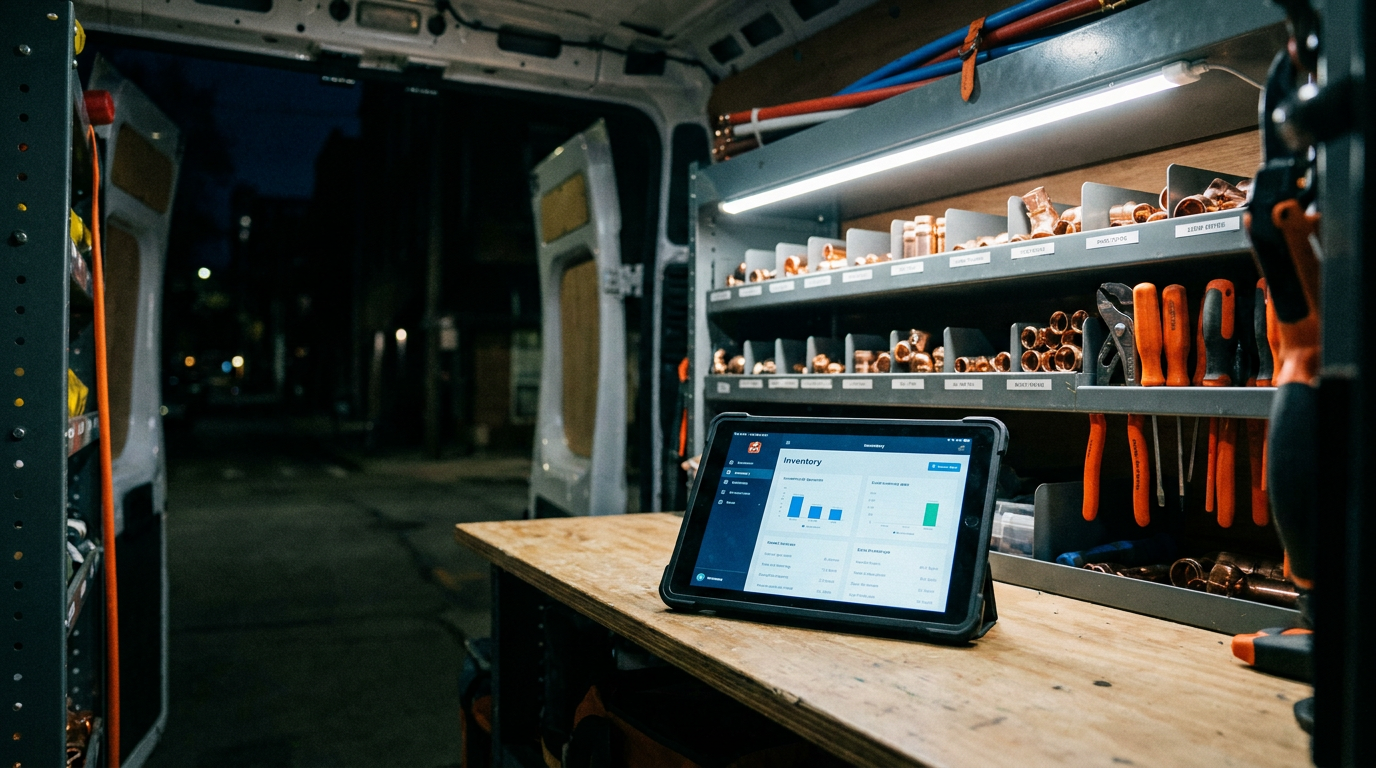
AI for plumbing business inventory management uses software to automate tracking parts in your van and shop. It can predict what you'll need for future jobs based on past work, seasonal trends, and job types. This reduces emergency supply runs, prevents overstocking, and ensures you always have the right fitting on hand.
You're Losing Money on Inventory. Here's the Fix.
Every lost 1/2-inch copper fitting or surprise trip to the supply house is money out of your pocket. You know the drill. A tech is on-site, needs a specific part that should be in the van, but it's not. That's a half-hour drive, lost billable time, and a customer staring at the clock.
For years, we've managed inventory with clipboards, spreadsheets, or just by 'eyeballing it.' It's a system that leaks cash. You either buy too much and tie up money in parts that gather dust, or you buy too little and waste time on constant supply runs.
AI isn't some sci-fi fantasy anymore. It's a real tool that's getting good at solving this exact problem. Think of it as a super-smart assistant who's obsessed with counting your parts so you don't have to be. It's about using tech to stop the bleeding and run a tighter, more profitable business.
The Real Cost of Bad Inventory
'Close enough' doesn't work when you're trying to grow a business. Relying on memory or messy spreadsheets for inventory has real-world costs that add up fast.
- Lost Billable Hours: Every 30-minute run to the supply house is time you're not earning. Do that a few times a week across a few vans, and you're losing thousands of dollars a month.
- Project Delays: Telling a customer you have to come back tomorrow because you don't have the right valve is a bad look. It hurts your reputation and can lead to negative reviews.
- Wasted Fuel and Vehicle Wear: Those 'quick trips' add up. More fuel burned, more miles on the truck, more maintenance. It's a hidden tax on being disorganized.
- Overstocking Costs: Parts aren't free. When you have thousands of dollars in fittings and valves sitting on a shelf for a year, that's dead money. It can't be used for marketing, new tools, or payroll. According to a Wipfli analysis of manufacturing and distribution, carrying costs can be up to 25% of your inventory's value.
- Shrinkage: This is the polite term for lost, misplaced, or stolen parts. Without a solid tracking system, a box of PEX fittings can walk away and you'd never know.
How AI Actually Manages Your Parts
You don't need a computer science degree to get this. AI helps in a few straightforward ways. It sees, it learns, and it acts.
It Sees: Image Recognition
New AI tools can look at a picture and identify objects. You can take a photo of a messy parts bin on your phone, and the AI can give you a list of what's in there. It can identify a 3/4-inch ball valve versus a 1/2-inch gate valve and even give you a rough count. It's not perfect yet, but it's getting shockingly good, and it's faster than dumping the bin out.
It Learns: Predictive Analytics
This is the real game-changer. AI can connect to your job history from your scheduling software or accounting program like QuickBooks. It analyzes the data to find patterns.
- It sees you did 15 water heater replacements last fall.
- It knows each job used specific flex lines, valves, and fittings.
- It predicts you'll do a similar number this fall and tells you to stock up on those parts before you need them.
It gets smarter over time, learning your business's unique rhythm.
It Acts: Automated Reordering
Once the AI knows what you have and what you'll need, it can automate the boring stuff. You set the rules. For example: 'When my stock of 1/2-inch SharkBite couplings drops below 20 in the main shop, add a box of 50 to the next supply house order.' The system builds the shopping list for you. No more forgetting.
Putting AI to Work in Your Van and Shop
Getting started is easier than you think. You don't need to change everything overnight. Start small and prove the concept to yourself.
1. Pick One Van or One Parts Category: Don't try to inventory your entire operation at once. Focus on one service van. Or, focus on your top 20 most-used parts, like common fittings, valves, and wax rings. Get that one area under control first.
2. Use Your Phone for a Quick Count: Use a general AI tool with image capabilities to do a spot-check. It's a great way to see the power of this tech for yourself. Take a clear, well-lit picture of a parts drawer and use a prompt like this.
Act as a master plumber and inventory expert. I've uploaded a photo of a parts bin from my work van. Analyze the image and identify all the plumbing parts you can see. Create a simple table with three columns: Part Name, Size (if you can tell), and Estimated Quantity. Be as specific as possible. If you are unsure, say 'Unidentified Fitting'.
3. Connect Your Job Data: The real power comes from looking at your past work. Export a list of jobs from the last year from your field service software. It should include the job description or a list of parts used. Then, you can use an AI tool to analyze it.
I'm a plumbing business owner trying to create a standard stock list for my service vans. I've pasted a list of job descriptions from the last 6 months below. Analyze this data and identify the top 15 most frequently used parts and materials. Provide a recommended 'par level' (minimum quantity to always have on hand) for each item on a standard service van. Explain your reasoning for each item.

[Paste your job data here as a simple list or table]
4. Build a Smart Tracking System: Use the insights from the AI to build a simple but effective tracking sheet. You don't need fancy software to start. A well-organized spreadsheet is a huge step up from a clipboard. This process helps you build better systems, which frees up time for more important things like improving your quoting process to win bigger jobs.
Create a template for a Google Sheet to track inventory for a small plumbing business. The sheet should be simple and easy to use on a phone. It needs columns for: Item Name, SKU/Part Number, Category (e.g., PEX, Copper, PVC), Location (e.g., Shop, Van 1), Current Quantity, Minimum Stock Level, and a 'Reorder?' column that automatically shows 'YES' if the current quantity is below the minimum.
The goal is to move from guessing to knowing. When you know what you have and where it is, your whole operation runs smoother. Your techs are happier, your customers are happier, and your bank account will show the difference.
Frequently asked questions
37 copy-paste prompts that save tradespeople 5+ hours a week. Plus one short email every Friday — no fluff.
More for plumbers

AI for Plumbers: The Practical Field Guide
AI for Plumbers comes down to using AI to do the slow stuff — quoting, paperwork, marketing, and customer follow-up — so you can stay on the tools. Below i

25 ChatGPT Prompts for Your Plumbing Business
25 ChatGPT Prompts for Your Plumbing Business comes down to using AI to do the slow stuff — quoting, paperwork, marketing, and customer follow-up — so you

AI Plumbing Diagnosis Apps: What Actually Works
AI Plumbing Diagnosis Apps comes down to using AI to do the slow stuff — quoting, paperwork, marketing, and customer follow-up — so you can stay on the too