Dirty Power? AI for Power Quality Troubleshooting
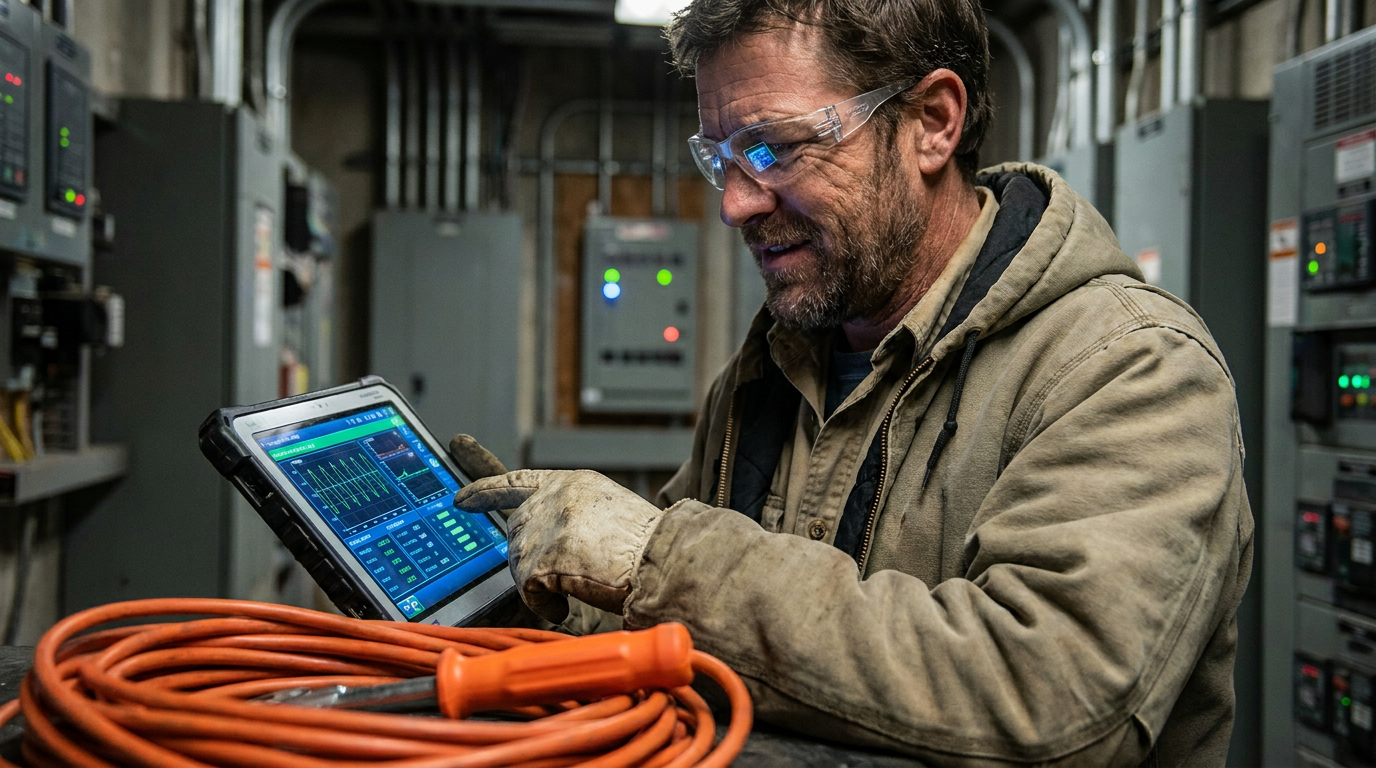
Electricians use AI for power quality analysis troubleshooting by feeding data from power quality analyzers into AI software. The AI quickly identifies complex patterns like harmonics, transients, and voltage sags that are hard to spot manually. This speeds up diagnosis and helps pinpoint the root cause of 'dirty power' issues.
Dirty Power? AI for Power Quality Troubleshooting
Flickering lights. Machines that trip for no reason. Overheating transformers. You know the signs. It’s “dirty power,” and finding the source can feel like a wild goose chase. You hook up a power quality analyzer (PQA), collect days of data, and then spend hours staring at waveforms on a laptop, hoping to spot the problem.
That whole process is slow, tedious, and costs you and your client time and money. But there's a new tool in the belt that's changing the game: Artificial Intelligence.
AI isn't here to take your job. It's here to make you faster and smarter. It acts like a super-powered assistant that can sift through a mountain of data in minutes, not days. Let's get into how it works and how you can use it on the job.
What is "Dirty Power," Anyway?
Before we talk about the fix, let's get on the same page. "Dirty power" isn't a technical term, but every electrician knows what it means. It refers to any problem with the electrical power that prevents a customer's equipment from working right.
Technically, we call these power quality issues. The main culprits are:
- Voltage Sags and Swells: Temporary drops (sags) or increases (swells) in voltage. Think of a big motor starting up and causing the lights to dim for a second.
- Transients (or Spikes): Very fast, very high-energy voltage spikes. They can be caused by lightning, utility switching, or even static discharge. They are killers for sensitive electronics.
- Harmonics: Extra, unwanted frequencies on your electrical lines. They are usually created by modern electronics like variable frequency drives (VFDs), LED lighting, and computer power supplies. Harmonics are a major cause of overheating in neutral wires and transformers.
- Interruptions: A complete loss of power. Can be momentary or long-term.
Finding which one of these is causing the problem, and where it's coming from, is the hard part.
The Old Way: A Mountain of Data
For years, troubleshooting power quality meant using a PQA. You'd connect it to the electrical panel, set your parameters, and let it record for a few days or even weeks. Then came the 'fun' part.
You'd download gigabytes of raw data and open it in some clunky software. You'd scroll through endless charts of voltage and current waveforms, trying to visually correlate an event with a timestamp the customer gave you. "The machine tripped around 2:30 PM on Tuesday."
It works, but it's inefficient. You can miss things. A microsecond transient is easy to overlook. Spotting a complex harmonic pattern requires a deep level of expertise and a lot of patience. This is where AI comes in.
Enter AI: The Smart Assistant for Your PQA
AI, specifically machine learning, is built for one thing: finding patterns in massive amounts of data. It does what the human brain does, but on a scale and at a speed we can't match.
Instead of you manually hunting for clues, you feed the data from your PQA into an AI model. This can be software built into the analyzer itself or a cloud-based platform where you upload the data file. The AI gets to work immediately.
Here’s what it can do:
- Automated Event Classification: The AI automatically identifies and tags events like sags, swells, transients, and high harmonic distortion. No more manual searching.
- Root Cause Analysis: Advanced AI can go a step further. By correlating events across different phases or circuits, it can suggest a probable root cause. For example, it might say, "High 5th-order harmonics detected on Phase C, correlating with the operational schedule of HVAC unit 2. Probable cause: VFD on HVAC 2."
- Predictive alerts: Some systems can even learn a building's normal electrical behavior. When it detects a deviation that could lead to a failure, it can send an alert before the equipment even goes down. This is a huge value-add for improving your business operations and offering service contracts.
This doesn't remove your expertise. It confirms it. The AI provides a data-driven hypothesis, and you use your real-world knowledge to verify it on-site and make the fix.
I've uploaded a CSV file with data from a 3-phase power quality analyzer in a commercial building. The columns are Timestamp, Voltage_A, Voltage_B, Voltage_C, Current_A, Current_B, Current_C, and THD. The client reports flickering lights and overheating transformers. Analyze this data to identify the likely cause, focusing on total harmonic distortion (THD) and specific harmonic orders. Summarize the findings in a bulleted list and suggest the most probable source of the harmonics.
Real-World Scenarios Where AI Shines
Let's make this practical.
Scenario 1: The Haunted Factory Floor A manufacturing client has a CNC machine that randomly faults out, ruining expensive parts. The errors happen a few times a week, with no clear pattern. You hook up a PQA for a week and collect a massive amount of data.
- Old Way: You spend a day sifting through waveforms, maybe find a few small voltage dips, but nothing conclusive.
- AI Way: You upload the data. Within minutes, the AI flags several high-frequency transients, all lasting less than a millisecond. It correlates the timestamps of the transients with the machine fault logs you provided. The AI points to an old arc welder on a nearby circuit being the likely source. You just saved a day of work and found a problem the human eye would likely miss.
Scenario 2: The Flickering Office Lights A newly renovated office building has reports of flickering LED lights. The contractor who installed them is blaming the utility company.
- Old Way: You measure voltage and it seems stable. You might check for loose neutrals, but you're mostly guessing.
- AI Way: You analyze a day's worth of data with an AI tool. It immediately generates a report showing high levels of 3rd and 5th harmonics, especially when most of the office lights are on. The AI explains that the non-linear loads from the new LED drivers are creating harmonic distortion, which is interfering with the power. You can now go to the contractor with a data-backed report and recommend installing harmonic filters.
Based on the following technical findings: 'AI analysis identified significant 5th and 7th order harmonics, with Total Harmonic Distortion (THD) peaking at 12% on Phase B during business hours, correlating with the operation of variable frequency drives (VFDs) on the HVAC system.' — Draft a simple, one-paragraph explanation for a non-technical building manager. Explain what harmonics are, how they are causing their problems, and recommend the next step (installing a harmonic filter).
Getting Started with AI for Power Quality
You don't need a computer science degree to use these tools. The industry is making it easier for tradespeople to get started.
- AI-Enabled PQAs: High-end analyzers from brands like Fluke, Dranetz, and AEMC are starting to include on-device or cloud-based AI features. They are designed to be used by electricians in the field.
- Cloud-Based Platforms: Some companies offer software-as-a-service (SaaS) where you can upload data from any compatible PQA and use their AI for analysis. This can be a more affordable way to get started.
- General AI Assistants: For simpler tasks like writing reports or explaining concepts, you can use general large language models (LLMs) like the ones that power ChatGPT or Claude. You can paste in your findings and ask it to write a client-friendly summary.
The key is to start small. Use it to help you write a report. Then, try it on your next power quality job to see if it can speed up your analysis.
I am an electrician specializing in commercial and industrial power quality. Create a comparison table of three leading power quality analyzers that have built-in AI or cloud-based AI analysis features. Compare them on key features like automated event classification, root cause analysis suggestions, reporting capabilities, ease of use for field technicians, and approximate price range. Include models from manufacturers like Fluke, Dranetz, and AEMC.
Your job is safe. Your expertise, your ability to walk a site, understand the systems, and safely make a repair, can't be replaced by software. But the parts of your job that involve staring at a screen for hours on end? AI is ready to take that over. Embrace it as a tool that gets you to the solution faster, making you more valuable to your customers.
Frequently asked questions
37 copy-paste prompts that save tradespeople 5+ hours a week. Plus one short email every Friday — no fluff.
More for electricians
AI for Electricians: A Field-Tested Guide
AI for Electricians comes down to using AI to do the slow stuff — quoting, paperwork, marketing, and customer follow-up — so you can stay on the tools. Bel
27 ChatGPT Prompts for Electricians (Copy & Paste)
27 ChatGPT Prompts for Electricians (Copy & Paste) comes down to using AI to do the slow stuff — quoting, paperwork, marketing, and customer follow-up — so

AI Electrical Load Calculator: How It Works & Free Prompt
AI Electrical Load Calculator comes down to using AI to do the slow stuff — quoting, paperwork, marketing, and customer follow-up — so you can stay on the