
Can AI Recommend a Heat Pump From Energy Data?
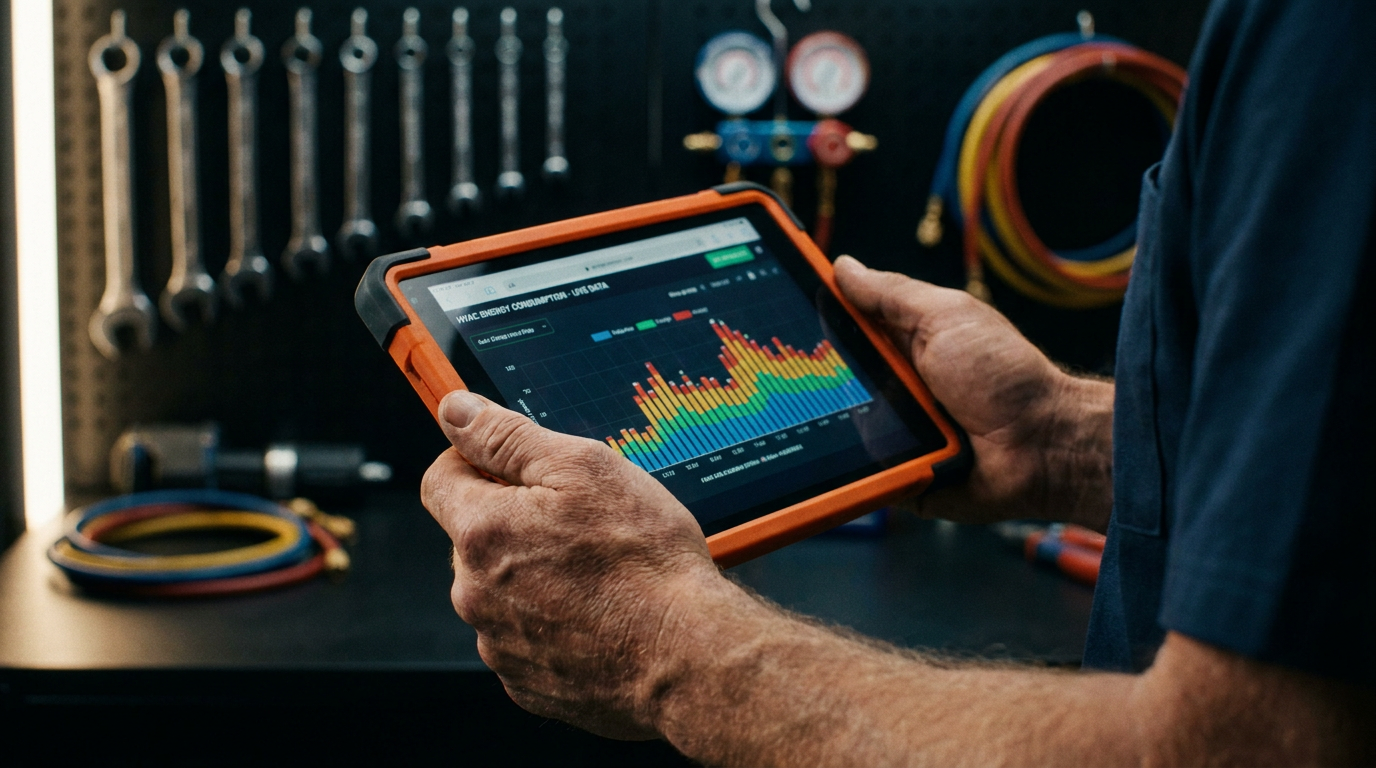
Yes, AI can recommend a heat pump based on a customer's energy data. By analyzing past electricity or gas bills, AI can estimate a home's heating and cooling load. This helps you size the unit correctly, predict savings, and build a stronger sales pitch for the upgrade.
Can AI Pick a Heat Pump Using Energy Bills?
You've done hundreds of Manual J calculations. You know how to size a system based on a home's square footage, windows, and insulation. But what if you could get even smarter? What if you could use a customer's past energy bills to double-check your work and build a rock-solid sales case?
That's where AI comes in. It's not about replacing your expertise. It's about adding a powerful new tool to your kit that uses real data to make your recommendations undeniable.
The Old Way vs. The Smart Way
The traditional way of sizing an HVAC system is solid. A proper Manual J calculation is still the industry standard, and for good reason. It accounts for the physical characteristics of the house—the building envelope, R-values, window efficiency, and local climate data.
But it has blind spots. It doesn't always capture how a specific family lives in their home. Do they keep the thermostat at 65 or 75? Do they have extra people living there? These things show up on a utility bill.
AI bridges that gap. By analyzing 12 to 24 months of energy bills, an AI can build a profile of the home's actual energy consumption. It can see the real-world heating and cooling load, not just the theoretical one. This doesn't replace your Manual J; it validates it. It gives you a second opinion, backed by the customer's own data.
How AI Uses Energy Data
It sounds complex, but the process is straightforward. You feed the AI the customer's energy usage data, usually in kilowatt-hours (kWh) for electricity or therms for natural gas, for each month over a year or two.
Here's what the AI does with it:
- Identifies the Baseline: The AI finds the months with the lowest energy use, typically in the spring or fall. This represents the home's baseload—energy used for things other than heating or cooling, like lights, appliances, and water heating.
- Calculates Heating/Cooling Load: It subtracts the baseload from the total usage in winter and summer months. What's left is a very good estimate of the energy used purely for heating and cooling.
- Correlates with Weather Data: The AI can pull historical weather data for the customer's zip code. It matches up the high-usage months with the coldest and hottest days from that period. This helps it understand how the house responds to extreme temperatures.
- Builds a Performance Model: With this information, the AI creates a simple model of the home's thermal performance. It can then use this model to predict how much energy a new, more efficient heat pump would use to achieve the same level of comfort.
This gives you a powerful number: a data-backed estimate of potential savings. It moves the conversation from "this will save you money" to "this will save you an estimated $75 per month, based on your own past usage."
Putting AI to Work: Prompts You Can Use
You don't need a PhD in data science to do this. Modern AI tools are built for plain English. Here are a couple of prompts you can adapt and use with a tool like ChatGPT or Claude.
Act as an HVAC system sizing expert. I will provide a customer's monthly energy usage in kWh for the last 12 months, along with their zip code.

Your task is to:
1.  Estimate the home's annual heating and cooling energy consumption by separating it from the baseload electricity usage.
2.  Using the zip code, find the historical heating degree days (HDD) and cooling degree days (CDD) for that period.
3.  Based on this analysis, recommend an appropriately sized heat pump in tons (e.g., 2-ton, 3-ton). Assume a standard SEER2 rating of 15 for your calculation.
4.  Explain your reasoning in simple terms I can share with the homeowner.

Zip Code: [Enter Zip Code]
Energy Data (kWh):
Jan: [kWh]
Feb: [kWh]
Mar: [kWh]
Apr: [kWh]
May: [kWh]
Jun: [kWh]
Jul: [kWh]
Aug: [kWh]
Sep: [kWh]
Oct: [kWh]
Nov: [kWh]
Dec: [kWh]
This next prompt helps you frame the value proposition for the customer.
Act as an HVAC sales consultant. I have analyzed a customer's energy bills and recommended a new 3-ton, 18 SEER2 heat pump to replace their old 10 SEER AC unit and gas furnace.

The AI analysis predicts an annual saving of $850.

Draft a short, clear paragraph for a sales proposal that explains the benefits. Focus on the data-driven recommendation, the projected savings, and the improved comfort and home value. Use a confident but not pushy tone. Avoid technical jargon.
Beyond Sizing: Using AI for the Sale
This data-driven approach is more than just a technical exercise. It's a powerful sales and quoting tool.
- Builds Trust: When you show a customer a chart of their own energy use and then overlay a projection of their future savings, you're not just a salesperson anymore. You're a trusted advisor. You're using their own data to help them make a smart decision.
- Creates Custom Projections: You can easily model "good, better, best" scenarios. Show them the savings from a 15 SEER2 unit versus an 18 SEER2 unit. The numbers become concrete and personal.
- Handles Objections: When a customer balks at the upfront cost, you can circle back to the data. "I understand it's a big investment. But based on your current bills, this unit is projected to pay for itself in about six years. After that, the savings go directly into your pocket."
The Limits: Where AI Falls Short
AI is a hammer, not a whole toolbox. It's powerful, but you're the one who needs to know when and how to swing it. Keep these limitations in mind:
- Garbage In, Garbage Out: The analysis is only as good as the data you provide. If the customer can only find three months of bills, the AI's projection won't be very accurate. Aim for at least 12 consecutive months.
- It Can't See the House: The AI doesn't know if the customer just added a new sunroom, replaced their old drafty windows, or has giant, uninsulated holes in their ductwork. Your on-site inspection and professional judgment are still essential.
- It's a Guide, Not a Law: The AI might recommend a 2.8-ton unit. You know they come in 2.5-ton or 3-ton sizes. Your job is to take the AI's precise recommendation and apply your real-world knowledge to make the right final choice.
Ultimately, using AI to analyze energy bills is about making you a smarter, more effective HVAC pro. It lets you combine your hard-won field experience with the power of data. It helps you deliver better results for your customers and, in turn, build a stronger business.
Frequently asked questions
37 copy-paste prompts that save tradespeople 5+ hours a week. Plus one short email every Friday — no fluff.
More for hvac

AI for HVAC Contractors: Everything You Need to Know
AI for HVAC Contractors comes down to using AI to do the slow stuff — quoting, paperwork, marketing, and customer follow-up — so you can stay on the tools.

ChatGPT for HVAC Technicians: 20 Real Use Cases
ChatGPT for HVAC Technicians comes down to using AI to do the slow stuff — quoting, paperwork, marketing, and customer follow-up — so you can stay on the t
AI HVAC Load Calculation: Manual J in Minutes
AI HVAC Load Calculation comes down to using AI to do the slow stuff — quoting, paperwork, marketing, and customer follow-up — so you can stay on the tools