AI for Repiping Cost Estimation: A Plumber's Guide
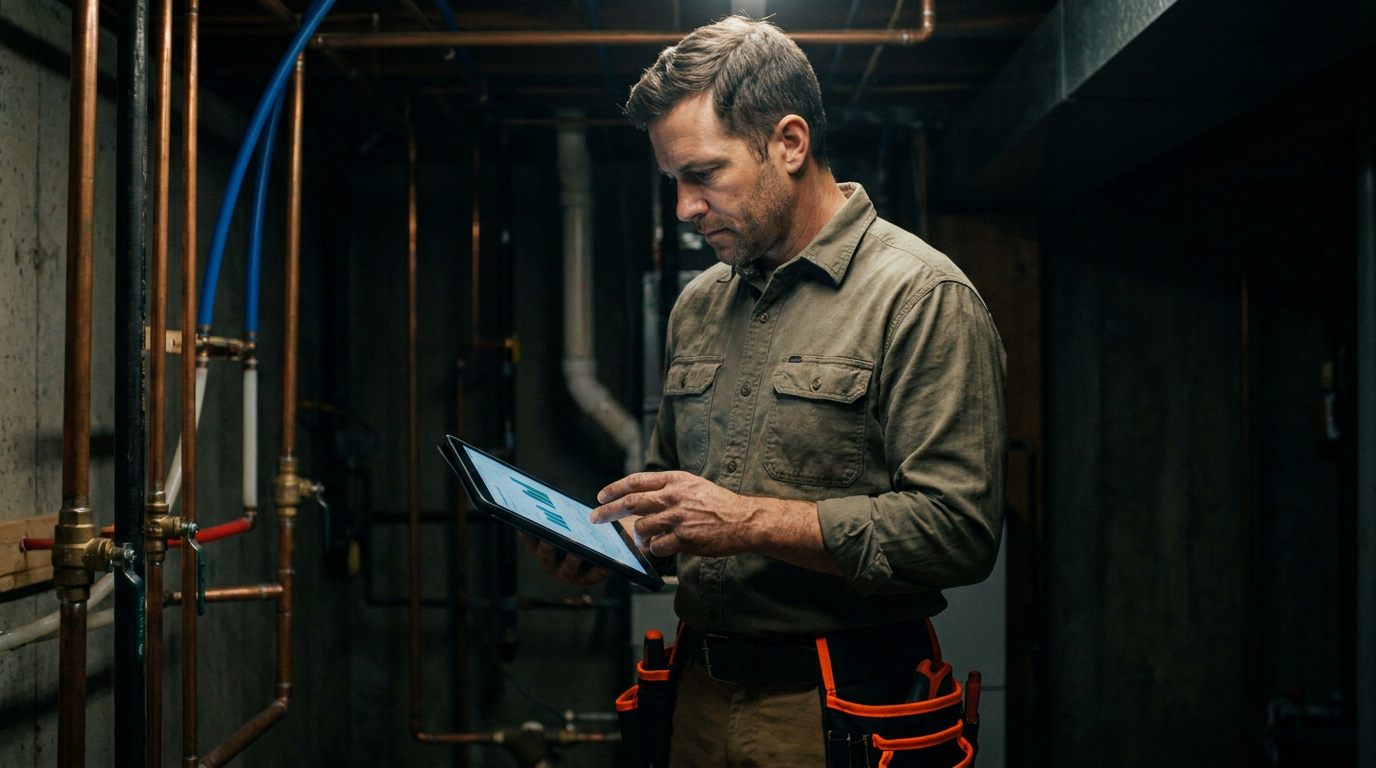
AI for repiping cost estimation works by analyzing job details you provide, like square footage, material types, and fixture count. It then references vast datasets of pricing and labor hours to generate a detailed estimate. This saves time and improves the accuracy of your bids for complex projects.
AI for Repiping Cost Estimation: A Plumber's Guide
Estimating a whole-house repipe is a beast. You’re balancing material costs that change daily, labor hours for unpredictable wall openings, and the customer’s budget. It’s easy to spend hours on a bid you might not even win. Get it wrong, and you either lose the job or lose your shirt.
Artificial intelligence, or AI, is changing this. It’s not about robots taking over your job. It's about having a super-smart assistant on your team. AI can process huge amounts of information in seconds, helping you build faster, more accurate, and more professional-looking bids. Think of it as a power tool for your office work.
This guide will show you how to use AI for repiping cost estimation. We'll cover what information to give it, how to ask for what you need, and where it fits in your workflow. No fluff, just practical steps.
Why AI is a Game-Changer for Repipe Bids
If you're still using a notebook and a calculator, you're leaving money on the table. AI offers a better way to handle the quoting process. It gives you an edge by improving several key areas.
- Speed: An experienced plumber can estimate a repipe, but it takes time. An AI can generate a detailed draft in minutes. This frees you up to bid on more jobs or spend more time on the tools.
- Accuracy: AI models are trained on massive amounts of data. They can calculate material needs and labor estimates based on thousands of similar projects. This reduces the chance of a costly mistake, like forgetting to factor in drywall repair or permit fees.
- Consistency: Every bid you produce with AI follows the same professional format. This builds trust with customers. It also makes it easier to track your bids and understand your win/loss rate.
- Data-Driven Decisions: AI can help you analyze different scenarios quickly. What's the cost difference between PEX-A and copper? How does adding a bathroom affect the price? AI can answer these questions instantly, helping you upsell and provide options to your customer.
Getting Started: What You Need to Feed the AI
AI is smart, but it's not a mind reader. The quality of your estimate depends entirely on the quality of the information you provide. Garbage in, garbage out. Before you start, gather the key details of the job. Treat the AI like a new apprentice you need to give clear instructions to.
Here’s a checklist of what to have ready:
- Property Details: Square footage, number of stories, year built.
- Layout and Access: Is it a concrete slab, a crawlspace, or an unfinished basement? Easy access saves time and money.
- Material Choices: Specify the type of pipe. PEX-A, PEX-B, copper (Type L or M), or CPVC. Be specific.
- Fixture Count: List every single water fixture. Sinks, toilets, showers, tubs, outdoor hose bibbs, laundry hookups, water heater.
- Scope of Work: Are you just replacing supply lines? What about drain lines or the main water service line?
- Finishing Work: Will you be responsible for drywall patching, texturing, and painting? This is a common point of conflict, so define it clearly.
- Your Numbers: The AI doesn't know your business. You need to provide your company's hourly labor rate, your material markup percentage, and any standard overhead costs.
Prompting for Profits: How to Talk to the AI
A 'prompt' is just the instruction you give to an AI. Being clear and detailed is the key to getting a useful result. Start with a simple request and then build on it for more detail.
Here’s a basic prompt to get a ballpark estimate:
Act as a senior plumbing estimator. Create a ballpark cost estimate for a whole-house repipe with the following details:
- House: 2,200 sq ft, 2-story, built in 1985
- Foundation: Crawlspace
- Fixtures: 2.5 bathrooms (2 full, 1 half), 1 kitchen sink, 1 dishwasher, 1 laundry room, 2 outdoor hose bibbs
- Material: PEX-A
- Scope: Replace all hot and cold water supply lines. Exclude drain lines.
- My labor rate is $125/hour.
- Provide a total estimated cost.
That gives you a starting point. Now, let's ask for a more detailed, professional bid that you could refine for a customer.
Based on the previous information, create a detailed line-item bid for the whole-house repipe. The bid should be suitable for a customer. Break it down into these sections:
1.  **Materials:** List major components like PEX-A tubing, fittings, valves, and fixture stops. Provide an estimated total material cost assuming a 30% markup.
2.  **Labor:** Estimate the total hours required and calculate the total labor cost based on a $125/hour rate.
3.  **Permits & Fees:** Include a placeholder for local permit costs.
4.  **Contingency:** Add a 10% contingency fund for unforeseen issues.
5.  **Total Project Cost:** Sum all sections for a final price.
Beyond the Numbers: Using AI for the Whole Proposal
AI's usefulness doesn't stop at the price. You can use it to build out the entire proposal, making your business look more professional. Once you have the cost breakdown, you can ask the AI to help with other parts of the sales process.
Use it to write a clear scope of work document. Ask it to generate a list of questions to ask the homeowner during your site visit. You can even have it write a follow-up email after you've sent the quote. This is all part of a solid system to build better quotes and win more jobs.
For example, try this prompt after you've generated your estimate:
Write a clear 'Scope of Work' section for my customer proposal. Use the previous repipe details. Explain what is included (e.g., replacing all supply lines, installing new shutoff valves) and what is excluded (e.g., drywall repair, drain line replacement). Write in simple, direct language a homeowner can understand.
The Reality Check: AI Isn't Magic
AI is a powerful tool, but it has limits. It can't walk the job site. It doesn't know about the weird framing someone did 40 years ago or the hidden mold behind the shower wall.
- Always Do a Site Visit: An AI estimate is a draft, not a final bid. You must put your own eyes on the project to verify access, check for existing problems, and build a relationship with the customer.
- Verify Material Costs: AI pricing data is a good starting point, but it's not tied to your local supply house's live inventory. Always double-check current material prices before finalizing a bid.
- You Are the Expert: The AI's output is a suggestion. Your experience is what makes the bid accurate. If the AI's labor estimate seems too low, trust your gut. Adjust the numbers based on your real-world knowledge. AI provides the data; you provide the wisdom.
Think of AI as the best apprentice you've ever had. It does the grunt work fast, but it still needs your supervision and final approval. Use it to eliminate the tedious parts of estimating so you can focus on what you do best: solving problems and delivering high-quality plumbing work.
Frequently asked questions
37 copy-paste prompts that save tradespeople 5+ hours a week. Plus one short email every Friday — no fluff.
More for plumbers
AI for Plumbers: The Practical Field Guide
AI for Plumbers comes down to using AI to do the slow stuff — quoting, paperwork, marketing, and customer follow-up — so you can stay on the tools. Below i

25 ChatGPT Prompts for Your Plumbing Business
25 ChatGPT Prompts for Your Plumbing Business comes down to using AI to do the slow stuff — quoting, paperwork, marketing, and customer follow-up — so you

AI Plumbing Diagnosis Apps: What Actually Works
AI Plumbing Diagnosis Apps comes down to using AI to do the slow stuff — quoting, paperwork, marketing, and customer follow-up — so you can stay on the too