Can AI Review a Subcontractor Agreement for Red Flags?
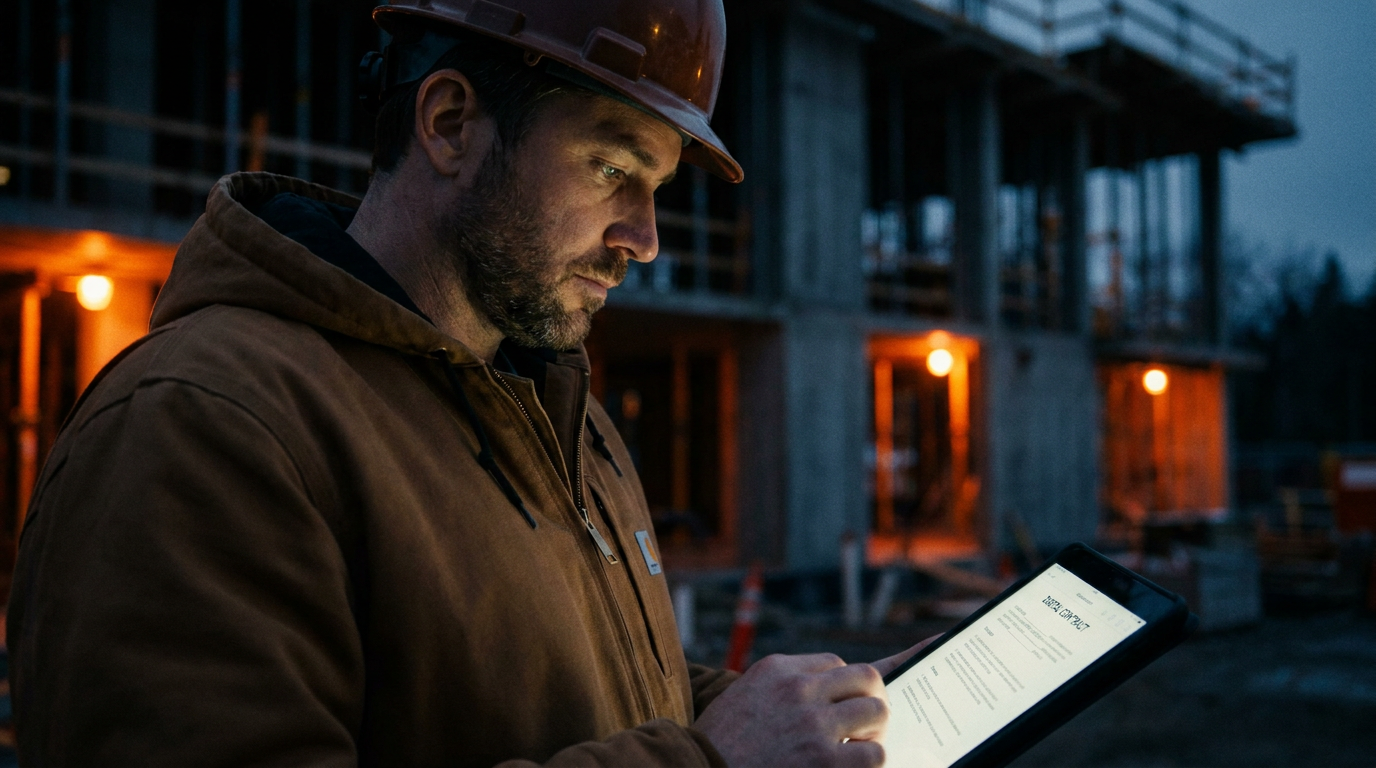
Yes, AI can review a subcontractor agreement for red flags. By uploading the document to a large language model, you can ask it to identify risky clauses, unfair payment terms, and vague scope of work definitions. While not a substitute for legal advice, AI offers a fast, first-pass analysis.
Can AI Spot Problems in a Subcontractor's Contract?
Contracts are a necessary evil. Nobody gets into construction because they love reading 30 pages of legal jargon. But a bad subcontractor agreement can sink a project, ruin a relationship, and cost you thousands. You either spend hours reading it yourself or pay a lawyer a few hundred bucks an hour to do it.
Now there's a third option. Artificial intelligence is a new tool in your belt that can give you a fast, cheap, first-pass review of any contract. It won't replace your lawyer, but it can flag the big stuff so you know where to focus your attention.
Think of it as a super-smart assistant who can read a document in seconds and tell you, 'Hey, you should probably look closer at this section.' For a busy general contractor, that's a game-changer.
What AI Can (and Can't) Do
It's important to have the right expectations. AI is a powerful tool, but it's not magic. It's a machine that's been trained on a massive amount of text from the internet, including millions of contracts and legal discussions.
Here's what AI is good at:
- Spotting Patterns: AI can quickly find common but risky clauses like 'pay-if-paid' or broad indemnification language. It's seen them thousands of times before.
- Summarizing Jargon: It can take a dense, confusing paragraph and translate it into plain English you can actually understand.
- Answering Specific Questions: You can ask it, 'Does this contract mention liquidated damages?' and it will find the exact clause in seconds.
- Comparing Documents: It can check a sub's proposed agreement against your own master contract and highlight the differences.
Here's what AI is NOT good at:
- Giving Legal Advice: An AI is not a lawyer. It cannot tell you if a clause is legally enforceable in your specific state. It provides information, not legal counsel.
- Understanding Your Business: It doesn't know the specific context of your project, your relationship with the sub, or your risk tolerance.
- Guaranteeing Accuracy: It can sometimes make mistakes or 'hallucinate' information. You must always double-check its findings in the actual document.
Treat AI like a sharp apprentice. It does the legwork, flags potential issues, and saves you time. But you, the GC, make the final call.
Red Flags AI Can Help You Spot
A subcontractor agreement is all about risk. The goal is to make sure the risk is divided fairly. AI is great at finding clauses where the sub is trying to push too much risk onto you. Feed your contract into an AI and ask it to look for these common red flags:
- 'Pay-if-Paid' Clauses: This is a big one. It means you only have to pay your sub if you get paid by the owner. A 'pay-when-paid' clause is better, as it means you'll pay the sub in a reasonable time after you get paid. AI can spot this language instantly.
- Broad Indemnification: This means the sub wants you to be responsible for any and all problems, even those they cause. A fair contract limits indemnification to each party's own negligence. AI can flag phrases like 'indemnify and hold harmless from any and all claims.'
- Vague Scope of Work: If the scope of work is not crystal clear, you're asking for disputes and change orders. AI can review the scope section and flag areas that seem ambiguous or incomplete.
- No Change Order Process: The contract must clearly state how change orders are proposed, approved, and paid for. If this process is missing or unclear, you're headed for trouble. AI can confirm if a process is defined.
- Unreasonable Insurance Requirements: The sub's insurance and bonding requirements should match the risk of their work. If they're asking you to carry an unusually high policy, it's a red flag. AI can extract the insurance requirements so you can review them easily.
- Termination for Convenience: This clause allows the sub to walk off the job for almost any reason, leaving you in a bind. It’s a major risk for a GC. An AI can scan the document for any mention of 'termination for convenience.'
How to Use AI for Contract Review
Getting started is simple. You don't need to be a tech wizard. All you need is a digital copy of your contract and access to an AI tool.
- Pick Your Tool: Tools like ChatGPT (the paid version, GPT-4, is better), Google's Gemini, or Anthropic's Claude work well. Business or 'Team' plans often have better data privacy policies.
- Get Your Contract Ready: You need the contract in a text format. If it's a PDF, just copy and paste the text into the AI chat window. For long documents, you may need to paste it in sections.
- Use a Clear Prompt: The key to getting a good result is asking a good question. Don't just say 'review this.' Be specific. Tell the AI who you are (a GC) and what you're worried about.
Here is a great starting prompt. Just copy and paste it into your AI tool, then paste your contract text below it.
Act as an experienced paralegal who specializes in construction law for general contractors. I am a GC reviewing a subcontractor agreement before I sign it. Read the following contract text and provide a summary of potential red flags for me, the GC. Focus on identifying clauses related to:

1.  Payment terms (especially 'pay-if-paid' vs 'pay-when-paid').
2.  Indemnification and liability (who is responsible for what).
3.  Scope of work clarity.
4.  Change order process.
5.  Insurance and bond requirements.
6.  Termination clauses.

For each red flag, explain the risk to me in simple terms. Do not give legal advice.
This single prompt can give you a powerful overview in less than a minute. It tells the AI its role, your role, and exactly what to search for. It's the first step you should take before diving into the hiring and onboarding process.
Getting More Specific
After a general review, you can dig deeper into specific areas. For example, maybe the payment terms look a little funny. You can use a follow-up prompt to get more detail.
Based on the contract I already provided, extract all clauses related to payment, invoicing, and retainage. Summarize them in a simple list. Then, do the same for all clauses related to indemnification, hold harmless, and duty to defend. Explain what 'duty to defend' means for me, the GC, in this context.
This kind of detailed analysis used to take hours of careful reading. Now, it takes seconds. You can create prompts to compare a sub's contract to your own standard agreement, or even ask the AI to rewrite a one-sided clause to be more fair and balanced.
The Human Element: AI is a Tool, Not a Replacement
Let's be clear: this process does not replace a good lawyer. For a multi-million dollar project or a complex, high-risk scope of work, you absolutely need professional legal review. No question.
But for the everyday MSA, the straightforward $50,000 plumbing contract, or a quick review of a supplier agreement, AI is an incredible new tool. It helps you do your due diligence faster and smarter.
It also doesn't replace your gut. You know the business, and you know your subs. If a contract feels off, or if a great sub has a weird clause in their standard agreement, use the AI's output as a starting point for a conversation. A good partner will be willing to talk through the terms and find a fair solution.
Using AI for contract review is about working smarter, not harder. It lets you focus your time and energy on building things, not getting buried in paperwork.
Frequently asked questions
37 copy-paste prompts that save tradespeople 5+ hours a week. Plus one short email every Friday — no fluff.
More for general contractors
AI for General Contractors: A Builder's Playbook
AI for General Contractors comes down to using AI to do the slow stuff — quoting, paperwork, marketing, and customer follow-up — so you can stay on the too
How to Use AI for Construction Project Management
How to Use AI for Construction Project Management comes down to using AI to do the slow stuff — quoting, paperwork, marketing, and customer follow-up — so