
AI Tools for New England Heat Pump Installation
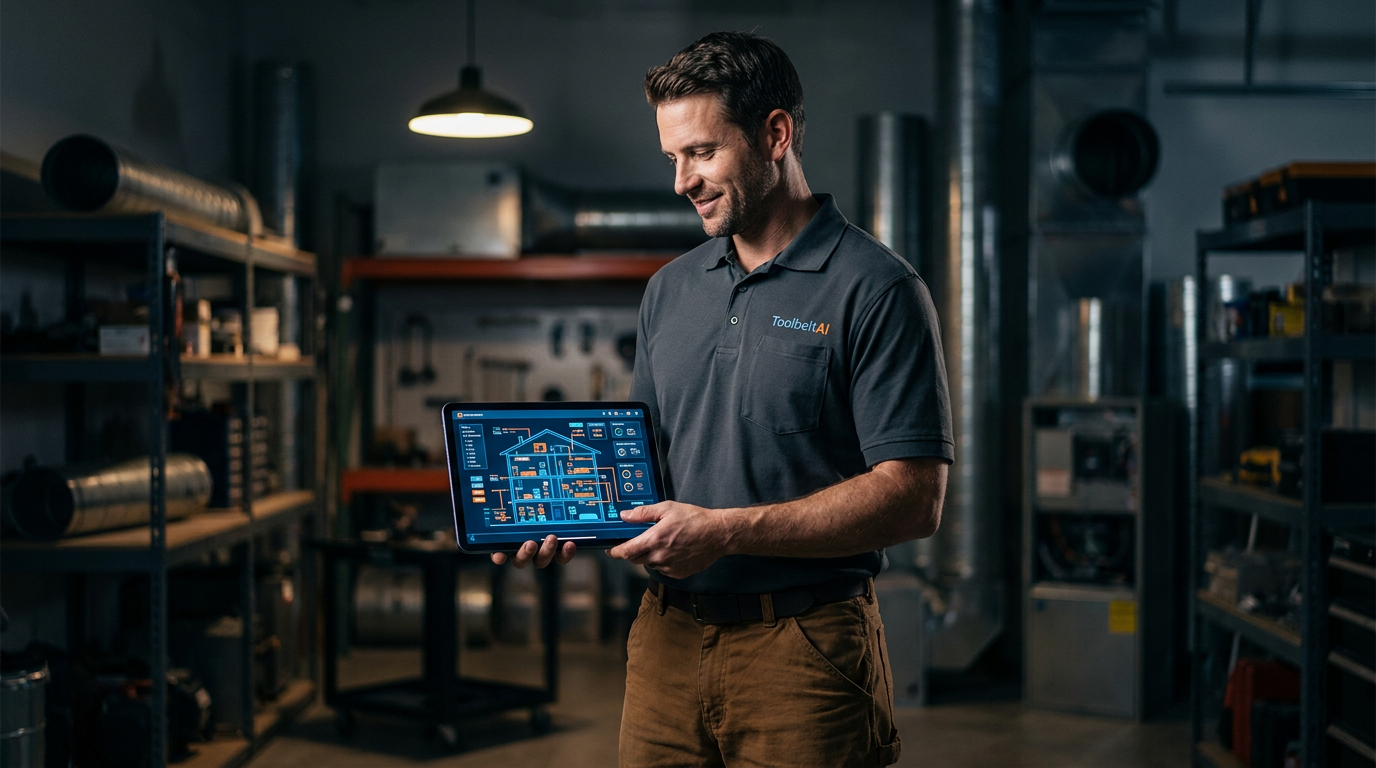
AI tools for cold climate heat pump installation in New England help techs by automating complex Manual J load calculations and system sizing. These tools analyze home specs, local climate data, and equipment performance curves to recommend the right-sized unit, ensuring efficiency and comfort even in sub-zero temperatures.
Selling Heat Pumps in the Snow
Selling a heat pump in New England can feel like selling ice in winter. Homeowners are tough. They've heard stories about systems that can't keep up when the temperature plummets in January. They're worried about sky-high electric bills. And if you size a unit wrong, you're the one getting the angry call when it's five below zero in Bangor.
For years, we've relied on experience and rule-of-thumb calculations. Maybe you'd run a full Manual J, but that takes time you don't always have on a busy sales call. This is where the game is changing. Artificial intelligence isn't just a buzzword anymore. It's a real tool in the truck that helps you size jobs faster, pick the right equipment, and prove to skeptical customers that a modern heat pump is the right call, even in the coldest corners of Vermont or New Hampshire.
Why Old Rules Don't Work for New England Homes
The classic "500 square feet per ton" rule is a recipe for disaster in our region. A 1910 farmhouse in the Berkshires with drafty windows and little insulation has a completely different heating need than a new 2020 build in a Boston suburb.
Our challenges are unique:
- Old Housing Stock: Lots of our jobs are in homes with horsehair plaster, stone foundations, and decades of uncoordinated renovations.
- Extreme Temperature Swings: We need systems that work efficiently at 45°F but can also deliver serious heat at -5°F.
- Moisture and Humidity: Sizing for heating is one thing, but you also need proper dehumidification in our humid summers without short-cycling the unit.
A full Manual J calculation is the professional standard, but it's complex and time-consuming. It requires dozens of inputs and careful calculations. While it's the most accurate method, it can slow down your sales process. AI offers a middle ground: the accuracy of a detailed calculation with the speed you need to close a deal.
How AI Masters Load Calculations
Think of AI as a super-powered calculator that has already studied every building science manual. When you feed it the right information, it can run a highly detailed load calculation in seconds, not hours. Instead of just using square footage, AI tools can process all the critical variables at once:
- Local weather data for a specific town
- U-values of windows and doors
- R-values of walls, ceilings, and floors
- Air infiltration rates (you can estimate or use blower door test results)
- Home orientation and window solar gain
- Internal heat gains from people and appliances
This lets you model a home's heating needs with incredible precision. You can show a customer exactly how much heat their home will lose on the coldest expected night of the year and prove the unit you're proposing can handle it.
Act as an HVAC design engineer specializing in cold climates. Perform a simplified heating load calculation for a single room in Burlington, Vermont, based on these specs:

- Room: Living Room
- Dimensions: 20' long x 15' wide x 8' high ceiling
- Exterior Walls: Two (20' wall and 15' wall)
- Insulation: R-13 in walls, R-38 in ceiling
- Windows: Three 3'x5' double-pane windows on the 20' wall
- Design Temperature: -5°F outside, 70°F inside

Calculate the estimated heat loss in BTU/hr for this room. Show your basic calculations for walls, ceiling, and windows. Ignore air infiltration for this simplified request.
Picking the Right Unit for a Polar Vortex
Not all heat pumps are created equal. A standard model that works great in North Carolina will fall flat on its face when a nor'easter hits. Cold-climate models, like Mitsubishi's Hyper-Heat or Fujitsu's Halcyon XLTH series, are designed to maintain high capacity at low temperatures. But how do you prove it?
This is where AI shines. You can use an AI assistant with data analysis capabilities to read and interpret manufacturer spec sheets. Feed it the PDFs for two or three different models, and you can ask it to compare their heating output and Coefficient of Performance (COP) at a specific temperature, like 5°F.
This gives you hard data to back up your recommendation. It's no longer just your opinion; it's a factual comparison that justifies the higher cost of a premium cold-climate unit. This data makes your quotes more accurate and builds trust.
I've uploaded two PDF spec sheets for cold-climate heat pumps: 'Model_A_Specs.pdf' and 'Model_B_Specs.pdf'. Analyze both documents. Create a simple table comparing the following for both models:

1.  Maximum heating capacity (BTU/hr) at 47°F.
2.  Heating capacity (BTU/hr) at 5°F.
3.  Heating capacity (BTU/hr) at -13°F.
4.  Coefficient of Performance (COP) at 5°F.

Present the data clearly so I can show it to a customer.
Use AI to Educate and Close the Deal
Your expertise is what closes the sale, but AI can be your best sales assistant. Once you have the right size and the right model, you need to explain it to the homeowner in simple terms. They don't care about COP or BTUs. They want to know: "Will I be warm?" and "How much will it cost me?"
Use AI to translate your technical findings into a simple, reassuring summary for the customer. You can generate paragraphs that explain why a certain size is needed, how it will perform during a cold snap, and what their estimated energy savings might be compared to their old oil furnace.
This builds confidence and overcomes the biggest hurdle in our market: fear. When you can back up your pitch with clear data and simple explanations, you move from being a salesperson to a trusted advisor. That's how you win the best jobs.
Write a simple, one-paragraph explanation for a homeowner in Nashua, New Hampshire. Explain why the heat pump I'm recommending, which seems larger than they expected, is the correct size for their 1980s-era home. Focus on the importance of having enough power during the coldest winter nights and how this ensures their comfort without relying on expensive backup heat.
AI isn't here to take your job. It's a tool, just like your manifold gauges or your vacuum pump. It's here to make your job faster, your numbers sharper, and your sales pitch stronger. By embracing these tools, you can install systems that work, build a reputation for quality, and confidently sell heat pumps, even in the dead of a New England winter.
Frequently asked questions
37 copy-paste prompts that save tradespeople 5+ hours a week. Plus one short email every Friday — no fluff.
More for hvac

AI for HVAC Contractors: Everything You Need to Know
AI for HVAC Contractors comes down to using AI to do the slow stuff — quoting, paperwork, marketing, and customer follow-up — so you can stay on the tools.

ChatGPT for HVAC Technicians: 20 Real Use Cases
ChatGPT for HVAC Technicians comes down to using AI to do the slow stuff — quoting, paperwork, marketing, and customer follow-up — so you can stay on the t
AI HVAC Load Calculation: Manual J in Minutes
AI HVAC Load Calculation comes down to using AI to do the slow stuff — quoting, paperwork, marketing, and customer follow-up — so you can stay on the tools