
AI for Truck & Warehouse Inventory: Stop Running Out of Parts
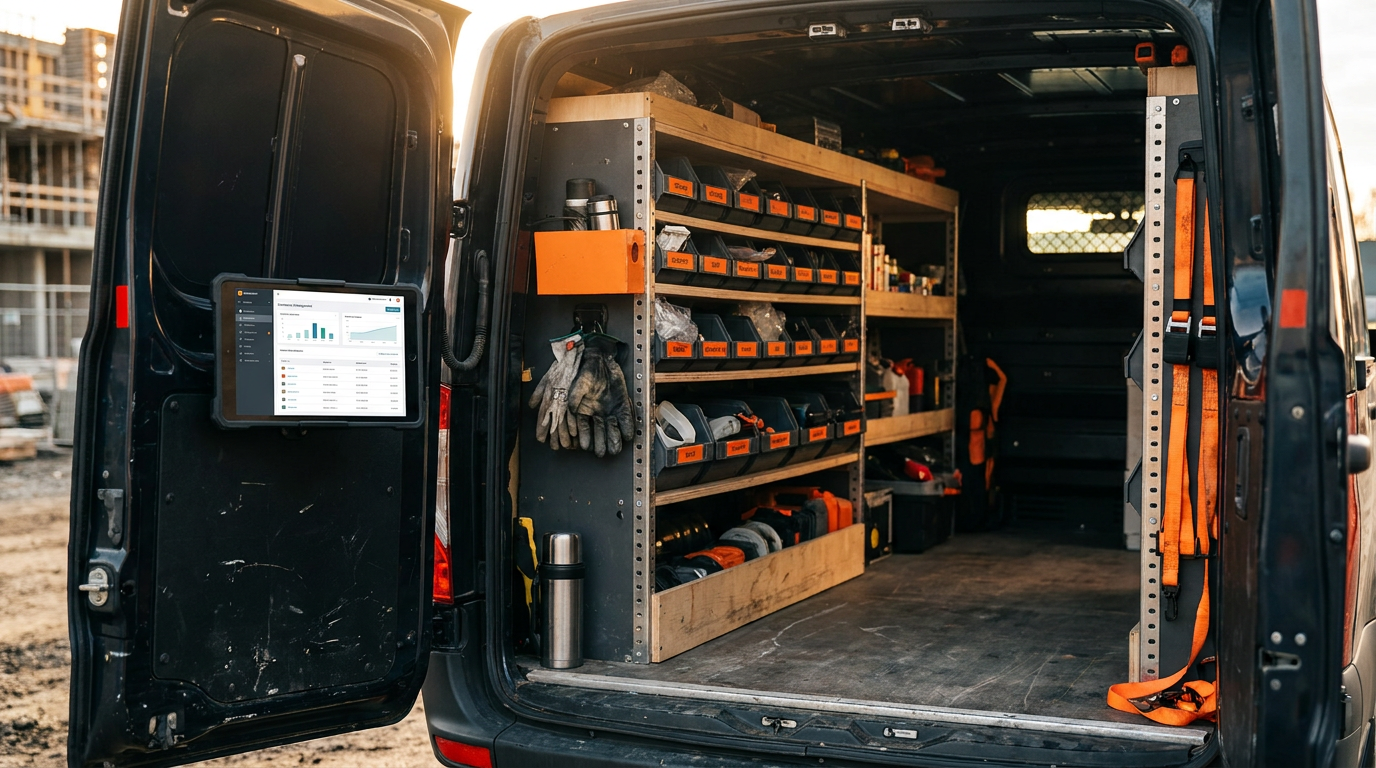
AI for truck stock and warehouse inventory management uses data to predict what parts you'll need and when. It analyzes past jobs, seasonality, and even local trends to automate reordering. This means fewer emergency supply runs, less cash tied up in slow-moving stock, and more profitable jobs.
Never Run Out of Parts Again: Your Guide to AI for Truck and Warehouse Inventory
It’s the story every contractor knows. You’re on a job, close to finishing, and you reach for that one specific fitting, capacitor, or bracket. It’s not there. The part you were sure was on the truck is missing. Now the job grinds to a halt. You have to make a choice: send your tech on an hour-long supply run or push the job to tomorrow. Either way, you’re losing money and disappointing a customer.
This isn't a sign of a bad crew. It's a sign of an outdated system. Relying on memory or messy spreadsheets to manage hundreds of parts across multiple trucks and a warehouse is a recipe for failure. The good news is, there’s a better way. Artificial intelligence (AI) is no longer just for tech giants. It’s a practical tool that can solve your inventory problem for good.
What is AI Inventory Management, Really?
Forget about robots taking over your warehouse. Think of AI as a super-smart assistant who has memorized every job you’ve ever done. AI for truck stock and warehouse inventory management is all about using data to make smarter predictions.
Instead of just counting what you have, AI systems look at your history:
- Past Jobs: What parts did you use on similar jobs last year?
- Seasonality: Do you use more HVAC capacitors in July? More de-icing cables in November?
- Technician Habits: Does one plumber seem to use a specific type of valve more than others?
- Job Location: Are jobs in a certain neighborhood more likely to require older, hard-to-find parts?
By analyzing these patterns, AI can predict what you’ll need before you even know you need it. It can tell you which parts are moving fast and which are just collecting dust. This is called predictive analytics, and it’s the key to running a leaner, more profitable operation.
The Real-World Payoff: Less Hassle, More Cash
Switching to an AI-powered system isn't about adding complexity. It's about removing the headaches that cost you time and money. Here’s what you gain:
- Fewer Stockouts: AI anticipates demand, so your trucks are stocked for the jobs they’re actually going to. This means more first-visit completions and happier customers.
- Reduced Carrying Costs: Every part sitting on a shelf is cash you can't use. AI helps you stock only what you need, freeing up capital for things like new tools or marketing.
- Less Waste: For trades that use materials with expiration dates, like sealants or chemicals, AI can ensure you use older stock first, cutting down on expired product.
- Smarter Purchasing: The system can identify your most-used items and recommend buying them in bulk for better pricing. It can also flag parts that are rarely used, so you stop wasting money on them.
- Better Ops: When inventory is handled, you and your team can focus on the bigger picture, like smarter scheduling and improving job quality.
Getting Started: It's Easier Than You Think
You don't need a degree from MIT to make this work. You can start implementing AI principles today with a few straightforward steps.
Get Your Data in Order: AI needs data to learn. If your records are on paper invoices in a shoebox, you need to digitize. Most modern job management or accounting software already tracks the parts used on each job. This is your gold mine. Your goal is to have a clean, simple list of what parts were used, on what job, and when.
Choose Your Weapon: You have options, from simple to complex.
- Inventory Management Software: Many field service management (FSM) platforms now have AI-powered inventory modules. These are often the easiest to adopt since they tie directly into your job scheduling and invoicing.
- Standalone AI Platforms: Companies like Sortly, Cin7, and Netstock offer powerful tools that can integrate with your existing software.
- Use Your Own AI Assistant: You can even use large language models like ChatGPT to analyze your data. By exporting your parts usage into a spreadsheet, you can ask an AI to find patterns for you.
Run a Pilot Program: Don't try to change everything overnight. Start small. Pick one truck or one category of parts (like HVAC filters). Track it closely for a month or two using your new system. When your team sees how it makes their lives easier, they'll be on board for a company-wide rollout.
Prompts to Put AI to Work Today
If you have your parts data in a spreadsheet, you can use these prompts with an AI assistant like Claude or ChatGPT to get instant insights. Just copy, paste, and replace the placeholder text.
Role: You are a data analyst for a contracting business.

Task: Analyze the attached CSV file of parts usage for the last 12 months. The columns are 'Date', 'Part_Number', 'Part_Description', 'Quantity_Used', 'Job_Type'.

Based on this data, provide the following:
1. A list of the top 10 most-used parts by quantity.
2. Any seasonal trends you notice for specific parts (e.g., parts used more in summer vs. winter).
3. A list of parts that are frequently used together on the same job types.
4. A list of 'dead stock' items that have been used less than 3 times in the past year.
Role: You are an operations manager for a residential plumbing company.

Task: Create a standardized truck stock list for a 'General Service Call' truck. My goal is to complete 95% of service calls without a trip to the supply house.

Here is a list of our top 10 most common service call jobs:
- Leaky faucet repair
- Clogged drain (kitchen/bath)
- Toilet repair/rebuild
- Water heater flush
- Shower valve replacement
- Garbage disposal replacement
- Sump pump failure
- Leaky pipe under sink
- Outdoor spigot repair
- Low water pressure diagnosis

Based on these jobs, generate a recommended parts list with quantities for a single truck. Organize the list by category (e.g., Fittings, Valves, Drain Supplies, Toilet Parts).
Clearing Common Roadblocks
Change can be tough, but these problems have simple solutions.
- "My team won't use it." Show them how it helps them. An organized truck means less time searching for parts and more time getting the job done. A properly stocked van means no more unpaid trips to the distributor. When they see the benefit, they'll adopt it.
- "It costs too much." Calculate the real cost of your current system. How much does an hour of a tech's time cost when they're driving to get a part? How much profit did you lose on that job you had to delay? The return on investment for AI inventory is usually fast and significant.
- "Our data is a mess." There's no better time to start cleaning it up than now. The insights you'll gain will be worth the effort. Start with this month's jobs and work your way back. Even a few months of clean data is enough for an AI to start finding valuable patterns.
Ultimately, using AI for your inventory isn't about replacing people. It's about giving them the tools to do their jobs better, faster, and with less frustration. It’s about building a stronger, more resilient business that doesn't get derailed by a single, missing part.
Frequently asked questions
37 copy-paste prompts that save tradespeople 5+ hours a week. Plus one short email every Friday — no fluff.
More for business ops

AI Voicemail for Electricians: Catch Every Lead
AI Voicemail for Electricians comes down to using AI to do the slow stuff — quoting, paperwork, marketing, and customer follow-up — so you can stay on the

AI Answering Service for Plumbers: Real Costs & Picks
AI Answering Service for Plumbers comes down to using AI to do the slow stuff — quoting, paperwork, marketing, and customer follow-up — so you can stay on

HVAC Maintenance Plan Template (AI-Built)
HVAC Maintenance Plan Template (AI-Built) comes down to using AI to do the slow stuff — quoting, paperwork, marketing, and customer follow-up — so you can