Midwest Roofers: AI Weather Prediction to Stop Rainouts
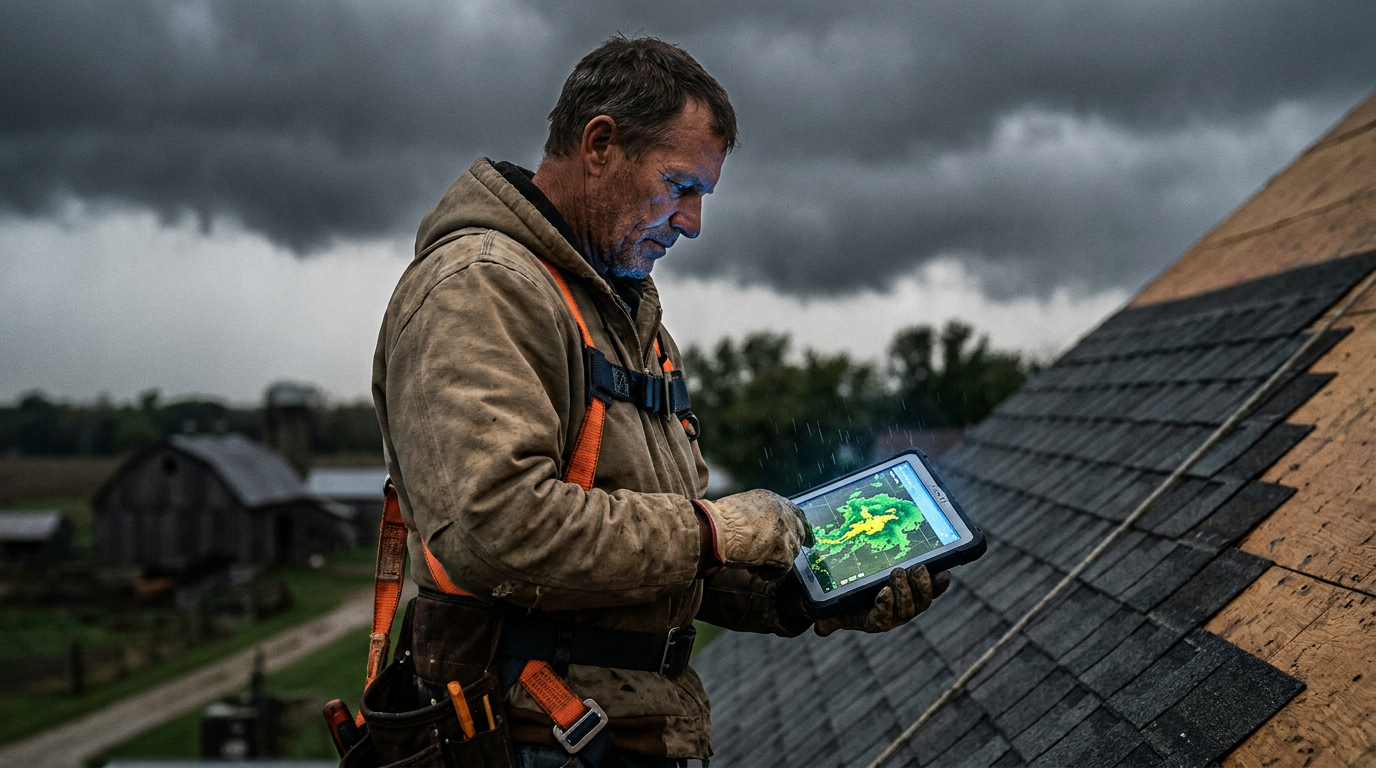
AI weather prediction helps Midwest roofers by providing highly accurate, block-by-block forecasts. This lets you schedule jobs with more confidence, reduce costly rainouts, and keep your crews safer. Instead of relying on general news reports, AI tools analyze massive datasets for real-time updates on wind, hail, and rain.
Your Weather App Is Costing You Money
Another day, another rainout. You checked the forecast last night. It said 20% chance of rain. Now, your crew is sitting in their trucks, the client's roof is half-exposed, and a surprise downpour is costing you hundreds, maybe thousands, in lost time.
For a Midwest roofer, weather is the boss. It dictates your schedule, your safety, and your profit. For decades, we've relied on the TV news or a basic phone app. But that's like using a handsaw when you could have a circular saw. It works, but it’s slow and imprecise.
Those general forecasts cover huge areas. A 20% chance of rain for Chicago doesn't tell you if it's going to hit your job site in Naperville or stay over the lake. You're left guessing. AI-powered weather prediction changes that. It's not about a general guess for the whole county; it's about a specific forecast for a single address.
How AI Predicts Weather Differently
So what is AI weather prediction? It's not magic. It’s just better math, done faster.
Traditional weather models are complex, but they update slowly and cover large grids. They might update every six hours and give you a forecast for a 10-square-mile area.
AI models, on the other hand, eat data for breakfast. They process information from every possible source in real time:
- High-resolution satellite images
- Doppler radar sweeps
- Ground station reports
- Atmospheric pressure sensors
- Even data from airplanes and drones
By analyzing all this information at once, AI can spot patterns humans and older models would miss. This allows for something called “nowcasting.” It’s the ability to predict weather with high accuracy in the next 0-6 hours. For a roofer, that’s the golden window.
This means getting an alert that a specific storm cell is heading for your job site in the next 45 minutes, complete with projected wind speeds and precipitation intensity. That’s information you can actually use.
Put AI to Work on the Roof
You don't need a data science degree to use these tools. You just need to know what to ask for. The benefits on the job are immediate and practical.
Smarter Scheduling: Stop guessing. An AI forecast can help you identify a 4-hour dry window with low winds, perfect for a tear-off and getting the underlayment down. You can stack your schedule with more confidence and complete more jobs per season.
Crew Safety: The Midwest is home to pop-up thunderstorms and dangerous wind gusts. AI tools can provide alerts for lightning strikes within a certain radius or when wind speeds are about to exceed safety thresholds. This isn't just about OSHA compliance; it's about making sure your team goes home safe. Better jobsite operations start with safety.
Material Protection: A surprise hailstorm or downpour can ruin thousands of dollars in shingles, plywood, and other supplies left uncovered. Hyper-local alerts give you the crucial 30-60 minutes you need to get materials covered and secure the site.
Better Client Communication: Instead of a vague 'we got rained out,' you can tell a client, 'We're pausing work due to a small but intense rain cell that will pass by 1:30 PM. We plan to be back on the roof by 2:00 PM.' This shows professionalism and builds trust.
You can even use AI to plan your entire season. By analyzing historical data, you can get a much clearer picture of the best and worst times to book jobs in your specific area.
Analyze the last 5 years of weather data for zip code 60614. Identify the months with the lowest average rainfall and fewest days with wind gusts over 25 mph. Present this as a simple table to help me plan my 2025 roofing season.
Creating a Weather-Proof Plan
Having the data is one thing. Acting on it is another. A good forecast is useless without a good plan. Use AI to build a Standard Operating Procedure (SOP) for your company so everyone knows what to do when bad weather hits.
Your SOP should be simple and clear. It should define exact triggers for stopping work. For example:
- Wind: All work stops if sustained winds exceed 25 mph or gusts exceed 35 mph.
- Lightning: Work stops when lightning is detected within an 8-mile radius. Work can resume 30 minutes after the last strike.
- Rain: Work stops when heavy rain begins. The site supervisor makes the call on light rain, depending on the task.
Having this written down removes guesswork and keeps your crew aligned and safe. It also provides a clear, defensible policy if issues arise.
Create a Standard Operating Procedure (SOP) for my roofing company for sudden severe weather. Include clear action steps for high winds (over 30 mph), lightning within a 5-mile radius, and unexpected heavy rain. The SOP must prioritize crew safety and securing the job site before stopping work.
The Right Tools for the Job
You don’t need to buy a supercomputer. Many of these powerful AI features are being built into tools you might already use.
- Advanced Weather Apps: Apps like Tomorrow.io, Carrot Weather, and MyRadar Pro offer hyper-local precipitation forecasts and severe weather alerts driven by AI.
- Construction Management Software: Some platforms are integrating these weather tools directly, linking forecasts to your daily job schedules.
- Free AI Assistants: You can use a free tool like ChatGPT or Google Gemini to interpret complex weather data or write client communications.
I have a roofing job scheduled for tomorrow at [Client Address]. Here is the technical weather forecast: [Paste technical forecast]. Rewrite this into a simple, clear text message for my client, explaining why we need to push our start time from 8 AM to 11 AM to ensure the job is done safely and with the highest quality.
This Isn't About Replacing Your Gut
Look, if you've been roofing in the Midwest for 20 years, you can feel a storm coming. You know the sky. You know the wind. AI isn't here to replace that hard-earned experience.
It's here to back it up with data. It’s a tool. It’s the difference between eyeballing a cut and using a speed square. Both can work, but one is more reliable, every single time.
By adding AI weather prediction to your digital toolbelt, you reduce risk, improve efficiency, and protect your bottom line. You stop letting the weather be the boss and start taking back control of your workday.
Frequently asked questions
37 copy-paste prompts that save tradespeople 5+ hours a week. Plus one short email every Friday — no fluff.
More for roofing

AI for Roofing Contractors: The Complete Guide
AI for Roofing Contractors comes down to using AI to do the slow stuff — quoting, paperwork, marketing, and customer follow-up — so you can stay on the too
AI Roof Measurement From a Photo: Apps That Work
AI Roof Measurement From a Photo comes down to using AI to do the slow stuff — quoting, paperwork, marketing, and customer follow-up — so you can stay on t