AI for Welders: Crafting a WPS with Artificial Intelligence
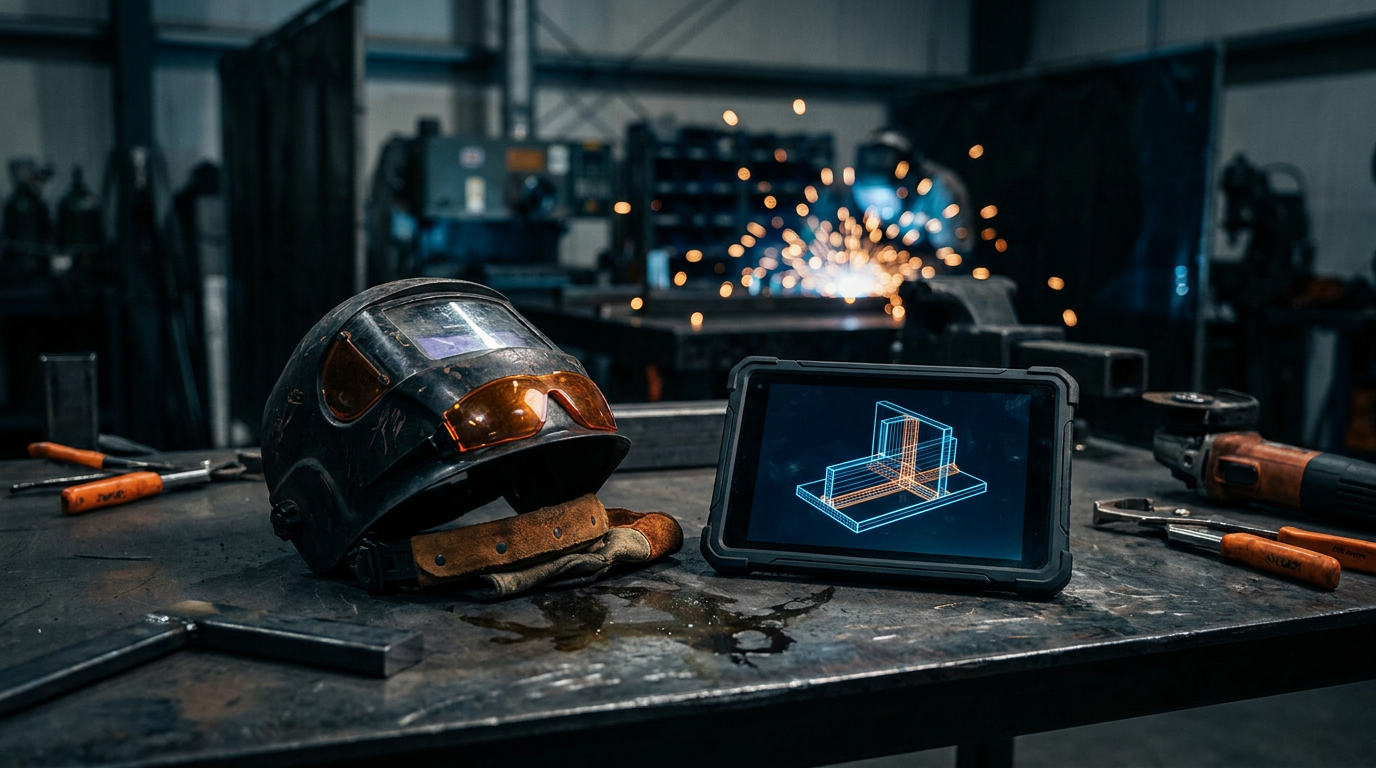
AI can help create a welding procedure specification (WPS) by drafting initial documents based on your inputs like materials, processes, and standards. It acts as a powerful assistant, organizing data and checking for gaps, but a certified welding inspector must always give the final approval for compliance.
AI for Welders: Crafting a WPS with Artificial Intelligence
Welding is a skill of the hands and eyes. You know the sound of a perfect arc, the smell of a clean bead, and the feel of a solid joint. But then there's the paperwork. The Welding Procedure Specification, or WPS, is the backbone of any professional job, but building one is a grind. It’s time on a keyboard instead of time under a helmet.
Artificial intelligence is changing that. Think of it not as a replacement for a welder, but as a new tool in your box, like a digital TIG finger or a self-darkening file cabinet. Using AI for welding procedure specification can cut down on the office time, reduce errors, and get you back to laying down metal.
This isn't sci-fi. It's about using a smart assistant to handle the tedious parts of the job so you can focus on the craft.
What is a WPS, Anyway?
Before we go further, let's get the terms straight. A lot of guys use them interchangeably, but they're different tools for different jobs.
WPS (Welding Procedure Specification): This is the recipe. It’s a set of written instructions telling a welder exactly how to make a specific weld. It covers everything from the type of metal and filler rod to the voltage, amperage, and travel speed. The WPS ensures every weld is made the same way, every time, to meet quality standards.
PQR (Procedure Qualification Record): This is the proof. The PQR is the official record that proves the WPS recipe actually works. It documents the actual welding test, including the conditions and the results of destructive and non-destructive testing. You weld a test coupon following the draft WPS, and the PQR documents that it passed.
WPQ (Welder Performance Qualification): This tests the cook, not the recipe. The WPQ certifies that a specific welder has the skill to follow a WPS and produce a sound weld. It's your personal license to weld a certain procedure.
Making a WPS from scratch means digging through code books like AWS D1.1, doing math, and a lot of typing. It’s a necessary pain. AI is here to make it less painful.
Where AI Fits in the WPS Workflow
AI doesn't actually know how to weld. It can't see the puddle or feel the heat. What it does know is data. AI is incredibly good at sorting, organizing, and generating text based on the rules you give it. Here’s how it helps with your WPS.
1. Drafting the Initial Document
Instead of starting with a blank Word document, you can give an AI a few key details. Tell it your process (GMAW), your material (A36 steel), thickness, and position. It can instantly generate a formatted WPS draft with all the required fields.
This saves a huge amount of time. The bones of the document are there. You just need to fill in the specific values from your PQR or company standards.
2. Organizing Data from a PQR
You can feed an AI the raw data from your PQR—the numbers, materials, and test results. Then, you can ask it to populate a WPS template with that information. It pulls the voltage from the PQR and puts it in the voltage box on the WPS. It takes the filler material and puts it in the right spot. No more copy-paste errors.
3. Verifying Against Code (The First Check)
This is a big one. You can ask an AI to review your draft WPS and compare it against the requirements of a specific code, like AWS D1.1. It can flag missing information, known as essential variables. For example, if you wrote a GMAW procedure but forgot to specify the shielding gas flow rate, the AI can point that out.
Important: This is not a final, legal verification. Think of it as a smart spell-check for welders. It helps you catch your own mistakes before you send the document to a Certified Welding Inspector (CWI) for the official stamp.
4. Improving Clarity and Language
Sometimes, the way a procedure is written is confusing. An AI can rephrase technical instructions into plain English. This helps ensure every welder on the floor, from the new apprentice to the 30-year veteran, understands the instructions clearly. Clear communication means fewer mistakes and better welds.
Prompts to Get You Started
Talking to an AI is a skill. The better your question, or 'prompt', the better your answer. Here are a couple of prompts you can copy and paste to try this out today.
Act as a welding compliance assistant. Draft a preliminary Welding Procedure Specification (WPS) based on AWS D1.1 standards. Use the following parameters: Process is GMAW-S, Position is 1G (flat), Base Metal is ASTM A36 steel, 3/8 inch thick. Filler metal is ER70S-6, 0.035 inch diameter. Shielding gas is 75% Argon / 25% CO2 at 35 CFH. Specify typical ranges for voltage and wire feed speed for this setup. Format the output in a clear, sectioned WPS document structure.
Review the following draft WPS for completeness against AWS D1.1 requirements for prequalified procedures. Identify any missing essential or nonessential variables. Point out any parameters that seem outside of typical ranges for the specified process and materials. Here is the draft: [Paste your draft WPS text here].
The Human in the Loop: Why You're Still the Boss
Let's be crystal clear: AI is a tool, not the tradesman. It’s a powerful assistant, but it’s not in charge. You are.
An AI has never struck an arc. It doesn’t understand the difference between a cold lap and proper fusion by looking at a bead. It only knows the numbers and words it was trained on. For more on how these systems work, you can read our guide on AI models.
A CWI is Not Optional. No AI on earth can replace a Certified Welding Inspector. The final WPS must be reviewed, approved, and signed by a human expert. The CWI holds the legal and professional responsibility for that weld's integrity. The AI holds nothing. Your shop is liable for the welds you produce, so the ultimate authority has to stay with a qualified person.
Think of it this way: a calculator can do the math for your bid, but you're the one who has to stand by the number. The same goes for an AI-assisted WPS.
Putting It to Work
So how can this help you in the shop tomorrow? Start small.
Summarize Old Records: Take a stack of old PQRs and use an AI to summarize them into a clean, digital list. This makes finding the right procedure for a new job much faster.
Pre-flight Check: Before you send a new WPS to your CWI, run it through an AI with a verification prompt. It’s a free proofread that can save you the time and money of having the CWI kick it back for simple errors.
Training: Use AI to generate study guides for apprentices. Ask it to create quizzes on welding symbols or to explain the metallurgy of different alloys in simple terms.
Using AI for welding procedure specification isn't about letting a robot do your job. It's about using a smart tool to handle the paperwork, so you have more time for the real work. It helps you stay organized, compliant, and efficient. That frees you up to do what you do best: fuse metal and build the world around us. For more ways to improve your business, check out our other articles for the skilled trades.
Frequently asked questions
37 copy-paste prompts that save tradespeople 5+ hours a week. Plus one short email every Friday — no fluff.
More for other trades

AI for Painting Contractors: Quoting to Marketing
AI for Painting Contractors comes down to using AI to do the slow stuff — quoting, paperwork, marketing, and customer follow-up — so you can stay on the to
AI for Fence Companies: 9 Practical Plays
AI for Fence Companies comes down to using AI to do the slow stuff — quoting, paperwork, marketing, and customer follow-up — so you can stay on the tools.
AI for Handyman Business: The Solo Operator Stack
AI for Handyman Business comes down to using AI to do the slow stuff — quoting, paperwork, marketing, and customer follow-up — so you can stay on the tools