
AI for Welding Quality Control: A Guide for Shops
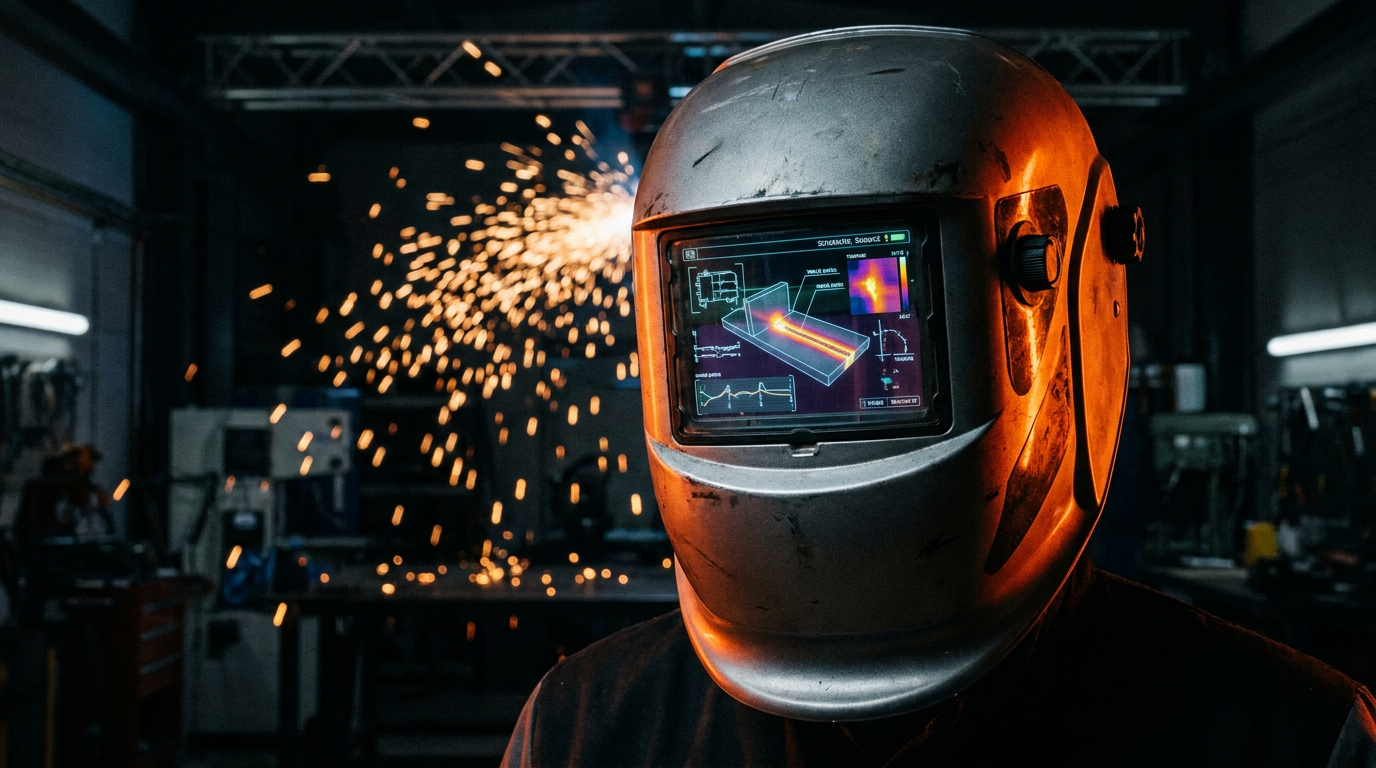
AI for welding quality control uses machine vision and algorithms to automatically inspect welds. It identifies defects like porosity, cracks, and undercut faster and more consistently than human inspectors. This improves accuracy, boosts productivity, and creates detailed quality reports for every joint, reducing costly rework.
The Bottleneck in Every Fab Shop
Let's be honest. Quality control is often the slowest part of the job. You've got skilled welders laying down perfect beads, but then everything grinds to a halt. A certified welding inspector (CWI) has to visually check every inch, or you have to run expensive, time-consuming non-destructive testing (NDT).
It's slow. It can be subjective. And if a problem is found hours or days later, the rework is a killer for your timeline and your bottom line. What if a machine could do the initial inspection, instantly and perfectly, every single time? That's not science fiction. That's AI for welding quality control, and it's changing the game for fab shops today.
What is AI Welding QC, Really?
Forget about robots taking over the world. Think of this as the smartest camera you've ever seen. In simple terms, AI for welding quality control uses a system of cameras, sensors, and smart software to analyze welds.
Here’s the breakdown:
- Capture: A high-resolution camera, often paired with a laser scanner, takes a detailed picture or 3D scan of the weld bead, either during the welding process (in-process) or immediately after.
- Analyze: The AI software instantly analyzes that image. It has been trained on thousands of images of both perfect and flawed welds. It looks for common defects based on standards like AWS D1.1.
- Report: The system flags any issues it finds, such as porosity, undercut, cracks, lack of fusion, or incorrect bead profile. It gives you a simple pass/fail result and can even pinpoint the exact location of the defect on the weld.
This isn't about replacing a CWI's judgment. It's about giving them a powerful tool to work faster and focus their expertise on the welds that actually need a closer look.
The Real-World Benefits for Your Shop
This technology isn't just for giant aerospace companies anymore. It's becoming more accessible for structural steel, pipe, and general fabrication shops. Here’s why you should care:
- Blazing Speed: AI can inspect a weld in seconds, not minutes. This means you can find and fix problems almost in real-time, eliminating bottlenecks.
- Unblinking Consistency: An AI doesn't have a bad day. It doesn't get tired. It judges every weld against the exact same standard, removing human subjectivity from the first pass of inspection.
- Digital Paper Trail: Every weld gets a digital record. The system logs the inspection results, complete with images. This is gold for jobs that require heavy documentation and traceability. You can prove your quality to any client.
- Drastic Reduction in Rework: Catching a bad weld right after it’s made is a quick fix. Catching it after the part has been painted, assembled, and shipped to the job site is a disaster. AI helps prevent those disasters.
Here's how you can use an AI tool like ChatGPT to start thinking about the data you already have. You don't need a fancy system to begin analyzing your QC reports for patterns.
I run a fabrication shop. I've collected weld repair data for the last 3 months. The most common defects are: 45 instances of porosity, 30 instances of undercut at the toe, and 15 instances of excessive convexity. The data also shows that 60% of these defects occur on the night shift. Based on this, what are the top 3 most likely root causes? For each cause, suggest one practical corrective action I can implement immediately. Present this as a simple action plan.
How to Get Started with AI in Your Shop
Jumping into AI doesn't mean you have to refit your entire operation overnight. The key is to start small and be strategic.
- Identify a Target: Don't try to boil the ocean. Pick one critical welding station or a single production line. Maybe it's a robotic cell where you need 100% inspection, or a manual station that's a known bottleneck.
- Talk to Your Suppliers: Companies that sell welding equipment, like Lincoln Electric, Miller, ESAB, and Fronius, are all deep into this technology. So are robotics companies like FANUC and Yaskawa. Ask your sales rep about their automated or AI-assisted quality control solutions. They can help you find a system that fits your process (MIG, TIG, laser, etc.) and your budget.
- Run a Pilot Program: Before you commit, run a trial. Test the system on your actual parts. See how it performs. Get feedback from the welders and QC personnel who will be using it. This is your chance to see the ROI in person.
Use this prompt to draft an email to a potential technology vendor. It shows you're serious and know what you're looking for.
Subject: Inquiry about AI Welding Inspection System for our Fab Shop

To the sales team,

I am the manager of a fabrication shop specializing in [describe your work, e.g., structural steel for commercial buildings]. We primarily use the [welding process, e.g., FCAW-G] process on [material, e.g., A36 carbon steel] up to [thickness, e.g., 1 inch].

We are looking to improve our quality control speed and documentation. We are interested in exploring an AI-powered visual inspection system for one of our robotic welding cells. The goal is to achieve 100% inspection on fillet welds and reduce our current manual inspection time.

Could you provide information on systems you offer that would be suitable for this application? Please include typical integration requirements and a budgetary price range.
It’s a Tool, Not a Replacement
Let’s clear the air on the biggest fear: AI is not going to make skilled welders obsolete. A machine can tell you that a weld is bad, but it can't tell you why.
It takes a skilled human to look at a report of consistent porosity and know to check the gas flow rate, look for a draft in the shop, or check the material for contamination. The AI is the watchdog; the welder is the problem-solver.
This technology elevates the role of the welder. It allows them to focus on perfecting their technique and process, not just laying down beads. It's a powerful tool that makes good welders even better and more valuable. This trend of technology assisting skilled labor is happening across all specialized trades.
By embracing tools like AI, you're not just improving your QC. You're building a smarter, more efficient, and more profitable fabrication business that's ready for the future.
Frequently asked questions
37 copy-paste prompts that save tradespeople 5+ hours a week. Plus one short email every Friday — no fluff.
More for other trades

AI for Painting Contractors: Quoting to Marketing
AI for Painting Contractors comes down to using AI to do the slow stuff — quoting, paperwork, marketing, and customer follow-up — so you can stay on the to
AI for Fence Companies: 9 Practical Plays
AI for Fence Companies comes down to using AI to do the slow stuff — quoting, paperwork, marketing, and customer follow-up — so you can stay on the tools.

AI for Handyman Business: The Solo Operator Stack
AI for Handyman Business comes down to using AI to do the slow stuff — quoting, paperwork, marketing, and customer follow-up — so you can stay on the tools