Can AI Size a Sump Pump? A Plumber's Guide
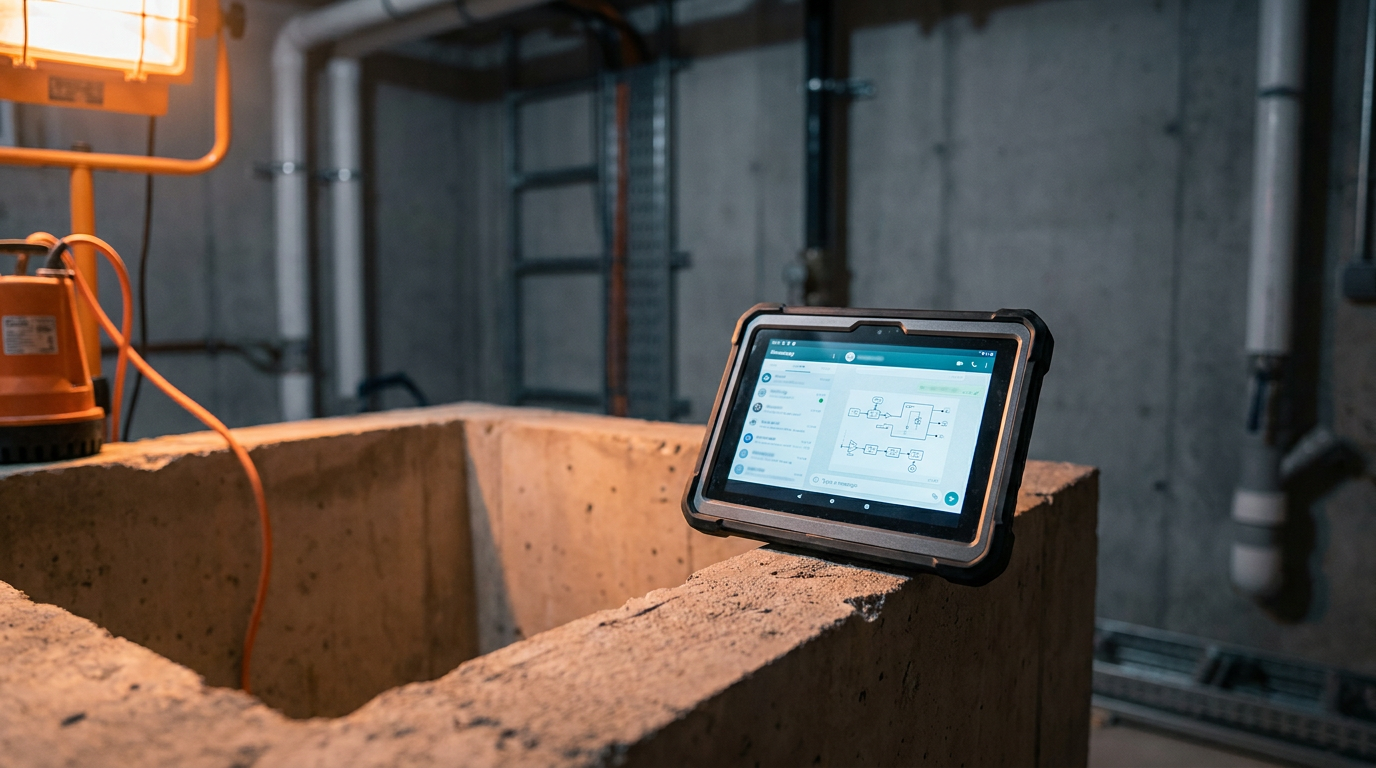
Yes, AI can help size a sump pump, but it cannot replace your professional judgment. It needs accurate data like basin size, inflow rate, and discharge height. Think of AI as a powerful calculator that speeds up the math, not a replacement for a site visit and your hands-on experience.
Can AI Correctly Size a Sump Pump?
Sizing a sump pump has always been a mix of science and gut feeling. You do the math on the head pressure, guess the gallons per minute (GPM) on a heavy rain day, and pick a pump you trust. Get it wrong, and you're back on a warranty call with a flooded basement and an unhappy customer.
Now, AI is in the toolbox. But can you really trust a chatbot to get the numbers right? The short answer is yes, but with a big asterisk. AI is a tool, like your pipe wrench or drain snake. It's powerful in the right hands, but it's not the one doing the job. You are.
This guide breaks down how to use AI to speed up your sump pump sizing, what information you need to give it, and where your own experience is still king.
The Old Way vs. The New Way
Remember the old routine? You’d break out a notepad and a pump manufacturer’s chart. You’d calculate:
- Basin Volume: Figuring out how many gallons the sump pit holds.
- Static Head: Measuring from the pump to the highest point of the discharge pipe.
- Friction Loss: Guessing the pressure loss from the pipe length, diameter, and every 90- or 45-degree elbow.
- Inflow: Making an educated guess on how fast water will fill the pit during a storm.
After all that, you'd find a pump on a performance curve that met your Total Dynamic Head (TDH) and GPM needs. It works, but it takes time and a lot of back-of-the-napkin math.
AI changes the process. Instead of you doing the math, you feed the raw numbers to the AI. It acts as a high-speed calculator that knows the formulas for friction loss and can process the data instantly. You're still the expert gathering the data; the AI just runs the numbers for you.
What AI Needs to Get it Right
Garbage in, garbage out. AI is only as good as the data you give it. To get a reliable sump pump recommendation, you need to provide precise measurements from the job site. Don't guess.
Here’s your checklist:
Sump Basin Dimensions:
- Diameter (usually 18 or 24 inches).
- Depth (from the basement floor to the bottom of the pit).
Static Head (Vertical Lift):
- Measure the vertical distance from the pump's discharge port to the highest point the water will travel before it goes horizontal or downhill outside.
Discharge Pipe Details:
- Total length of the pipe from the pump to the exit point.
- Pipe diameter (typically 1.5 inches for residential).
Fittings and Valves:
- Count every single fitting. Each one adds to the friction loss.
- Number of 90-degree elbows.
- Number of 45-degree elbows.
- Type of check valve (swing or spring). A spring check valve adds more friction.
Required Gallons Per Minute (GPM):
- This is the hardest part and where your experience shines. You can estimate it by timing how long it takes the pit to fill a certain amount during a steady rain. For a new install, you have to rely on your knowledge of the local water table, soil type, and property grading. A home in a low-lying area of New Orleans will need a higher GPM than one on a hill in Phoenix.
Once you have this data, you can build a prompt for your AI assistant.
Act as a hydraulics expert for a licensed plumber. I need to calculate the Total Dynamic Head (TDH) and recommend a sump pump size for a residential job.

Here is the data:
- Sump Basin Diameter: 18 inches
- Sump Basin Depth: 24 inches
- Static Head (Vertical Lift): 10 feet
- Discharge Pipe: 1.5-inch Schedule 40 PVC
- Total Pipe Length: 40 feet
- Fittings: Three 90-degree elbows, one swing check valve
- Estimated Inflow: 30 Gallons Per Minute (GPM)

Calculate the friction loss in the pipe and fittings, add it to the static head to find the TDH, and then recommend the required pump performance (GPM at the calculated TDH). Suggest a minimum horsepower for this application. Explain your calculations.
Where AI Falls Short (For Now)
An AI can't walk a job site. It's a powerful calculator, but it lacks the common sense and experience you bring to every job. Your expertise is what protects the homeowner and your reputation.
Here’s what AI can’t do:
- See the Big Picture: AI doesn't know if the home is in a floodplain designated by FEMA. It can't see the high-water marks on the foundation from a previous flood. It won't notice that the gutters are clogged and dumping water right next to the foundation, creating extra work for the pump.
- Understand Local Codes: AI might not know your local code requirements for discharge locations (e.g., must be 10 feet from the property line) or if a specific type of check valve is required.
- Diagnose Underlying Issues: If a pump is failing prematurely, AI can't diagnose the root cause. It won't know if the problem is a clogged impeller, an undersized discharge pipe causing the pump to run hot, or a faulty float switch. That requires hands-on troubleshooting.
- Choose the Right Brand: AI can recommend specs like a 1/2 HP pump that delivers 40 GPM at 15 feet of head. It can't tell you whether a Zoeller, Liberty, or Wayne pump is more reliable or easier to source from your local supplier. That decision comes from your own jobsite experience.
Think of using AI for pump sizing like using a GPS. It gives you the best route based on the data it has, but you're the one driving. If you see a road closure or a hazard ahead, you ignore the GPS and use your own judgment.
I need to choose between two sump pump models for a job requiring 35 GPM at 12 feet of TDH.

- Pump A: 1/3 HP, provides 40 GPM at 10 feet of head and 30 GPM at 15 feet of head.
- Pump B: 1/2 HP, provides 50 GPM at 10 feet of head and 40 GPM at 15 feet of head.

Based on their performance curves, which pump is a better fit for the required duty point of 35 GPM at 12 feet TDH? Explain why, considering efficiency and avoiding short-cycling.
The Bottom Line: Your New Digital Apprentice
AI isn't here to take your job. It's here to make your job easier. By offloading the tedious calculations, it frees you up to focus on what matters: quality installation, customer communication, and solving the real-world problems that a computer can't see.
Use AI to double-check your math and explore different scenarios quickly. But the final decision on which pump goes into that pit? That's still on you. And that’s how it should be.
Frequently asked questions
37 copy-paste prompts that save tradespeople 5+ hours a week. Plus one short email every Friday — no fluff.
More for plumbers
AI for Plumbers: The Practical Field Guide
AI for Plumbers comes down to using AI to do the slow stuff — quoting, paperwork, marketing, and customer follow-up — so you can stay on the tools. Below i

25 ChatGPT Prompts for Your Plumbing Business
25 ChatGPT Prompts for Your Plumbing Business comes down to using AI to do the slow stuff — quoting, paperwork, marketing, and customer follow-up — so you

AI Plumbing Diagnosis Apps: What Actually Works
AI Plumbing Diagnosis Apps comes down to using AI to do the slow stuff — quoting, paperwork, marketing, and customer follow-up — so you can stay on the too