
Colorado Roofers: Let AI Handle Snow Load Calculations
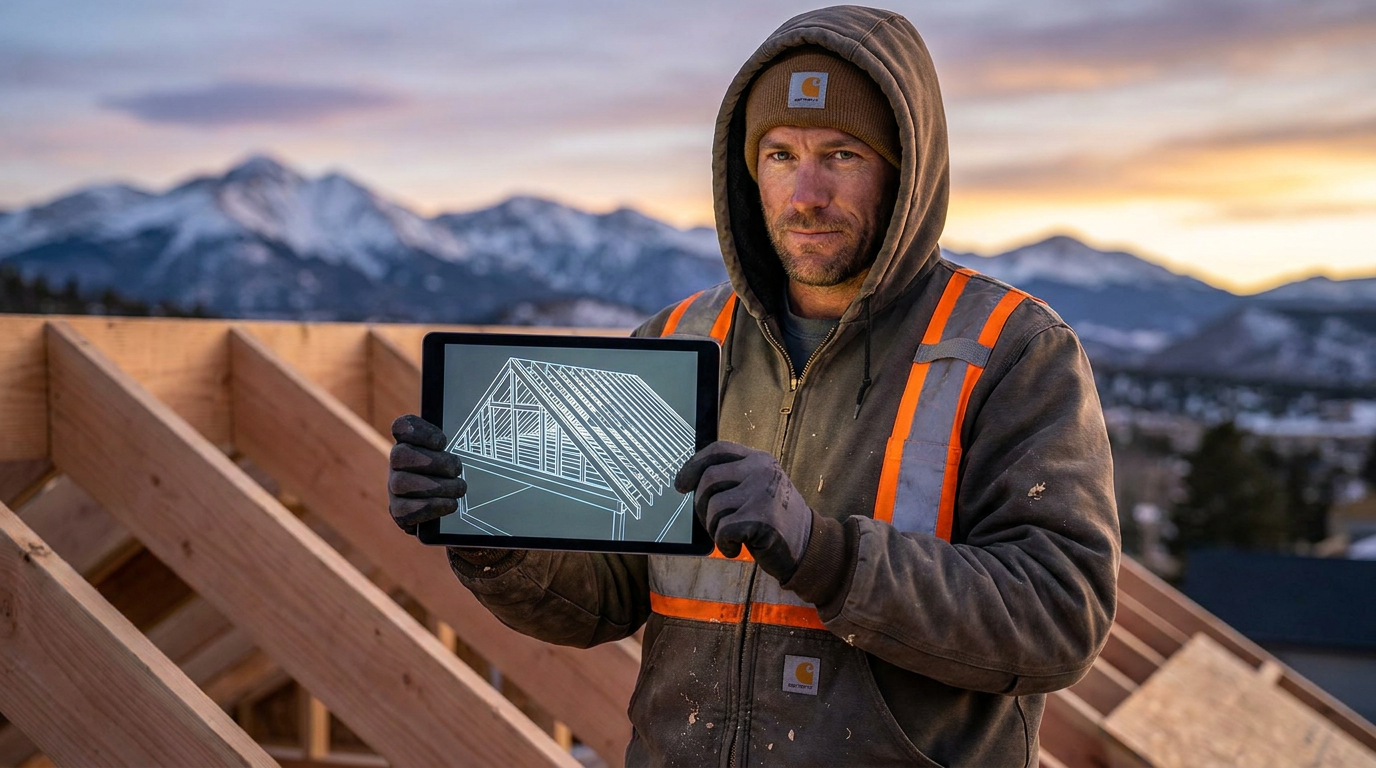
Yes, you can use AI for snow load calculation. By providing AI tools with key data like your project's location, roof pitch, and building type, you can get fast, reliable estimates. This saves time and helps ensure your projects meet Colorado's specific structural requirements for heavy snowfall.
Colorado Roofers: Let AI Handle Snow Load Calculations
In Colorado, snow isn't just a part of the scenery; it's a force of nature that weighs on every roof you build or repair. Calculating snow loads is a critical part of the job. It ensures safety and durability. But the math can be a headache, especially with the state's wild variations in elevation and weather.
Manual calculations using charts from the American Society of Civil Engineers (ASCE) are the old way. They work, but they're slow. They take you away from the jobsite and bog you down in paperwork. There's a better way to get your initial numbers.
AI assistants are more than just a gimmick. They're powerful calculators that can process huge amounts of data in seconds. For a Colorado roofer, that means turning a complex engineering problem into a quick conversation. This guide will show you how to use AI to get fast, reliable snow load estimates, so you can spend more time on the roof and less time on the paperwork.
Why Snow Load Matters in Colorado
Getting snow load wrong has serious consequences. An underestimated load can lead to structural failure, a collapsed roof, and a destroyed reputation. An overestimated load means you might bid too high on materials and labor, losing the job to a competitor.
Colorado's geography makes this especially tricky. A roof in Denver on the Front Range has completely different requirements than one in Vail or Telluride. The state's building codes rely on ground snow load (Pg) maps, often provided by sources like the Structural Engineers Association of Colorado (SEAC). These values can range from 20 pounds per square foot (psf) in the eastern plains to over 200 psf in the high country.
From that ground load, you have to calculate the actual load on the roof. This involves factors like:
- Roof Pitch: Steeper roofs shed snow better.
- Exposure: Is the building sheltered by trees or out in the open?
- Thermal Factor: A heated building can melt snow, reducing the load.
- Drift: Wind can pile snow up in certain areas, creating massive, unbalanced loads.
This is where AI becomes your new best friend. It can handle all these variables without making you break out a calculator.
What is AI Snow Load Calculation?
Think of AI as a junior engineer who has memorized every building code and snow load map. It's not magic. You provide the specific details of your project, and the AI runs the numbers based on established engineering principles, primarily the ASCE 7-16 standard used across the United States.
Instead of you looking up the ground snow load for Aspen, then finding the right formulas for exposure, thermal conditions, and roof slope, you just ask. The AI does the grunt work. It pulls the right data for the location and applies the standard calculations instantly.
This is a massive time-saver, especially during the quoting phase. You can get a solid preliminary number in minutes, helping you build a more accurate bid on the spot.
Getting Started: What AI Needs from You
Garbage in, garbage out. The quality of the AI's answer depends on the quality of your question. To get an accurate snow load estimate, you need to provide clear, specific information.
Have this data ready:
- Location: City and county are good. An exact address is better. Elevation is also very helpful.
- Building Category: This relates to the building's importance. Most residential homes are Category II. Hospitals are Category IV.
- Roof Geometry: The pitch (e.g., 6/12), and type (gable, hip, flat, monoslope).
- Thermal Conditions: Is the structure heated (Ct = 1.0 or 1.1) or unheated (Ct = 1.2)?
- Exposure: Is it fully exposed in an open field, partially exposed in a suburb, or fully sheltered by dense trees?
With these details, you're ready to make your first request.
Prompting for Success: Your First AI Request
Let's run a real-world example. You're bidding a new roof for a house in Evergreen, up in Jefferson County. You know it gets more snow than Denver, but how much more? Instead of digging through charts, you can use a prompt like this.
I'm a roofer in Colorado. I need a preliminary snow load calculation for a residential project. Location: Evergreen, CO (Jefferson County). Elevation is approx. 7,220 ft. The roof is a standard gable roof with a 6/12 pitch. The building is in a residential area with some trees (partially exposed) and is a heated structure. Based on ASCE 7-16 standards, what is the estimated ground snow load (Pg) for this location, and what is the calculated sloped-roof snow load (Ps)?
The AI should be able to identify the ground snow load for that area (likely around 60-70 psf based on SEAC maps) and then apply the necessary factors to give you the final design snow load for your roof. It saves you at least 15 minutes of research.
Refining the Numbers: Advanced AI Prompts
Basic calculations are just the start. AI can also help you think through more complex situations, like snow drift. Drift is the real roof killer. It happens when wind blows snow off a higher roof onto a lower one, or piles it up against a parapet wall. These loads can be two or three times the normal balanced snow load.
Here's how you can ask AI to help you account for it.
I'm estimating a roofing project for a commercial building in Breckenridge, CO. The building has a large, low-slope main roof (2/12 pitch) and a taller, adjacent wall section. I need to account for potential snow drift. The ground snow load (Pg) is 140 psf. Can you walk me through the basic steps to estimate the additional drift surcharge load on the lower roof according to ASCE 7-16 principles? Explain the concepts of leeward and windward drifts.
AI can also help you communicate these technical details to clients. A homeowner doesn't know what 85 psf means. You can use AI to translate it into plain English.
Act as a roofer explaining snow load to a homeowner in simple terms. The calculated roof snow load for their project in Vail, CO is 85 psf. Write a short, clear paragraph I can use in an email or quote. Explain what 'pounds per square foot' means in a practical way and why it's important for the safety and longevity of their roof in a high-snow area like Vail.
The Limits of AI: Where a Human Expert is King
This is the most important part: AI is not a licensed structural engineer.
AI-driven calculations are for estimation, bidding, and preliminary planning only. They are not a substitute for professional engineering review. For any project that requires a permit, you will need plans stamped by a Professional Engineer (P.E.) licensed in the state of Colorado.
Use AI to:
- Get fast, accurate estimates for quotes.
- Double-check your own manual calculations.
- Understand complex scenarios like snow drift.
- Explain technical concepts to clients.
Do not use AI to:
- Generate final structural plans for a permit application.
- Make final decisions on beam sizes or truss spacing without engineering oversight.
Always defer to the local building department and your project's engineer. They are the final authority. Think of AI as the best apprentice you've ever had—fast and knowledgeable, but not the one signing off on the work.
By using this tool correctly, you can work faster, create smarter bids, and build safer, more durable roofs for your Colorado clients. For more practical advice, explore our other roofing articles.
Frequently asked questions
37 copy-paste prompts that save tradespeople 5+ hours a week. Plus one short email every Friday — no fluff.
More for roofing

AI for Roofing Contractors: The Complete Guide
AI for Roofing Contractors comes down to using AI to do the slow stuff — quoting, paperwork, marketing, and customer follow-up — so you can stay on the too
AI Roof Measurement From a Photo: Apps That Work
AI Roof Measurement From a Photo comes down to using AI to do the slow stuff — quoting, paperwork, marketing, and customer follow-up — so you can stay on t