DeepL vs. Google Translate: Which Is Best for Trade Docs?
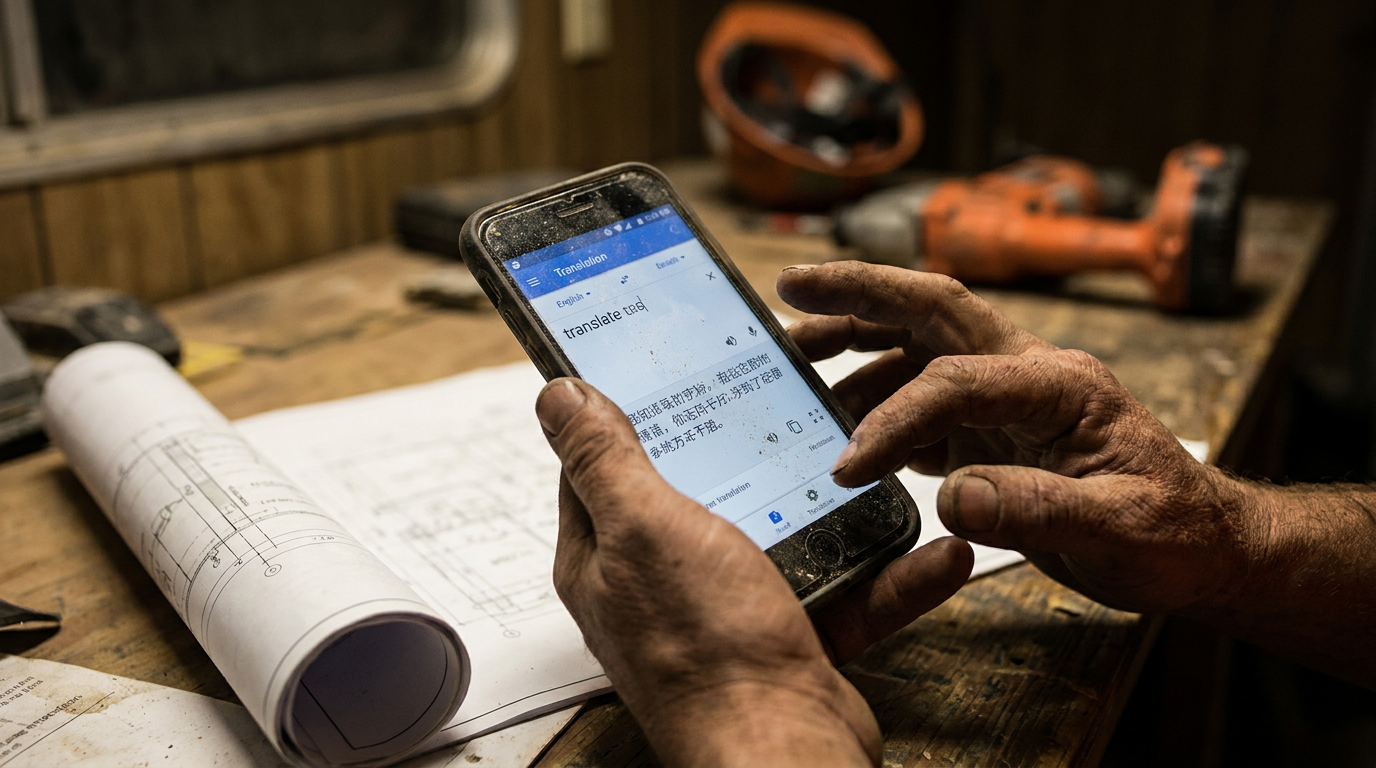
For technical trade documents, DeepL is generally more accurate than Google Translate. Its AI is better at understanding context, industry jargon, and nuance, which results in more natural and precise translations. While Google is fast for simple words, DeepL is the safer bet for instructions, specs, and important communications.
DeepL vs. Google Translate: The Right Tool for the Job
On today's job sites, you're as likely to hear Spanish, Polish, or Portuguese as you are to hear English. A diverse crew is a strong crew, but language barriers can cause serious problems. A misunderstood instruction can lead to costly rework or, worse, a safety incident. That's where translation apps come in.
For years, Google Translate has been the go-to. It's free, it's fast, and it's on every phone. But a newer tool, DeepL, claims to be far more accurate, especially with complex text. For a contractor, that's a big deal. We're not translating poetry; we're translating safety warnings, building specs, and client change orders. Precision matters.
So, which one should you trust when the work depends on it? Let's put them to the test.
What We Mean by "Technical Documents"
When we talk about technical documents in the trades, we're not talking about simple text messages. We're talking about documents where one wrong word can have real consequences. These include:
- Tool and Equipment Manuals: Correct operation and safety procedures are critical.
- Safety Data Sheets (SDS): Chemical handling information where accuracy can be a matter of life and death.
- Building Plans and Specifications: Details on materials, measurements, and methods.
- Contracts and Change Orders: Legally binding documents that define the scope of work and payment.
- Client and Crew Emails: Clear communication about schedules, expectations, and issues.
Getting these wrong isn't an option. A bad translation could mean using the wrong material, violating a code, or creating a legal dispute.
Google Translate: The Old Standby
Everyone knows Google Translate. It's been around since 2006, and it's incredibly convenient. You can type text, speak into your phone, or even point your camera at a sign.
The Good:
- It's Free and Fast: You get instant translations at no cost.
- Huge Language Support: It supports over 130 languages, more than any other major service.
- Well-Integrated: It's built into the Chrome browser, Android phones, and many other apps.
The Bad:
- Too Literal: Google often translates word-for-word. This works for simple phrases like "Where is the saw?" but fails with idioms or technical jargon. It might translate "wire nut" into something that makes no sense to an electrician in another language.
- Struggles with Context: It looks at sentences in isolation. It doesn't always grasp the overall topic, leading to weird word choices. For example, it might not know if "panel" refers to an electrical panel, a solar panel, or a wall panel.
Google Translate is a useful tool for quick, low-stakes communication. But relying on it for complex instructions is a gamble.
DeepL: The New Challenger
DeepL came on the scene in 2017 and quickly gained a reputation for high-quality translation. It uses a more advanced form of artificial intelligence that is better at understanding the context and nuance of the original text.
The Good:
- Better with Nuance: DeepL is known for producing translations that sound more natural and human. It's better at picking the right word based on the surrounding text.
- Understands Jargon Better: While not perfect, it's generally more successful at translating technical terms correctly because it analyzes sentence structure and context more deeply.
- Glossary Feature: This is a game-changer for pros. The paid version (DeepL Pro) lets you create a glossary. You can tell it exactly how to translate specific terms. For example, you can set "P-trap" to always translate to "sifón en P" in Spanish, ensuring consistency across all your documents.
The Bad:
- Fewer Languages: It supports around 30 languages. It covers the most common ones you'll find on a US job site, but it's not as comprehensive as Google.
- Free Version has Limits: The free web translator and app have limits on how much text you can translate at once. For professional use, you'll likely need a paid plan.
To improve your translations, you can first simplify your English. This helps any AI tool get it right.
Rewrite the following technical instruction in simple, clear English with short sentences. The goal is to prepare it for machine translation, so avoid jargon, idioms, and complex sentence structures. Original text: 'The installer must ensure that the HVAC unit's condensate drain line maintains a consistent minimum 1/4-inch per foot downward slope to prevent blockages and subsequent water damage.'
Head-to-Head Test: A Real-World Example
Let's take a sentence from a technical manual.
English: "Torque the lug nuts to 80 ft-lbs in a star pattern to ensure even seating of the wheel."
Google Translate (to Spanish): "Apriete las tuercas de seguridad a 80 ft-lbs en un patrón de estrella para asegurar un asiento uniforme de la rueda."
- Analysis: This is okay, but "tuercas de seguridad" usually means "lock nuts." The more common term for "lug nuts" is "tuercas de rueda." It's a small difference, but a professional mechanic would notice.
DeepL (to Spanish): "Apriete las tuercas de la rueda a 80 ft-lbs en un patrón de estrella para garantizar un asentamiento uniforme de la rueda."
- Analysis: This is better. "Tuercas de la rueda" is the correct term. "Garantizar un asentamiento uniforme" is also a slightly more professional and accurate phrasing than Google's version. DeepL understood the context was automotive.
While Google's translation is understandable, DeepL's is more precise. In the trades, precision is everything. This is where you can start building your own library of terms for your crew.
Create a simple, bilingual glossary of 15 common job site terms for a residential construction project. The columns should be 'English Term', 'Spanish Term', and 'Simple Definition/Context'. Include terms like 'stud', 'drywall', 'GFCI outlet', 'subfloor', and 'change order'.
The Verdict: When to Use Which Tool
Both tools have their place in your digital toolbox.
Use Google Translate for:
- Quick, informal conversations.
- Translating a single word or simple phrase.
- Reading signs or labels with the camera feature.
- When you need a language DeepL doesn't support.
Use DeepL for:
- Translating safety procedures or equipment instructions.
- Writing emails or messages to clients or crew members about important topics.
- Translating sections of contracts or technical specs (before having a human review them).
- Anything where accuracy and professional tone matter more than speed.
For any document with legal or financial liability, like a full contract, you must use a certified human translator. AI is a powerful tool for improving daily jobsite communication, but it is not a substitute for a legal expert.
You can even use AI to check the work of another AI, adding a layer of quality control to your operations.
I used an online translator for this technical text for a plumbing project. The original is in English, translated to Spanish. Review the Spanish translation for accuracy, clarity, and correct use of trade-specific terminology. The original English is: '[paste English text]'. The initial Spanish translation is: '[paste translated text]'. Provide a corrected version and explain any major changes.
For contractors, DeepL is the clear winner for serious work. The improved accuracy with technical language and the glossary feature in the pro version make it a much more reliable tool. Think of it like this: Google Translate is a multi-tool, and DeepL is a calibrated torque wrench. Both are useful, but you only trust one for the most important jobs.
Frequently asked questions
37 copy-paste prompts that save tradespeople 5+ hours a week. Plus one short email every Friday — no fluff.
More for other trades

AI for Painting Contractors: Quoting to Marketing
AI for Painting Contractors comes down to using AI to do the slow stuff — quoting, paperwork, marketing, and customer follow-up — so you can stay on the to
AI for Fence Companies: 9 Practical Plays
AI for Fence Companies comes down to using AI to do the slow stuff — quoting, paperwork, marketing, and customer follow-up — so you can stay on the tools.
AI for Handyman Business: The Solo Operator Stack
AI for Handyman Business comes down to using AI to do the slow stuff — quoting, paperwork, marketing, and customer follow-up — so you can stay on the tools