
Hurricane-Proof Bids: AI Wind Load Tools for Florida
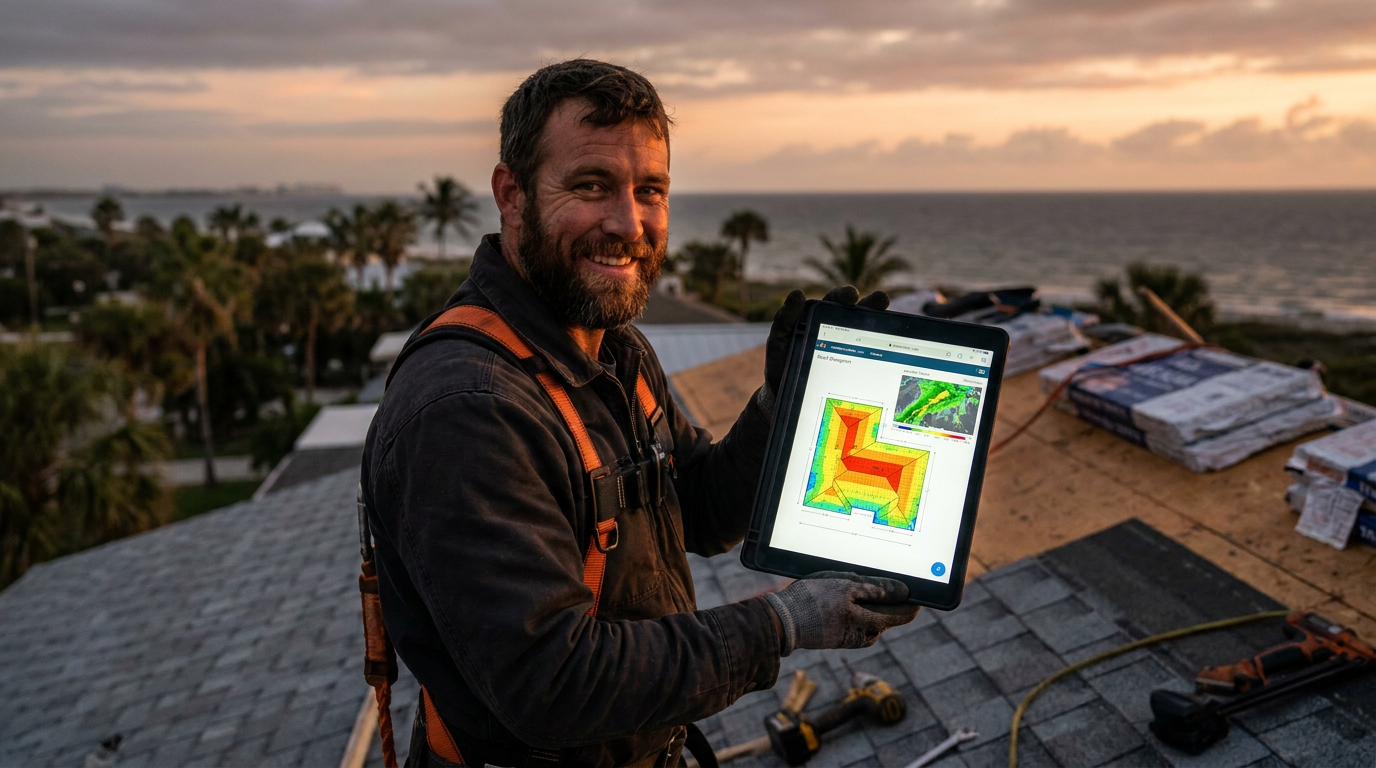
AI wind load calculation for Florida roofers uses software to automate complex structural analysis based on the Florida Building Code (FBC). These tools process site-specific data like location, building height, and roof geometry to quickly generate the required uplift pressures, helping you create accurate, compliant bids faster than manual methods.
Hurricane-Proof Your Bids: AI Wind Load Tools for Florida Roofers
If you're a roofer in Florida, you know the drill. Wind load calculations are not optional. They're a critical part of every bid, required by the Florida Building Code (FBC) to make sure your roofs can handle the next big storm. For years, this meant busting out the ASCE 7 manual, running numbers, and double-checking everything. It’s slow, tedious work where one small mistake can lead to a failed inspection or, worse, a failed roof.
Now, there’s a better way. Artificial intelligence (AI) is changing the game. New software tools can run these complex wind load calculations for you in minutes, not hours. They help you build faster, more accurate, and more professional bids that are FBC-compliant right from the start. This isn't about replacing your expertise. It's about giving you a power tool to do the job better and faster.
Why Manual Wind Load Calcs Are a Drag
Let's be honest, nobody enjoys manually calculating wind loads. It's a bottleneck in your sales process and a major headache for your team.
Here’s what you’re up against:
- It’s Time-Consuming: You have to dig through the ASCE 7-16 or 7-22 standards, find the right tables, and perform a series of calculations for wind speed, exposure, and building geometry. This is time you could be spending on other parts of your business, like managing your crew or landing the next job.
- It’s Easy to Mess Up: Human error is a real risk. A misplaced decimal or using the wrong risk category can throw off your entire calculation. These mistakes can lead to costly change orders or failed inspections, damaging your reputation and your bottom line.
- The Code is Complicated: The FBC is a massive document, and the wind load provisions are some of its most complex parts. Keeping up with changes, especially with the move to ASCE 7-22, is a job in itself. And if you work in a High-Velocity Hurricane Zone (HVHZ) like Miami-Dade or Broward, the rules are even stricter.
- It Slows Down Your Bids: While you're busy with calculations, your competition might already be in the customer's inbox with a complete proposal. In a competitive market, speed matters.
How AI Changes the Game for Wind Loads
AI-powered software takes the manual labor and guesswork out of wind load calculations. Instead of being a code expert, you just need to provide the basic project details. The AI does the heavy lifting.
Here’s how it works:
- Input the Data: You start by entering the property address. The software often integrates with aerial measurement services like EagleView or uses GIS data to pull in roof dimensions, pitch, and building height.
- AI Does the Math: The AI engine takes this information and automatically applies the complex formulas from the ASCE 7 standard. It determines the correct wind speed for the location, the risk category, and the exposure coefficient.
- It Defines the Zones: The software maps the roof and correctly identifies the different wind zones—field (Zone 1), edges (Zone 2), and corners (Zone 3). It then calculates the specific uplift pressures required for each zone.
- Generates a Report: In seconds, you get a professional, easy-to-read report that clearly shows the wind load calculations and the required fastening patterns. You can include this report directly in your proposal to the homeowner, showing them you’ve done your homework. This builds trust and makes your quoting process look sharp.
I'm a Florida roofer. Explain the difference between roof wind load zones 1 (field), 2 (edge), and 3 (corner) as defined by ASCE 7-22 for a simple hip roof on a 25-foot-tall house in Tampa, FL (Risk Category II). Tell me why the uplift pressure is highest in the corners. Keep it simple, like you're explaining it to a new crew member.
Finding the Right AI Wind Load Tool
Not all software is created equal. If you're ready to add an AI tool to your toolbox, here's what to look for:
- FBC and ASCE 7-22 Compliance: This is non-negotiable. The tool must be built on the latest version of the Florida Building Code and the ASCE 7 standard it references. Make sure it can handle HVHZ requirements if you work in South Florida.
- Integration: The best tools work with the software you already use. Look for integrations with your CRM, proposal software, and aerial measurement providers. This saves you from entering the same data multiple times.
- Ease of Use: You and your team should be able to use it without needing a degree in engineering. A clean interface and a simple workflow are key.
- Professional Reports: The output should be a clean, client-facing report that you can confidently add to your bid packet. It should clearly state the design pressures and project details.
Some roofing platforms like AccuLynx and JobNimbus are starting to integrate these features, while specialized engineering software also offers solutions. Do your research and find the one that fits your workflow.
I'm a roofing contractor in Florida. Draft a short, professional email for my client, John Smith. I need to explain why the wind load calculation included in his re-roofing proposal is important. Mention that it's required by the Florida Building Code to ensure the roof can withstand hurricane-force winds and is essential for passing inspection. Keep the tone confident and educational, not overly technical.
The Bottom Line: Better Bids, Safer Roofs
Using AI for your Florida wind load calculations isn't about cutting corners. It's about being more precise, more efficient, and more competitive. By automating these calculations, you free up valuable time, reduce the risk of costly errors, and build stronger, safer roofs for your customers.
Think about it. You can get a fully compliant bid out the door in a fraction of the time it used to take. You can show homeowners a detailed report that proves your work meets the highest safety standards. In a state where the weather is always a threat, this level of professionalism sets you apart from the competition.
This technology helps you spend less time on paperwork and more time doing what you do best: building great roofs that protect Florida families.
I'm considering two roofing software tools: [Software A] and [Software B]. Create a comparison table that helps me decide which is better for my Florida-based business. Key features to compare are: automated FBC wind load calculations (ASCE 7-22), integration with EagleView/other measurement tools, proposal generation, price, and user-friendliness for a small team.
Frequently asked questions
37 copy-paste prompts that save tradespeople 5+ hours a week. Plus one short email every Friday — no fluff.
More for roofing

AI for Roofing Contractors: The Complete Guide
AI for Roofing Contractors comes down to using AI to do the slow stuff — quoting, paperwork, marketing, and customer follow-up — so you can stay on the too
AI Roof Measurement From a Photo: Apps That Work
AI Roof Measurement From a Photo comes down to using AI to do the slow stuff — quoting, paperwork, marketing, and customer follow-up — so you can stay on t