NY Electricians: AI for Fast NEC Code Lookups
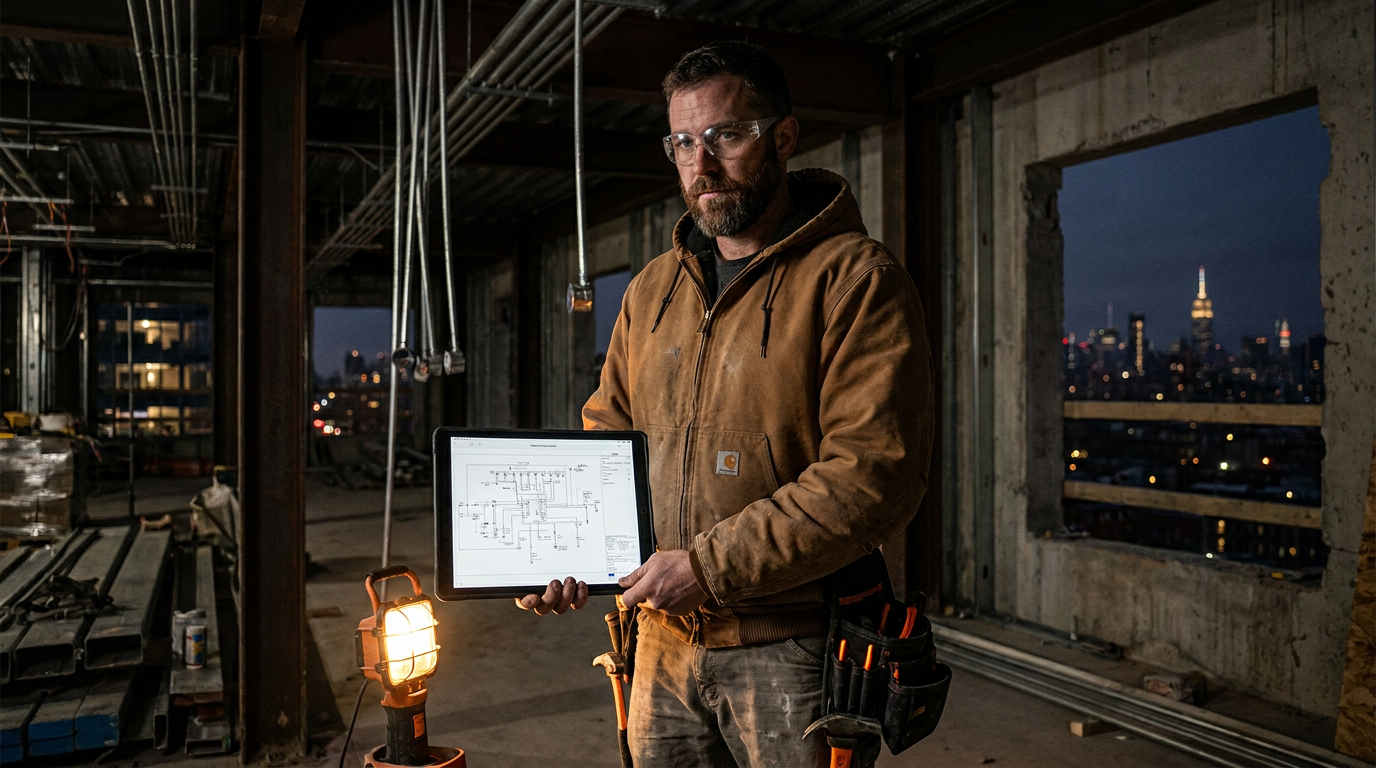
AI tools for NEC code lookup in New York, like ChatGPT-4 and Perplexity, can dramatically speed up your workflow. By using specific, location-aware prompts, you can get instant answers on national codes and complex local amendments, like those in NYC. These tools act as a powerful assistant, not a replacement for your professional judgment.
Stop Flipping, Start Asking
You know the drill. You're on a job in Brooklyn, the client is breathing down your neck, and you need to double-check a specific requirement in the New York City Electrical Code. You can either walk back to the truck to grab the thick, dog-eared code book, or you can pull out your phone.
For years, that meant searching clunky PDF documents. Today, it means asking a simple question in plain English. Artificial intelligence isn't just some tech fantasy anymore. It's a practical tool that can save you time and headaches, especially when dealing with the layers of code that apply to New York electricians.
Think of it as having a master electrician in your pocket who has memorized the entire NEC and all local rules. It's not perfect, but it's a powerful first stop for answers.
Why AI is a Game-Changer for NY Code Lookups
The National Electrical Code (NEC) is complex enough. But in New York, and especially in New York City, you're dealing with a whole other layer of amendments and local laws. The NYC Electrical Code is its own beast, based on the NEC but with significant changes.
This is where AI shines. Instead of just searching for keywords, you can ask questions in context.
- Speed: Get answers in seconds, not minutes.
- Clarity: Ask the AI to "explain this like I'm a first-year apprentice" to get a simple breakdown of a complex rule.
- Cross-Referencing: You can ask it to compare an NEC rule with the specific NYC amendment, highlighting the differences.
- On-the-Go Access: All you need is your phone and a data connection.
This isn't about replacing your experience. It's about making your experience more efficient. You're still the pro making the final call, but you get to the answer faster.
I am a licensed electrician in New York City. According to the NYC Electrical Code Amendments to the 2020 NEC, what are the specific requirements for installing AFCI protection in existing dwelling units? Please cite the relevant NYC code section and explain the difference from the standard NEC 2020 requirement.
The Right AI Tools for the Job
Right now, the best tools are the big, general-purpose AIs. The market for electrician-specific AI is still new, but these powerful models can get the job done if you know how to use them.
- ChatGPT (GPT-4): The paid version (GPT-4) is your best bet. Its knowledge is vast, and its reasoning capabilities are strong. You can upload PDFs of local amendments to give it even more specific context for your questions.
- Perplexity AI: This tool is great because it often cites its sources. When you ask a code question, it can provide links to the web pages where it found the information, giving you a path to verify the answer.
- Google Gemini: Another strong contender, Gemini is built into the Google ecosystem and is good at summarizing information from multiple sources.
When you use these tools, the key is to be specific. Don't just ask, "Is this to code?" You need to provide context.
How to Write Prompts That Get Accurate Answers
Garbage in, garbage out. A lazy question will get you a lazy, and possibly wrong, answer. A good prompt acts like a work order for the AI.
- State Your Role and Location: Always start with "I am a licensed electrician in [Your City/Region, NY]."
- Specify the Code: Mention the code you're working with, e.g., "According to the NEC 2020 as amended by the NYC Electrical Code..."
- Ask a Clear Question: Be direct. Are you asking for requirements, a definition, a calculation, or a comparison?
- Request a Source: End your prompt with "Please cite the specific code article number."
Here’s another example you can use on your next jobsite.
Explain NEC 2020 Article 210.8(A) regarding GFCI protection in dwelling units. List all the locations where GFCI is required. Present the information in a simple bulleted list. I am working on a residential project in upstate New York, which follows the state's adoption of the NEC.
The "Trust But Verify" Rule
This is the most important part. AI is a powerful assistant, but it is not a licensed electrician. It can be wrong. It can "hallucinate" and make up code articles that don't exist. You are the professional of record, and you are 100% liable for your work.
AI is your co-pilot, not the pilot.
Use AI to find the answer and the code reference quickly. Then, use that reference to check the answer in your official, up-to-date code book or digital version from the NFPA. The AI points you to the right page; you confirm the information is correct before you cut a single wire.
Think of it as a massive upgrade to the index in the back of the codebook. It saves you the search time, but it doesn't remove your professional responsibility to get it right.
Frequently asked questions
37 copy-paste prompts that save tradespeople 5+ hours a week. Plus one short email every Friday — no fluff.
More for electricians
AI for Electricians: A Field-Tested Guide
AI for Electricians comes down to using AI to do the slow stuff — quoting, paperwork, marketing, and customer follow-up — so you can stay on the tools. Bel
27 ChatGPT Prompts for Electricians (Copy & Paste)
27 ChatGPT Prompts for Electricians (Copy & Paste) comes down to using AI to do the slow stuff — quoting, paperwork, marketing, and customer follow-up — so

AI Electrical Load Calculator: How It Works & Free Prompt
AI Electrical Load Calculator comes down to using AI to do the slow stuff — quoting, paperwork, marketing, and customer follow-up — so you can stay on the