Timekettle vs. Pocketalk: Best Translator for Construction?
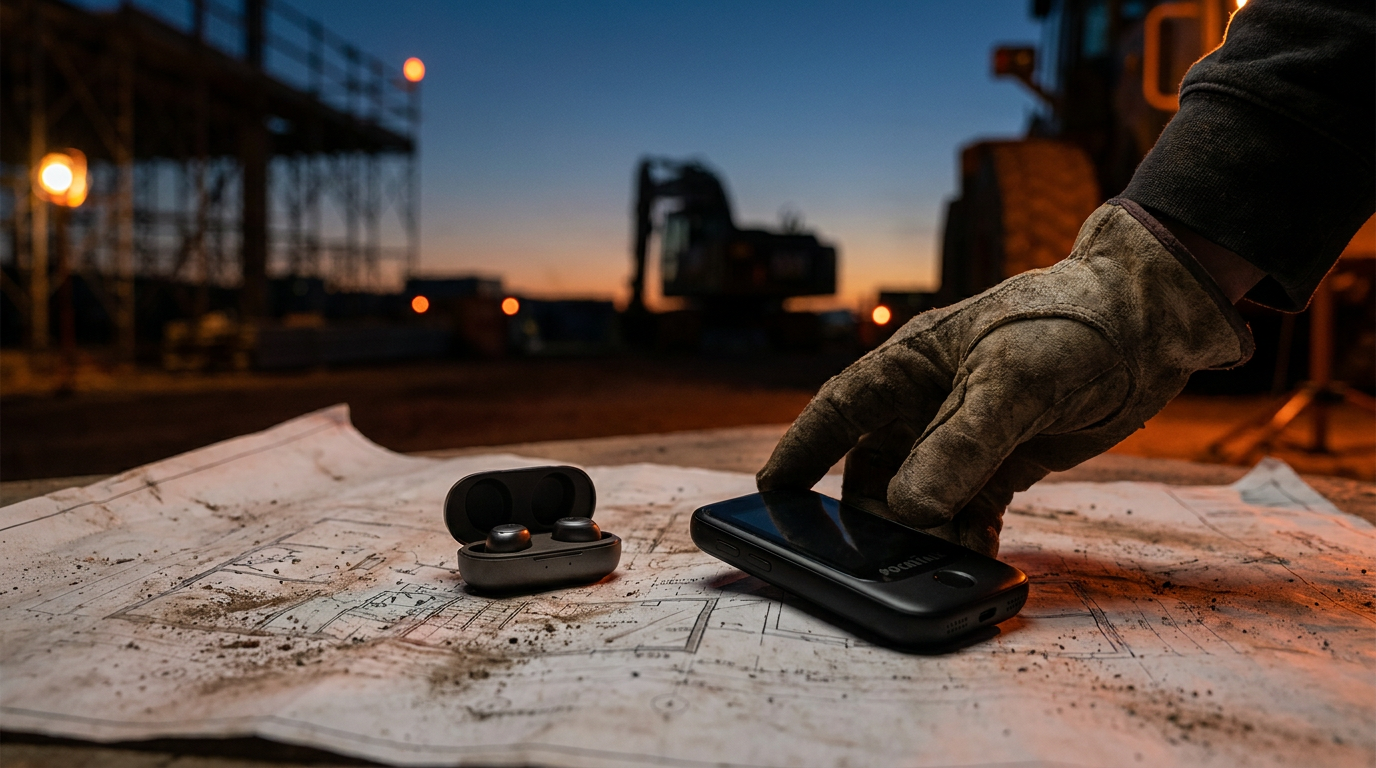
For construction, Pocketalk is the better choice due to its simple, one-button design and rugged build. Timekettle's earbuds are great for one-on-one talks but can be less practical on a noisy, busy jobsite where sharing devices or wearing earbuds all day is a safety and hygiene issue.
Clear Communication is Not Optional
On any jobsite, a misunderstanding can cost you more than just time. It can lead to rework, wasted materials, or worst of all, a safety incident. According to the Pew Research Center, Hispanic workers make up a significant portion of the U.S. construction workforce. If your foreman and your crew don't speak the same language, you have a problem that needs a real solution.
Apps on your phone are a start, but they're clumsy. You have to pull out your phone, unlock it, open the app, and pass it back and forth. It’s slow, and your phone screen won't last long out in the field. This is where dedicated translator devices come in. We're putting two of the biggest names, Timekettle and Pocketalk, head-to-head to see which one really works for a construction crew.
Timekettle: The Earbud Approach
Timekettle's main products are translator earbuds, like the WT2 Edge and M3. The idea is that two people each wear an earbud, and the translation happens right in your ear. It’s designed to feel like a natural, hands-free conversation.
Where It Works:
- Quiet Settings: Great for an office meeting with a subcontractor or a final walkthrough with a client who speaks another language.
- One-on-One: The system is built for two people to have a continuous conversation.
- Hands-Free: Once they are set up, you can talk without holding a device.
Where It Fails on the Jobsite:
- Safety: This is the biggest dealbreaker. On a construction site, wearing earbuds that block out sound is a major safety hazard. It violates OSHA's standards for hearing protection and situational awareness. You need to hear warnings, machinery, and your surroundings.
- Hygiene and Practicality: Are you really going to ask your crew to share sweaty, dusty earbuds? It’s not practical or sanitary. Passing a single device is much simpler.
- Durability: Earbuds are small, plastic, and easy to lose or crush. A jobsite will eat them for lunch.
- Group Talk: The earbud model falls apart when a foreman needs to talk to a group of two, three, or more workers at once.
Pocketalk: The Dedicated Handheld
Pocketalk makes a single, handheld device that looks like a small, modern walkie-talkie. You hold it, press a button to talk, and it speaks the translation out loud through a built-in speaker. Then you hand it to the other person so they can do the same.
Where It Works:
- Simplicity: There’s almost no learning curve. You press the button and talk. It's built for quick, clear exchanges.
- Durability: It’s a solid-state device designed to be held and passed around. While not indestructible, it’s far more rugged than a pair of earbuds. Protective cases are also available.
- Group Use: The loud speaker means a foreman can speak an instruction and the whole crew can hear it in their language. It's a one-to-many tool.
- Safety: No earbuds means your crew keeps their situational awareness. It doesn't interfere with required hearing protection.
Where It Could Be Better:
- Not Hands-Free: You have to stop what you're doing and hold the device. This can be disruptive for someone in the middle of a task.
- Turn-Based: It’s a push-to-talk system, so it’s not a fluid, natural conversation. But on a jobsite, clear, turn-based instructions are often better anyway.
Head-to-Head: The Jobsite Test
Let's break it down by what matters most in the field.
- Ease of Use: Winner: Pocketalk. Its one-button design is foolproof. Timekettle has multiple modes that can be confusing to set up, especially for workers who aren't tech-savvy.
- Safety: Winner: Pocketalk. This isn't even a contest. Earbuds are a non-starter on any site that takes safety seriously.
- Durability: Winner: Pocketalk. It’s a single, solid device. Timekettle involves two delicate earbuds and a charging case—more parts to break, lose, or get clogged with dust.
- Noise Cancellation: Tie. Both have good noise-canceling microphones. Pocketalk might have a slight edge because you hold the mic right up to your mouth, which helps isolate your voice from background noise like saws and generators.
- Battery Life: Winner: Pocketalk. The Pocketalk S has up to 72 hours of standby. With Timekettle, you have to worry about the battery of the case and each individual earbud. It's just more to manage.
- Cost & Connectivity: Tie. Both devices cost around $300. The big difference is that Pocketalk comes with a complimentary 2-year global data plan, so it works anywhere you have a cell signal. With Timekettle, you're tethered to your phone and using its data plan.
Improving jobsite communication is a critical part of running a smooth operation. You can use modern tools to bridge language gaps beyond just spoken words.
Act as a construction safety manager. Create a simple, one-page safety instruction sheet for setting up and using a 12-foot A-frame ladder. Use simple language (7th-grade reading level). Provide the instructions in both English and Spanish, side-by-side. Focus on three key safety checks before climbing and three key rules while on the ladder. Include simple icons or visual descriptions for each step to make it easy to understand for workers with low literacy.
The Verdict: Pocketalk is the Right Tool for the Job
For a foreman, superintendent, or GC who needs to communicate with a diverse crew, the Pocketalk is the clear winner. It's built for the environment. It's simple, rugged enough, and safe. It treats communication like any other critical task: something you do with a specific, reliable tool.
Timekettle is a cool piece of tech, but it’s a solution for a different problem. It belongs in the site trailer for a client meeting, not out on the deck where the real work happens. When you're choosing your gear, you pick what's effective and what will last. Having the right communication device is just as important as having the right tools in your truck.
You are a construction foreman who needs to communicate better with your Spanish-speaking crew members. Generate a list of 20 essential, short phrases for a typical workday on a residential construction site. Organize them into categories: 'Greetings & Basics,' 'Tools & Materials,' 'Instructions & Directions,' and 'Safety & Urgency.' Provide each phrase in both English and Spanish. Keep the phrases to 2-5 words each.
Frequently asked questions
37 copy-paste prompts that save tradespeople 5+ hours a week. Plus one short email every Friday — no fluff.
More for jobsite ai
How Plumbers Use ChatGPT on the Jobsite (5 Ways)
How Plumbers Use ChatGPT on the Jobsite (5 Ways) comes down to using AI to do the slow stuff — quoting, paperwork, marketing, and customer follow-up — so y
How to Use ChatGPT on the Jobsite (Practical Guide)
How to Use ChatGPT on the Jobsite (Practical Guide) comes down to using AI to do the slow stuff — quoting, paperwork, marketing, and customer follow-up — s
AI Voice Notes to Job Report in 60 Seconds
AI Voice Notes to Job Report in 60 Seconds comes down to using AI to do the slow stuff — quoting, paperwork, marketing, and customer follow-up — so you can